
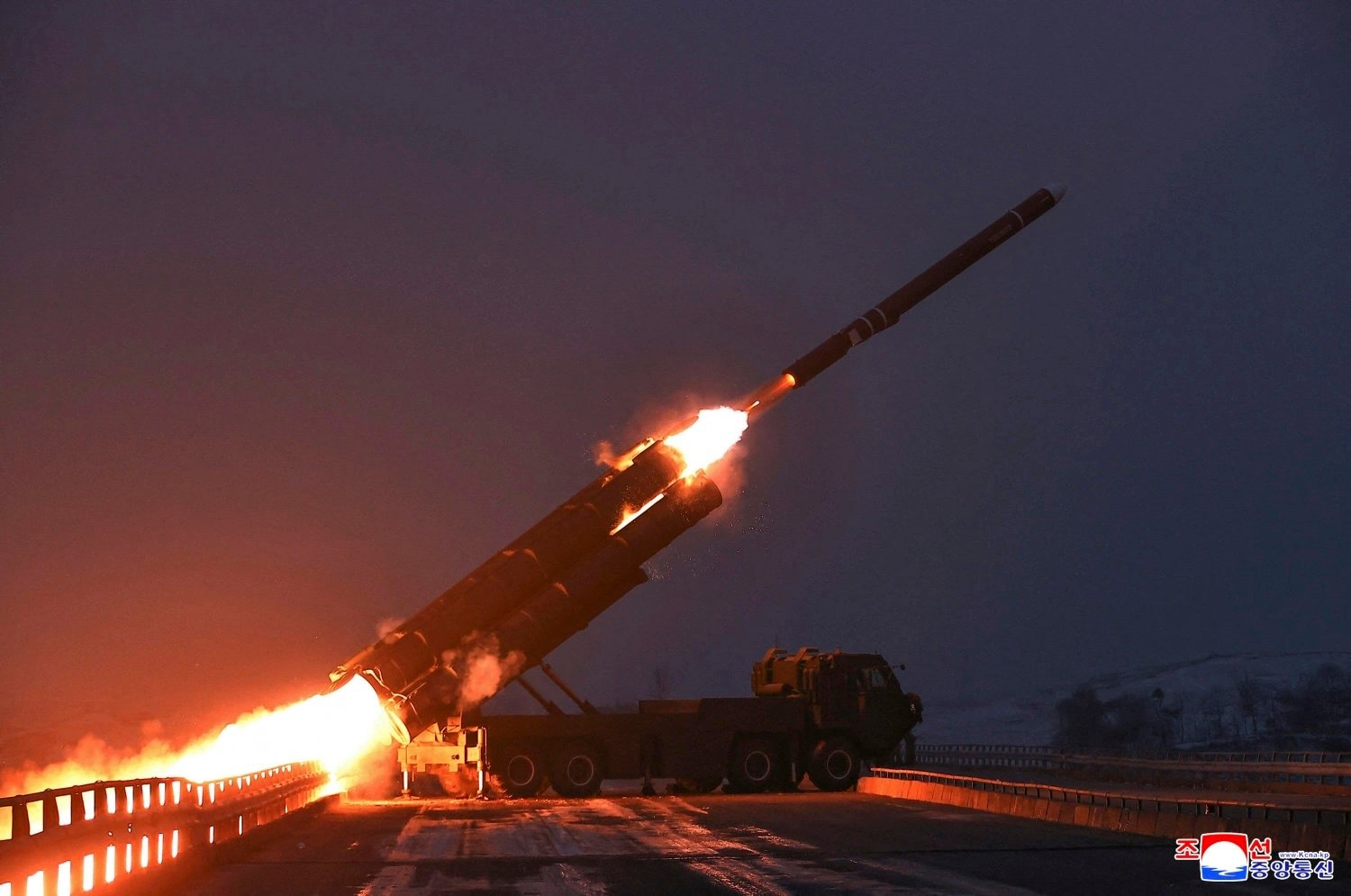

North Korea over the weekend fired a barrage of rockets and long-range rockets in the sea on its east coast. This show of force came as the United States military had its hands full in Iran. The article below analyzes Pyongyang’s strategy. – Eds.
When the United States becomes embroiled in a major conflict, adversaries around the globe inevitably reevaluate their strategies.
While Washington is waging war in Iran, the real test of US credibility may come thousands of miles away – in East Asia, where North Korea is watching closely.
While some analysts are no doubt wondering whether North Korea will seize the moment to exploit the American distraction from East Asia, the answer is likely to be nuanced. Pyongyang will exploit the situation, but not through reckless military adventurism.
Instead, it will double down on nuclear deterrence, escalate its rhetoric and deepen ties with Russia and China.
The historical model of opportunism
North Korea has a long history of testing its limits when the US is distracted elsewhere. During the Iraq War in 2003, Pyongyang withdrew from the Nuclear Non-Proliferation Treaty and accelerated its nuclear program. In 2010, while Washington was focused on Afghanistan, North Korea bombed the South Korean island of Yeonpyeong.
These moves were not outright invasions, but calibrated provocations designed to remind the world of Pyongyang’s importance. The current war in Iran presents a similar opportunity.
However, compared to past episodes, the stakes are higher: North Korea now possesses a credible nuclear arsenal and long-range missiles capable of striking US territory. This makes her opportunism more dangerous, but also paradoxically more restrained.
Pyongyang’s response to US attacks on Iran
The latest expert analysis shows that North Korea has already reacted strongly to the US and Israeli attacks on Iranian nuclear facilities. Respected media focused on Korea 38 North reported that Pyongyang issued an extremely strong Foreign Ministry statement condemning the attacks as “unlawful aggression” and warning that such actions prove the necessity of nuclear deterrence. of East-West Center It similarly noted that the attacks reinforced North Korea’s belief that only nuclear weapons can guarantee the regime’s survival.
Iran’s weakness, in Pyongyang’s eyes, stems from the lack of a nuclear deterrent. North Korea interprets this as proof of its nuclear doctrine.
Fear of decapitation, not adventurism
The assassination of Iran’s supreme leader sent shockwaves through Pyongyang. South Korean media have noted that North Korea fears similar US operations targeting Kim Jong Un. This fear makes the regime more protective, not more reckless.
In other words, Iran’s war doesn’t encourage North Korea to launch attacks—it terrifies it further. strengthening its nuclear posture. Pyongyang sees Iran as a cautionary tale: without nuclear weapons, even powerful states can cut off their heads overnight.
Possible and unlikely moves from North Korea
Given this context, what can North Korea actually do while the US is distracted?
The most likely scenario is an increase in missile tests, especially intercontinental ballistic missiles and submarine-launched ballistic missiles. These tests serve both technical and political purposes: advancing capabilities while reminding Washington of Pyongyang’s reach.
North Korea may also attempt additional satellite launches that double as ballistic missile development exercises.
Rhetorically, Pyongyang will issue sharper statements against the US, framing Iran’s war as proof of US imperialism. Diplomatically, it will seek deeper military cooperation with Russia and Iran (assuming the latter survives), both of which share animosity toward Washington.
Most importantly, North Korea will accelerate nuclear production, convinced that deterrence is the only path to survival.
Despite speculation, North Korea is highly unlikely to invade South Korea, directly attack US forces or launch a major provocation that risks full-scale war. Such actions would provoke devastating retaliation. Pyongyang is opportunistic, but not suicidal.
The Iran war does not create a window for North Korea to launch reckless military campaigns. Instead, it reinforces Pyongyang’s belief in nuclear deterrence and justifies its continued weapons development. like Eurasia Review notes, the Iran conflict has become a “teachable moment” for Pyongyang: nuclear weapons are the ultimate insurance policy against regime change.
Implications for American politics
For Washington, the challenge is twofold. First, it must reassure allies in South Korea and Japan that US commitments remain ironclad despite the war in Iran. Second, it must deter North Korea without escalating tensions unnecessarily.
This requires a delicate balance: maintaining a visible military presence in East Asia while avoiding actions that could push Pyongyang toward even more aggressive nuclear development. The US cannot allow its attention to shift entirely to the Middle East, lest North Korea interpret the distraction as weakness.
Calculated opportunism, not reckless warfare
The broader strategic picture is sobering. North Korea thrives when America is distracted. But his opportunism is calculated, not reckless. War in Iran will encourage Pyongyang to test missiles, expand nuclear capabilities and deepen ties with other US adversaries. However, it will not risk a war that could destroy the regime.
In fact, the Iran conflict may make North Korea more cautious militarily, even as it becomes more aggressive rhetorically and technologically. For Pyongyang, the lesson is clear: only nuclear weapons prevent beheading. For Washington, the challenge is equally clear: prevent opportunism from turning into escalation.
Therefore, the United States must adopt a strategy that recognizes North Korea’s opportunism without overreacting to it. That means maintaining deterrence, strengthening alliances and keeping diplomatic channels open – even as attention is consumed by the war in Iran. Failure to do so would risk Pyongyang turning opportunism into strategic advantage.
The Iran war may be taking place in the Middle East, but its ripple effects are already being felt in East Asia.
Liang Tuang Nah, PhD, is a researcher at the Institute of Defense and Strategic Studies, a constituent unit of the S. Rajaratnam School of International Studies (RSIS), Nanyang Technological University.



