
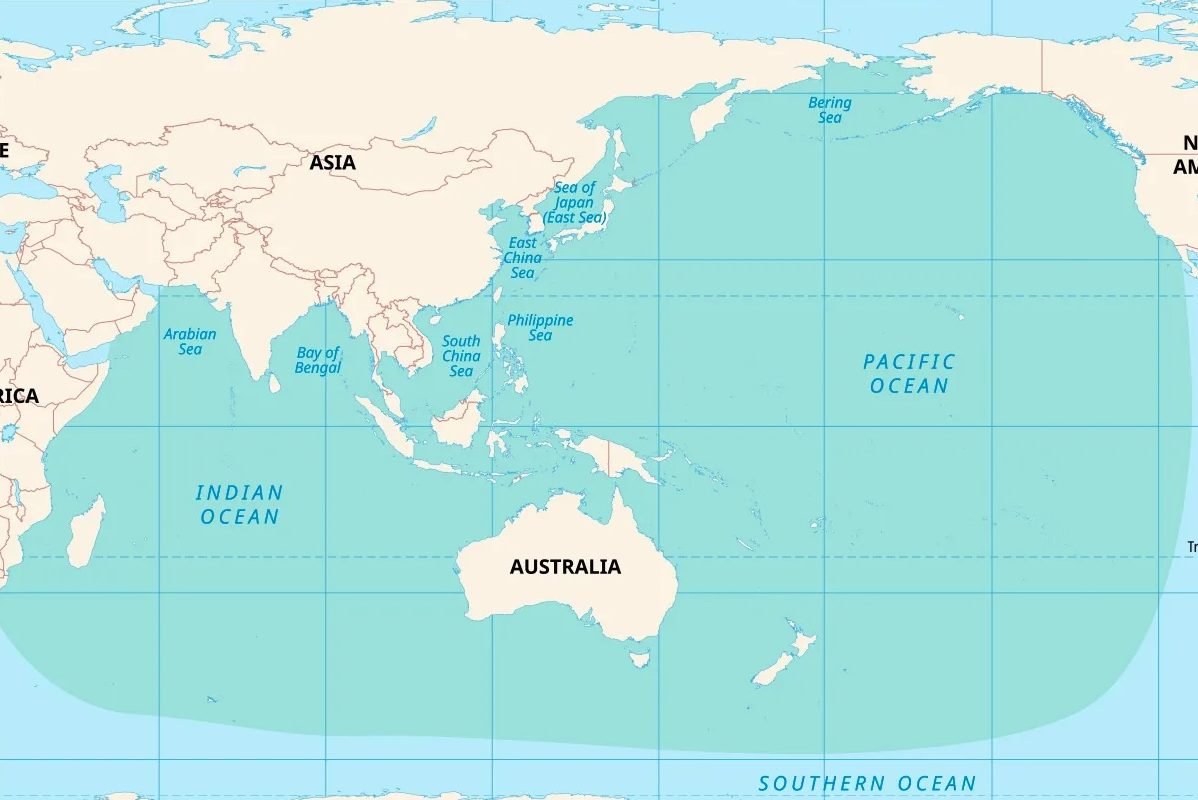

The Indo-Pacific concept was built on the assumption that naval power could extend across the oceans, provide access, and shape events at a distance. that the assumption no longer holds. Across Eurasia, advances in missile technology, layered air defenses, and long-range strike capabilities have made proximity dangerous and penetration costly.
The balance has shifted towards denial, depth and defense. What was once a permissive marine environment is becoming a contested environment.
This is not a marginal adjustment; it is the quiet end of an era. The Indo-Pacific framework, most strongly embraced by Australia and Japan, rests on a vision of order supported by maritime reach and coalition mobility. But as access erodes, so does the logic of that system. The question is no longer how to maintain the Indo-Pacific, but what comes after it.
For Canberra and Tokyo, this is not an abstract debate. It is a strategic calculation. What do sea-oriented states do when the conditions that favored sea power begin to disappear?
Australia: sea or land power?
For Australia, the Indo-Pacific concept had obvious appeal. It placed the country within a reassuring strategic geometry—Japan to the north, India to the west, and the United States entrenched as the stable guarantor of maritime order. It was a vision that satisfied Australia’s sense of self-importance while anchoring its security in familiar models of alliance and sea power.
However, the concept was never particularly sound. It endured less because it reflected strategic reality than because it conformed to Australia’s inherited strategic culture.
That culture has long interpreted security through the prism of the sea. Reliance on distant great powers—first Britain, then the United States—encouraged a worldview in which security was provided by naval coalitions and external balancing.
The Indo-Pacific framework fit neatly into this tradition. It emphasized maritime cooperation, freedom of navigation and alliance cohesion, allowing Australia to operate within a structure it already understood. However, comfort came at the expense of clarity.
For all its historical pretensions, Australia is not essentially a sea power. It is a continental state with maritime interests. Its geography offers depth, distance, and the potential for layered protection—advantages that favor resilience over projection.
The logistical burden of conquering the continent is far greater than that of defending it. Australia is not bound by geography to project external force; is given the strategic luxury of consolidation.
There have been moments when this reality has been recognized. During Imperial Japan’s advance into Southeast Asia, Australia considered defense-in-depth approaches, and at various points it experimented with reducing its expeditionary commitments in favor of greater self-reliance.
However, these impulses have been repeatedly ignored. The strategic culture, reinforced by alliance dependence, has drawn Australia back to external engagements and special expeditionary roles in line with US global strategy.
AUKUS represents the latest iteration: a costly bet on remote capabilities, based on increasingly implausible timelines and assumptions.
What is emerging now is not simply the failure of a concept, but the exposure of a deeper mismatch between geography and strategy. The erosion of maritime guarantees in contested regions forces a reckoning that Australian policymakers have long put off.
The question is no longer how Australia fits into an Indo-Pacific system, but whether that system can deliver the security it promises.
A more prudent course lies in reviewing the logic of a continental strategy. The “defence Australia” approach – once treated as parochial or outdated – provides a framework based on geography rather than aspiration. It prioritizes denial over projection, resilience over achievement, and self-reliance over dependence.
The end of the Indo-Pacific moment does not leave Australia without options; IT can turn it into the strategic reality it has long sought to avoid. When you have a continent, thinking about continental defense just makes sense.
Unfortunately, Australia will probably continue to pursue the Indo-Pacific concept long after the US quietly abandons it. The pull of its naval tradition, the weight of its alliance commitments, and the lingering scent of old scholars invested in ideas make it almost inevitable to continue down the well-trodden path of relying on friends at a distance.
Japan: a naval power with a reserve
Japan presents a more resilient model. It remains a core naval power, maintaining one of the world’s most capable navies with advanced anti-submarine warfare, missile defense and sea control capabilities.
Its naval posture is not merely an adjunct to alliance structures; it is a national capability, deeply embedded, technologically sophisticated and designed to operate with a high degree of autonomy if required.
At the same time, Japan has shown a clear acceptance of its strategic environment. It operates alongside a rising continental power and within a region where the costs of escalation are steadily rising.
Rather than trying to overturn this reality entirely, Tokyo has demonstrated an ability to adapt—by strengthening deterrence, strengthening its defenses, and calibrating its posture in ways that acknowledge the limits of external guarantees. Naval power is retained, but is no longer assumed to be decisive on its own.
Crucially, Japan has retained options beyond conventional force. Its advanced nuclear fuel cycle, substantial stockpiles of fissile material, and world-class industrial base provide it with a latent deterrence capability that few states possess. This has not been formalized as policy, but is widely understood. In the extreme, Japan could move quickly and reliably to create an independent strategic deterrent, fundamentally altering the regional balance.
In this sense, Japan is not simply dependent on a naval command supported by others. It is positioned to withstand its erosion. If foreign support is reduced or withdrawn, Japan retains the capacity – military, industrial and technological – to stand on its own.
Its strategy reflects a quiet recognition that alliances may fluctuate, but geography and capabilities remain.
End of an era
In the end, the Indo-Pacific concept is best understood as a product of its moment: a transitory construct born of uncertainty, intended to preserve a fading order rather than navigate an emerging one.
The implications are grim. A concept built to extend naval reach is clashing with a strategic environment that increasingly punishes exposure and rewards depth. What was presented as a stable framework for regional order now appears as a holdover model – useful while conditions held, but unable to survive their erosion.
of events in Iran do not stand apart from the Indo-Pacific; they discover its limits. An access-based strategy has met a reality defined by denial.
What will follow is not a simple replacement, but a period of adjustment. States will begin, unevenly and often reluctantly, to realign their strategies with geography rather than abstraction. Maritime cooperation will continue, but it will no longer be sufficient as an organizing principle of order.
The center of gravity is shifting back towards the continent – towards resilience, self-reliance and managing proximity rather than distance. The Indo-Pacific concept did not fail because it was poorly articulated; it failed because the world it described is no longer the one that exists.
READ: Indo-Pacific strategy just sunk in Iran
Jeffrey Robertson is an academic, consultant and writer focused on foreign affairs, diplomacy and the Korean Peninsula. it ITEM was originally published in his submarine, Junotaneand reprinted with permission.




