

Since the United States and Israel began their war against Iran in late February, Iran has he countered targeting merchant ships in the Strait of Hormuz, effectively closing the narrow water channel.
It has caused a global fuel crisis, although some ships are making it through the strait. US President Donald Trump has gave Iran an ultimatum to fully reopen the waterway to oil and gas shipments, and appealed to NATO allies to assist in the effort.
We asked maritime expert Jennifer Parker, who served 20 years with the Royal Australian Navy, to explain what kind of military force would be required to reopen the strait to merchant shipping and why the US has yet to take that step.
Why is it so hard to prevent attacks on ships?
The geography of the region has a lot to do with it.

Iran clearly dominates the northern part of the Persian Gulf, the Strait of Hormuz and the Gulf of Oman. This proximity allows her to use her cheaper weapons, such as drones to target ships.
Creating the conditions to make commercial shipping safe – or at least reduce risk – requires a two-phase campaign.
The first phase is removing Iran’s ability to target ships. There are two ways to do this:
- persuade or force Iran to stop attacks on ships
- destroy Iran’s ability to attack ships by removing radar facilities, command and control structures, and weapons bunkers along the coast.
The US has the air power, intelligence, surveillance and reconnaissance capabilities to identify and destroy most of these targets. Finding and destroying Iran’s mass of drones will be more difficult, as they can be stored almost anywhere, so intelligence will be crucial here.

After reducing the risk through a bombing campaign, the second element of returning ships through the strait is a security campaign.
This requires early warning aircraft and maritime patrol aircraft to monitor not only the strait, but also the Gulf of Oman, the Persian Gulf and along Iran’s coastline.
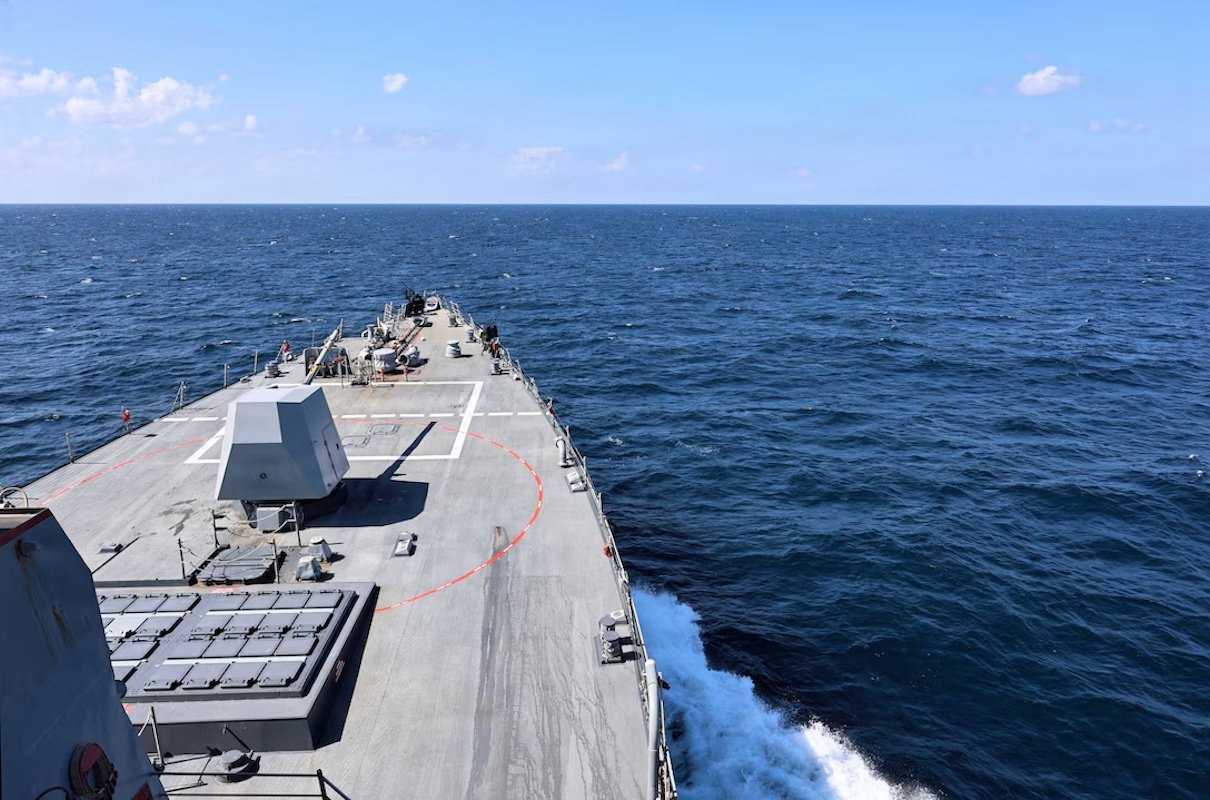
Fighter jets will need to be deployed over the strait and gulf, as combat air patrols and helicopters will need to be ready to deploy against attacks if necessary. And on the water, the US will need to station warships to provide occasional escort.
If mines are confirmed or even suspected to be in the strait, this complicates matters. The US would require an extensive and time-consuming demining operation.
So why won’t the US try to militarily secure the strait?
There are four main reasons the US will not attempt to militarily secure the strait without first achieving the first stage (removing Iran’s ability to target ships) – and why it has not been at the heart of the campaign so far.
First, it would divert military assets, such as aircraft, that are needed elsewhere to carry out Trump’s war objectives.
Second, to make the strait safe for shipping, you actually need to secure not just the water, but the land on either side of it. And that would likely require ground forces — or perhaps party raids on Iran’s coastline — which would be complicated and dangerous for the U.S. military.
Third, securing the ships would require a significant number of naval vessels. Realistically, you would need one or two naval vessels for escort operation. A convoy larger than that would be at greater risk of attack unless the US and Israel have dramatically reduced Iran’s ability to target ships.

And fourth, the military must weigh the risk to its assets against the benefits of opening the strait. An American warship has a crew of more than 200 people. Given Iran’s ability to strike ships with unmanned surface vessels, drones, and cruise missiles, is it worth putting these personnel at risk before reducing threats from Iran’s coastline?
What about mines in the strait?
This would be a significant challenge. But one thing first: Iran doesn’t actually need to physically plant the mines, it just needs to convince the US and others that it has them. This is enough to prevent civilian ships from wanting to transit through the strait.

Sometimes mines can float on the surface of the water, so they are visible. However, mines are often submerged or anchored. The US would have to send in submarines or remotely piloted vehicles launched from ships to remove them. This would take weeks or maybe even months.
Although it has not been publicly confirmed, I think it is unlikely that Iran will deploy mines widely. There are two reasons for this.
First, Iran’s economy relies on its ability to transport its own oil from Kharg Island to the Persian Gulf through the strait. Iran has other ports outside the strait, but they cannot accommodate larger ships, so mining would interfere with their trade.
Second, some reports have suggested Iran has used acoustic minesa type of impact mine that detonates based on an acoustic “signature,” essentially what a ship sounds like as it moves through water. While this technology certainly exists, it is unlikely that such mines are designed to reliably distinguish between Iranian-flagged and foreign-flagged merchant ships.
Maintaining accurate and comprehensive signature data for a large number of commercial vessels – especially in a dense and dynamic shipping environment such as a strait – would be extremely challenging. In practice, these mines would pose risks to a wide range of transport.
The US also has significant intelligence assets and surveillance and reconnaissance systems along the Iranian coast, so it is likely to detect mine-laying operations, although this could also happen from any vessel, including fishing boats.
What about Iran’s ability to target ships with drones?
Iran has used various types of drones so far in the war. Drones or unmanned surface ships are remotely controlled and have been used to attack commercial tankers.

Compared to other weapons, such as missiles, it is much more difficult for the US and Israel to target Iran’s drones on the ground because they can be launched from almost anywhere. And while they can’t be built anywhere, drones don’t require the same advanced manufacturing facilities as missiles. In short, they are harder to detect and disappear.
But the US could bomb some of Iran’s launch sites and drone reserves along the coast to prevent some attacks on ships.
What is the top priority for the US in Iran right now?
Although there have been many the regime change debateThe Trump administration has been clear about its four primary military objectives, which are to destroy:
- Iran’s ballistic missile capability
- its nuclear capability
- its navy (which has largely been achieved)
- and its proxy networks, including Hezbollah in Lebanon, which has been attacked by Israel over the past few weeks.
Destroying Iran’s nuclear and ballistic missile capabilities requires significant aircraft and weaponry – as the US and Israeli bombing campaigns have already made clear. Diversion of these assets to secure the Strait of Hormuz could undermine the achievement of these military objectives.
Justin Bergman is the international affairs editor, Conversation; Matt Garrow is an editorial web developer, ConversationAND Mitchell Costello is deputy social media producer, Conversation
This article was reprinted from Conversation under a Creative Commons license. Read on original article.



