
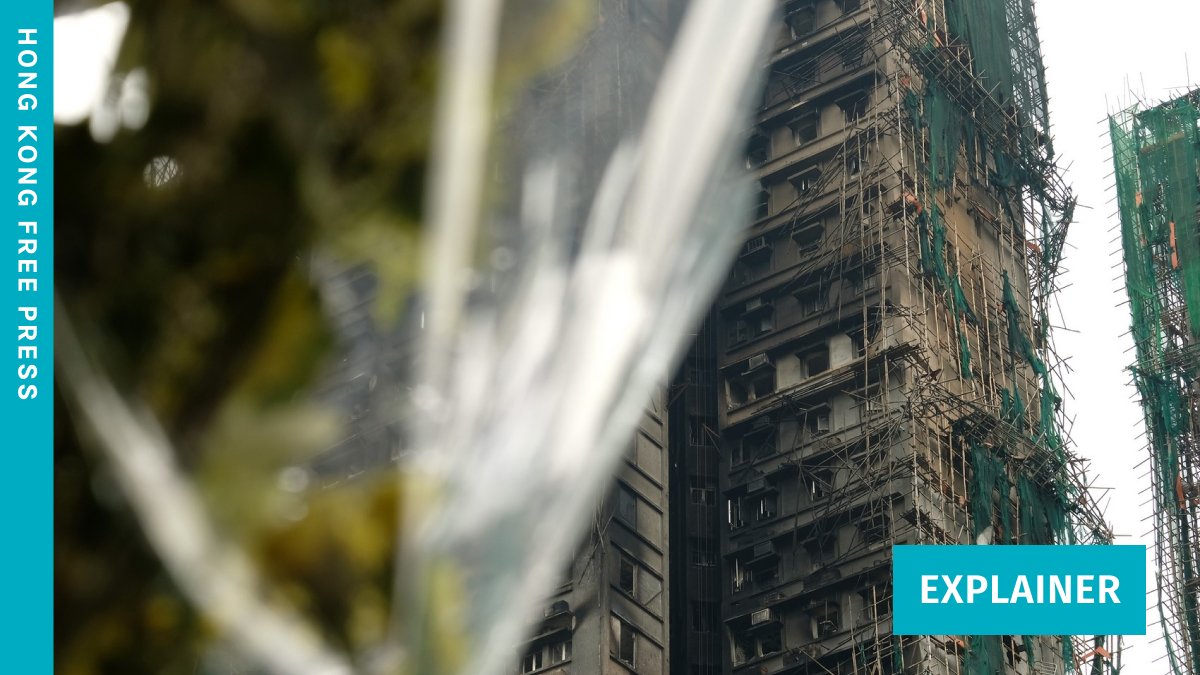


It’s been almost four months since a deadly fire engulfed seven of the eight towers in the Wang Fuk Courta housing estate in Tai Po, killing 168 people and displacing thousands. For the survivors, however, unresolved issues remain.

Residents petitioned Hong Kong leader John Lee this week to facilitate a meeting between them and government-appointed administrator Hop On Management, which took over as administrator of Wang Fuk Court after a tribunal dissolved the owners’ committee in the fire-ravaged property.
The more than 430 residents who signed the petition laid out concerns they would raise with Hop On. High on the agenda: the progress of insurance claims.
Like many high-rise complexes in Hong Kong, Wang Fuk Court is secured. Its board of owners had purchased compulsory insurance, such as public liability and workers’ compensation, as well as a HK$2 billion “fire insurance” policy intended to cover reconstruction costs.
However, the unprecedented scale of the disaster has posed a significant challenge to insurance payouts, especially as it remains unclear whether the property will ultimately be rebuilt or destroyed.
HKFP examines Wang Fuk Court’s insurance policies and the uncertainties that complicate the claims process.
What insurance does Wang Fuk Court have?
Wang Fuk Court is a residential property under the Home Ownership Scheme, a government subsidized housing program.
In Hong Kong, residential buildings are required to purchase two types of insurance. The first is public liability insurance, which covers compensation and legal costs for injuries or deaths due to management negligence. The second is workers’ compensation insurance, which provides compensation for construction personnel who are injured or killed while on the job.
While buildings are not required by law to have fire insurance, which covers repair costs arising from a blaze, most buildings choose to purchase it to meet mortgage bank requirements.
According to the minutes of a December 2024 board of owners meeting, Wang Fuk Court is insured by China Taiping Insurance Holdings for compulsory insurance as well as fire insurance.
The coverage amount for Wang Fuk Court’s fire insurance is HK$2 billion, while that for its public liability insurance is limited to HK$20 million per incident.

Individual Wang Fuk Court residents may also maintain private plans. As of early February, about 85 percent of claims under such individual plans had been settled, totaling HK$510 million in disbursements. according to to the Insurance Authority.
This included more than 1,000 general insurance claims and 169 life insurance claims involving HK$450 million and HK$60 million respectively.
Insurers have adopted a “special treatment” approach, for example waiving the need for residents of Wang Fuk Court to provide proof of their belongings lost in the fire.
However, property-wide fire insurance claims may be more complex, as the insurance firm has not been able to enter Wang Fuk Court to review the damage after the fire, according to the Hong Kong Federation of Insurers (HKFI).
The issue has been further complicated after the government proposed demolishing seven buildings destroyed by the fire, raising questions about whether the insurance, which covers the cost of reconstruction, will apply.
What does HK$2 billion fire insurance cover?
In principle, fire insurance covers the structure of the building and its common parts.
“This means exteriors, walls, ceilings, floors and windows in corridors, etc.,” HKFI CEO Selina Lau said on a Cantonese radio program last month.
“For Wang Fuk Court, the HK$2 billion (fire insurance) purchased by the board of owners also covers each residential unit as well as public areas such as stairs and elevators,” she said.

The fact that the fire insurance covers the common areas of Wang Fuk Court also means that the disbursement will not be split and distributed to the owners of the property’s 1,984 residential units, Lau said. “We are not talking about each family getting HK$1 million by sharing HK$2 billion,” she said.
“The insurance is about restoring Wang Fuk Court to its condition before the fire,” Lau said. “This HK$2 billion does not include premiums or market values (of housing); it only deals with construction costs.”
The cost of rebuilding Wang Fuk Court may vary due to legal requirements for the building’s safety and structural integrity, Lau warned.
“It is impossible to rebuild (Wang Fuk Court) as it was close to 50 years ago,” she said. The Wang Fuk Court was established in 1983.
“There will be new elements … there will probably be improvements in fire safety equipment and building materials.”
Speaking on the same radio programme, Tony Wan, president of the Hong Kong Institute of Surveyors, estimated that rebuilding Wang Fuk Court could cost around HK$2.7 billion, based on an average cost of HK$3,000 per square foot for government-subsidised housing.
What happens if the government decides to overthrow him?
Although hope remains for some residents, the prospect of rebuilding Wang Fuk Court appears slim after the government said it intended to demolish the burnt-out blocks and build a park or other community facilities on the site.
In February, while unveiling the government’s HK$6.8 billion buyout plan, Deputy Financial Secretary Michael Wong said rebuilding Wang Fuk Court was not “appropriate” because it would take at least nine years and many residents may have already started a life elsewhere.

The authorities intend to receive the title deeds from the flat owners, either in cash or as part of a flat exchange deal.
If the government is successful in obtaining the titles, the beneficiary of Wang Fuk Court’s fire insurance will be transferred to the government, said Lau, CEO of HKFI.
“Future damages will be negotiated by the government and the insurance company. Because it is not a reconstruction plan, it is unclear what the disbursement amount will be,” she added.





