
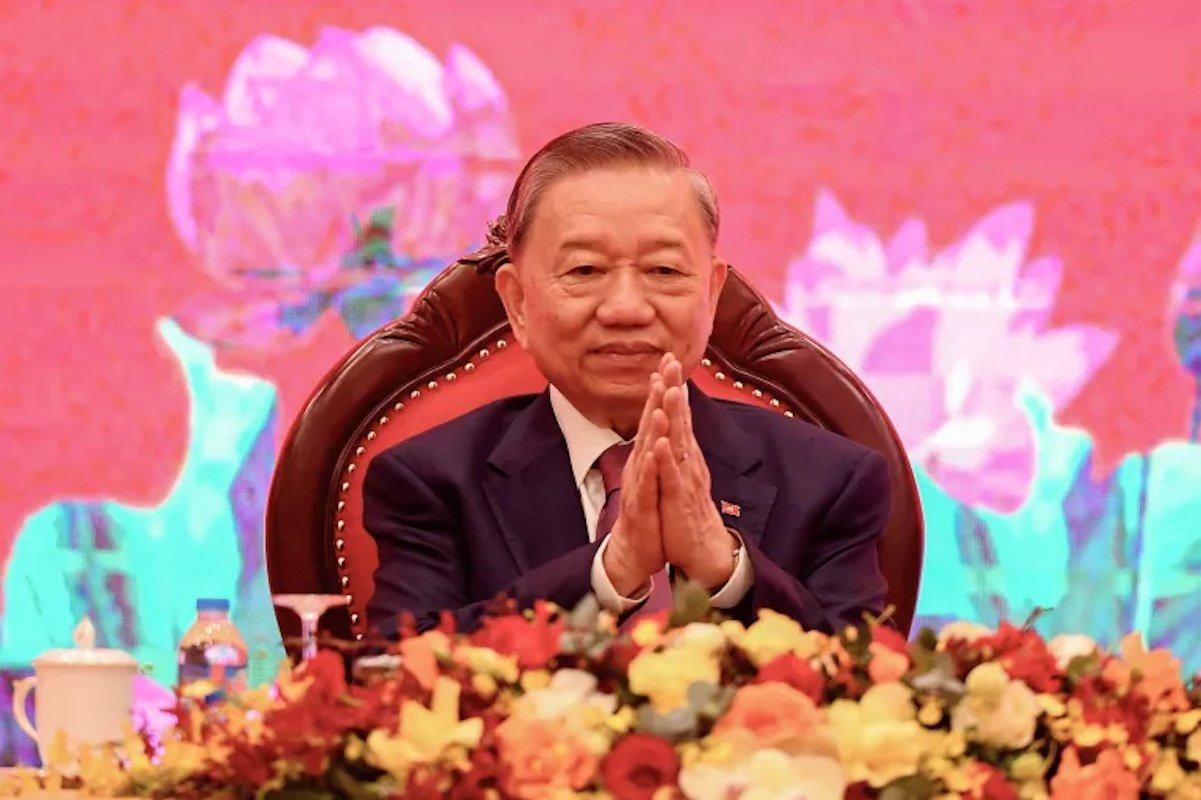

Lam’s assumption of the state presidency alongside his post as general secretary of the Communist Party of Vietnam (CPV) is neither surprising nor unprecedented.
Nguyen Phu Trong held both roles from 2018 to 2021 before relinquishing the presidency. Lam himself briefly combined them after Trong’s death in mid-2024, before handing over the presidency to Luong Cuong.
Change this time is the goal. Previous consolidations were temporary or circumstantial arrangements; this is deliberate, closed for a full five-year term.
What it reveals about the evolving architecture of Vietnamese politics—and what it implies for the country’s trajectory—deserves greater attention.
It is tempting to frame this consolidation of power as one dismantling the collective leadership of Vietnam. This may overstate the case.
The CPV formalized a “five-pillar” structure until 2024 Regulation no. 368raising the permanent member of the secretariat – now Tran Cam Tu – along with the traditional four: general secretary, state president, prime minister and speaker of the National Assembly.
With To Lam holding two of these five roles, the system is adapted, settling on five pillars held by four people. However, this adaptation shows.
Two of the four holders occupy internal party roles: To Lam as general secretary and Tran Cam Tu as a permanent member of the secretariat. Previously, the structure more evenly balanced party and state institutions.
The center of gravity has shifted firmly towards the CPV apparatus, reinforcing a wider trend in which state institutions – National Assembly in particular — have seen their relative influence diminish.
Consolidation must also be understood in precise terms. The state presidency is largely ceremonial, holding little independent policy-making authority.
The Politburo decides by vote and To Lam already commands that body as secretary general. Luong Cuong’s short tenure as president illustrated as much: he held the position without meaningfully shaping Vietnam’s foreign engagements or domestic direction.
The practical reason, then, is significant, but narrower than it might seem. The presidency is the role defined by the Constitution for obtaining foreign credentials, signing treaties and conducting state visits.
Holding both positions allows To Lam to improve diplomatic mechanics at a time when Vietnam’s key foreign relations require careful management.
The U.S. relationship alone — complicated by trade tensions, including de facto shipping issues of Chinese-made goods, and Vietnam’s ongoing balancing act between Washington and Beijing — benefits from having a single interlocutor setting strategic direction and diplomatic protocol.
For foreign counterparts, fewer principals means faster engagement. This efficiency argument extends to Lam’s economic ambitions. Vietnam’s target of 10% GDP growth requires closing investment and trade commitments quickly, especially amid global uncertainty.
A consolidated leadership projects resolve to investors and negotiating partners. The party’s dominance over economic policy was already established; what the presidency adds is a smoother execution on the international stage.
The risks are real, though often mischaracterized. The CPV’s internal discipline mechanisms remain intact and the Politburo still functions as a collective decision-making body.
The deeper concern is institutional narrowing. Any consolidation weakens the informal norms that supported distributed leadership, making it easier for followers to follow the same path.
And when accountability is centered along with authority, setbacks to the growth agenda or a diplomatic misstep fall squarely on one set of shoulders.
Vietnam is aligning its leadership model more closely with that of China, in which Xi Jinping holds both party and state roles. For governments and foreign investors, this simplifies engagement. A single authoritative peer reduces ambiguity.
It also means that Vietnam’s political stability is increasingly tied to the ability and judgment of one figure, in a system designed to distribute those very burdens.
For Lam, consolidation is a bet that the efficiency gains from centralized authority will outweigh the stability and inertia that collective leadership offered.
Vietnam’s political architecture has not collapsed. But it is leaning toward the party, toward a single leader, and toward a model where the margin for error is thinner than it has been in decades.
Lam Duc Vu is a Vietnam-based risk analyst focused on trade and regional geopolitics



