
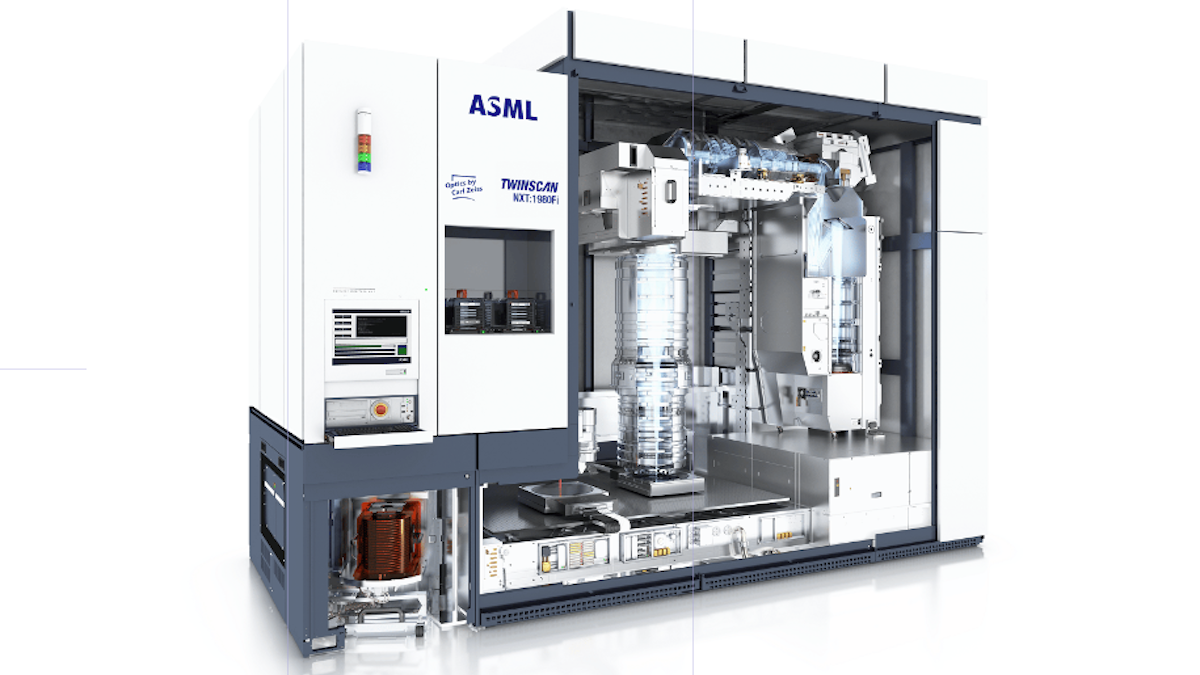

A bipartisan group of lawmakers in the United States has introduced legislation to tighten restrictions on advanced semiconductor manufacturing equipment, seeking to block Chinese chipmakers from accessing deep ultraviolet immersion (DUV) lithography systems, as well as related parts and maintenance services.
The Multilateral Harmonization of Technology Controls in Hardware (MATCH) Act is designed to coordinate export controls with US allies and partners, targeting a group of Chinese semiconductor firms and aiming to prevent the transfer of critical chip-making assets provided by companies such as ASML to the Netherlands.
According to the proposed legislation, the main provisions include:
- A complete ban on the sale and servicing of critical chip-making equipment in countries of concern, unless the facilities are controlled by the US or its allies.
- Tougher restrictions on China’s top chipmakers, including ChangXin Memory Technologies (CXMT), Hua Hong, Huawei Technologies, Semiconductor Manufacturing International Corp (SMIC) and Yangtze Memory Technologies Corp (YMTC). The rules would limit exports, service and technical support to these firms and their subsidiaries.
- A diplomatic route to harmonize export controls with allies, with a 150-day deadline to reach an agreement. Aat also allows national security waivers if more time is required.
- Steps to ensure a level playing field by expanding controls on foreign-made equipment that uses US technology if allied countries fail to comply with US restrictions within a certain period.
The proposed legislation marks a significant escalation by explicitly targeting “all DUV immersion lithography systems, through-silicon deposition and etching tools (TSV), cryogenic etching equipment, and cobalt deposition equipment.”
While TSV and cryogenic etching allow engineers to drill deep vertical paths through the silicon wafer to stack layers, cobalt deposition provides high-performance metal wiring that connects those layers into a single, powerful processor.
The act would also prevent allied firms, mainly in the Netherlands and Japan, from providing engineering services to maintain or upgrade existing machinery already operating in China.
This matters because Chinese chipmakers still rely on older tools like ASML’s NXT:1980i, which can be shipped and serviced. SMIC has used such equipment, along with multiple patterning techniques, to produce 7-nanometer chips for Huawei Technologies, despite US sanctions.
The impact extends beyond technology into the commercial and geopolitical realms, according to some observers.
If SMIC’s 7nm production is limited, Huawei’s ability to supply domestic AI chips could be weakened as Beijing urges firms to prioritize its products over US alternatives such as Nvidia’s H200. The measures also add to uncertainty ahead of a planned meeting between US President Donald Trump and Chinese President Xi Jinping on May 14-15, potentially complicating broader trade and strategic talks.
Chinese media and commentators said the MATCH Act, if passed, would deal a significant blow to China’s semiconductor ambitions, while also underscoring the urgency of building domestic alternatives.
“Overseas supply channels for key semiconductor equipment will be further disrupted, and even maintenance and service may be limited.” says a columnist based in Henan who writes under the pen name “Wu Mou”. “The biggest impact will be on Chinese chipmakers that depend on imported equipment to keep their production lines running.”
“The MATCH Act is clearly intended to keep China’s chip industry limited to older manufacturing processes of 14 nanometers (nm) and above,” he says. “Processes at 14nm and below are still dependent on imported lithography systems, and the disruption of suppliers such as ASML and Tokyo Electron will inevitably disrupt China’s semiconductor manufacturing plans.”
He says tighter restrictions would force Chinese firms to pay higher prices for foreign chips, potentially slowing domestic industrial development and leading to job losses in less competitive segments.
He adds that the potential expansion of US chip export controls reinforces a long-held view in China’s technology community, often associated with Chinese Academy of Engineering academic Ni Guangnan, that core technologies cannot be bought overseas and must be developed domestically.
Technological decoupling
In June 2023, ASML said would require export licenses from the Dutch government for shipments of its most advanced DUV diving systems, including the NXT:2000i and newer models. By January 1, 2024, the Dutch authorities already had is revoked licenses for NXT:2050i and NXT:2100i systems.
The Dutch company did not clarify the status of NXT:2000i. If that system were also limited, the most advanced DUV submersibles available in China would be the oldest NXT: The 1980 Serieswhich can produce 14-16nm chips in a single exposure and achieve 7-10nm through multiple patterning techniques.
“The United States is moving from a ‘stifle’ approach to some advanced technologies to what amounts to a full-body blockade of China’s semiconductor industry.
Zhang Guobin, CEO of Eetrend.com
US lawmakers are pushing it Match Act to strengthen national security by closing loopholes in export controls on semiconductor manufacturing equipment. The bill will require approval by both houses of Congress and the president’s signature to become law.
US Senator Jim Risch said The MATCH Act would prevent adversaries from undermining the U.S. semiconductor industry and threatening national security, while Sen. Andrew Kim said that beyond limiting advanced chips, Washington must also ensure that China does not develop the ability to manufacture such technologies on its own.
“The MATCH Act shows that the US is moving from a ‘stifling’ approach on some advanced technologies to what amounts to a full body lock on China’s semiconductor industry.” says Zhang Guobin, CEO of Eetrend.com. “If implemented, it would go beyond tougher export controls and move from case-by-case restrictions to broader, system-wide controls.”
“The US is no longer satisfied with being two or three generations ahead of China in the chip sector,” he says. “It is trying to use technology decoupling to keep China limited to mature nodes, such as 28nm and above, and block its path to advanced AI processes and chips. This reflects Washington’s growing anxiety about China’s ability to catch up.”
Zhang says the new restrictions will hit China’s semiconductor sector hard in the short term, cutting off maintenance support, noting that chipmaking equipment depends on continuous servicing from original suppliers and would otherwise enter a “chronic death”. He adds that restrictions on mature node tools will hold back expansion in automotive and industrial chips, limiting production, but China’s semiconductor sector will still become more independent over time.
Some Chinese commentators SAY that the negative impact of the MATCH Act on China will be short-lived, as domestic firms have already developed DUV submersible tools capable of 28nm production and are expected to make further advances. They say Shanghai Micro Electronics Equipment’s (SMEE) SSA800 costs only one-seventh of ASML’s equivalent products.
However, a Chinese writer with the pen name “Sumang Shanran” says there is still a long way to go before China can match systems like ASML’s NXT:1980, which was first launched in 2015.
He emphasizes that:
- The SSA800 series uses a 193 nm Argon Fluoride (ArF) light source, but relies on multiple exposures, called self-aligned quadruple patterning (SAQP), to produce 28 nm chips, making manufacturing more complex and expensive.
- Key components still depend on imports, including Zeiss lenses and Cymer’s ArF light sources. While Beijing U-Precision’s two-stage platform has improved positioning accuracy to about 1.5nm, it still remains roughly 0.5nm of ASML in stability.
- Upstream materials and tools also remain a bottleneck. The homemade ArF photoresist from Jiangsu Nata Opto-Electronic Material Co Ltd has a yield of about 60%, compared to about 95% for Shin-Etsu Chemical Co Ltd of Japan.
- Shenzhen Qingyi Photomask Ltd can mass produce 65nm photomasks, but still relies on imports from Shin-Etsu for more advanced masks.
He says China may have to wait until 2030 to launch a DUV lithography capable of producing 14nm chips.
Some Chinese media reports say SMEE has sold around 10 units of its SSA800 system, although others suggest the car is still in the testing phase. On SMEE’s official website, the most advanced lithography tool listed on the market is it SSA600 serieswhich supports 90nm, 110nm and 280nm processes.
Read: Nvidia chip restrictions turn Singapore into AI hub for China
Follow Jeff Pao on Twitter at @jeffpao3



