
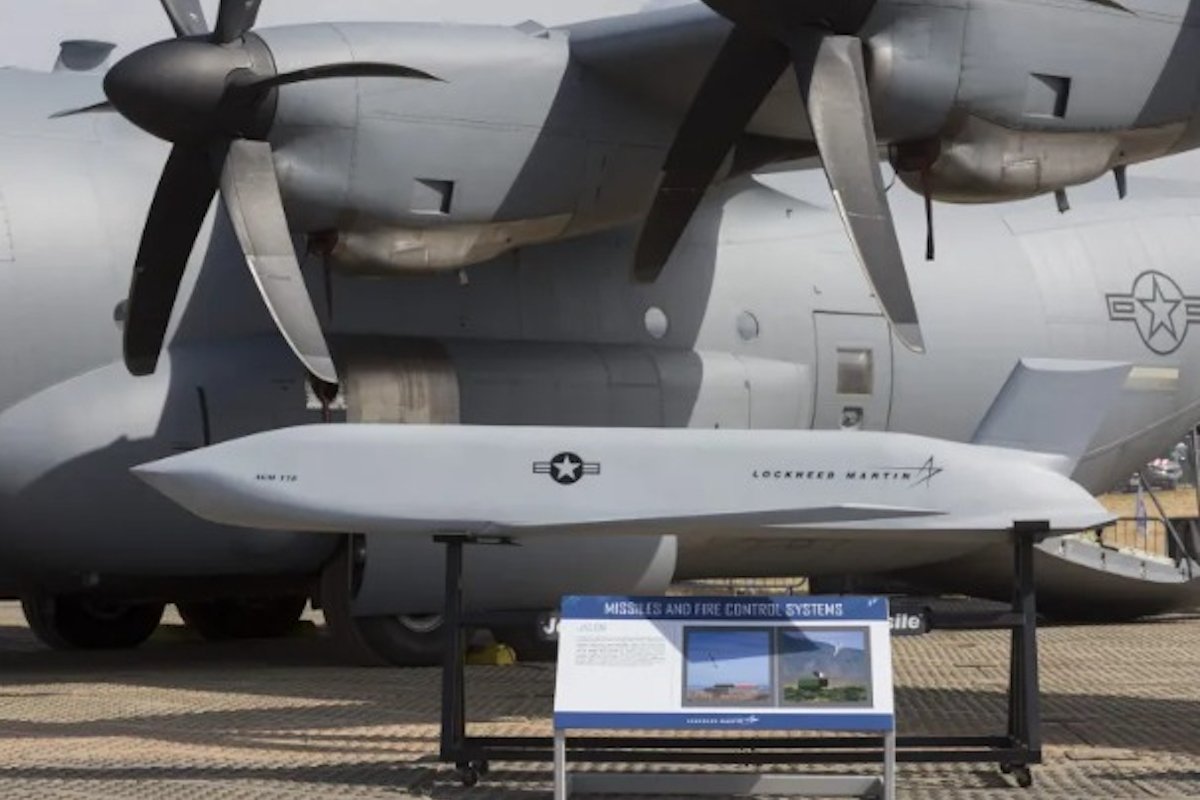

The US decision to move its most advanced long-range cruise missiles to the Iran war is exposing a growing strain on its global strike posture as advanced munitions are withdrawn from other theaters.
The US is committing almost its entire stockpile of JASSM-ER long-range cruise missiles to the Iran war, pulling many of the stocks previously allocated to other regions, including the Pacific, The South China Morning Post reported citing anonymous sources familiar with the matter.
The decision, said to have been issued in late March, will see the missiles redeployed to US Central Command (CENTCOM) bases and Europe as the US intensifies its air campaign with Israel launched on February 28.
Capable of hitting targets from over 965 kilometers with a 450-kilogram warhead designed for hardened and soft targets while avoiding air defenses, the JASSM-ER has been used extensively in the first four weeks of fighting in Iran. About two-thirds of US JASSM stocks are said to be now engaged in the conflict.
Only about 425 usable missiles remain globally from a pre-war stockpile of 2,300, raising concerns about reduced readiness against higher-level adversaries such as China. The campaign has relied heavily on interdiction weapons to minimize the risk to personnel, although recent US losses, including downed aircraft and drones, highlight the continuing threats.
Given current production rates, replenishment of JASSM-ER stocks is expected to take years, even as the US Department of Defense (DoD) expands production capacity.
The escalation comes amid uncertainty over the next steps in the Iran war, with US President Donald Trump signaling further intensification of operations. This operational requirement is now driving a rapid and potentially unsustainable rate of ammunition expenditure.
At the same time, the stockpile reallocation of the JASSM-ER, a weapon designed to penetrate protected airspace, could mean that Iran’s air defenses remain a substantial threat, despite US claims to the contrary.
In March 2026, the Wall Street Journal reported that 85% of Iran’s air defense systems and radars have been neutralized, with 100 anti-aircraft batteries and 120 radars destroyed, citing Israeli military sources.
However, the New York Times reported this month, the numerous crashes of American planes, specifically those of an F-15E and an A-10are evidence that, despite being significantly degraded, Iran’s air defenses are still a threat to US operations.
Citing U.S. intelligence reports, the NYT notes that Iran has kept much of its capabilities underground, which could have saved some systems from U.S. and Israeli airstrikes, and that even if the underground bunkers and silos may have appeared damaged, Iran has been able to dig up the launchers and fire them again quickly.
Despite these operational requirements, the cost of sustaining such airstrikes is becoming increasingly apparent. More than five weeks into the Iran war, the US may be facing a shortage of long-range munitions, forcing a reliance on less capable alternatives.
In March 2026 press conferenceThe chairman of the Joint Chiefs of Staff, General Dan Caine, stated that the use of such munitions – particularly the Tomahawk cruise missile – may have to be replaced with less sophisticated munitions such as the Joint Direct Attack Munition (JDAM) and AGM-114 Hellfire missiles.
Both have significantly shorter intervals than JASSM-ER. Highlighting the likely rates of JASSM-ER spending during intensified airstrikes against Iran, Macdonald Amoah and other authors mention in a Foreign Policy Research Institute (FPRI) in March 2026. ITEMciting data from the Payne Institute, that in the first 96 hours of Operation Epic Fury, the US launched 135 JASSM/JASSM-ER missiles. This rate could increase exponentially if the US decides to intensify operations on Iran, as Trump has threatened.
In their analysis, Amoah and others note that the pace of operations is consuming munitions faster than they can be replenished, especially long-range strike systems like the JASSM-ER. They highlight a gap in US industrial viability, particularly in finding minerals and materials essential to the production of more munitions and weapons systems.
This imbalance between consumption and replenishment reflects deeper structural constraints. Seth Jones Center for Strategic and International Studies in January 2023 REPORT highlights gaps in US military resilience, noting that the defense industrial base operates at a peacetime pace with limited capacity for growth, risking rapid depletion of reserves during major conflicts.
It highlights the risk-averse nature of the industry, reliance on multi-year contracts and 12-24-month lead times for critical components, which delay production. Jones also criticizes antiquated acquisition regulations and slow funding processes that hamper response, as well as wartime logistical challenges that complicate replenishment and distribution.
Reinforcing this point, Tyler Hacker’s Center for Strategic and Budgetary Assessment in June 2023 REPORT highlights the fiscal constraints on munitions such as the JASSM-ER, with procurements accounting for only a small fraction of defense spending, thus limiting production despite growing demand.
Hacker notes that the defense industry is optimized for efficiency, not scale, with complex, high-end designs that increase production time and cost. He points out that reliance on advanced components and technology makes a rapid ramp-up capability for sophisticated munitions impossible, thus making existing inventories the key to short-term combat capability.
Taken together, these burn rates and institutional constraints could mean the US effectively disarms in the Pacific to support operations in Iran. Noting the possible depletion of ammunition in a possible conflict with China over Taiwan, a CSIS Conference indicates that starting with a stockpile of 500 JASSM-ER missiles, these supplies would be depleted 30 days into a four-week operation.
In this context, if Chinese leaders intend to carry out their longstanding threat to invade Taiwan, the optimal window for action may be within the next three or four years, when the missile gap with the US will be at its maximum.
If current burn rates continue, the US risks degrading its high-level strike capability in the Indo-Pacific, potentially undermining conventional deterrence against China and the defense of regional allies at a time when replenishment timelines lag behind operational demand.



