
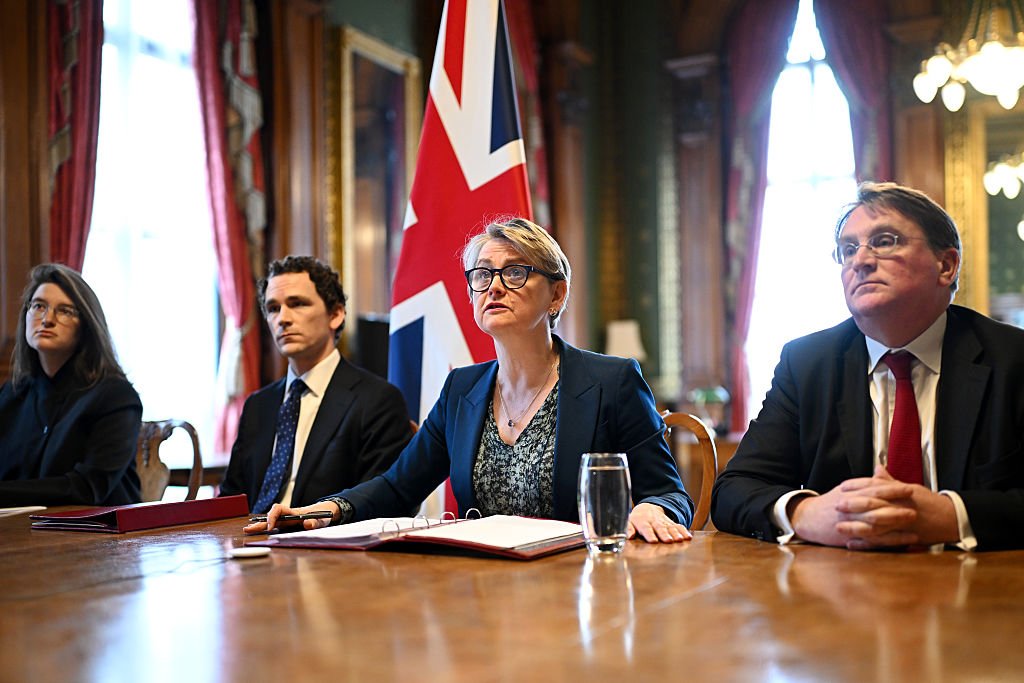

A UK-led meeting of around 40 countries on the Strait of Hormuz crisis ended on Thursday with a demand for the “immediate and unconditional” reopening of the vital shipping route, but no immediate progress.
“Iran is trying to hold the global economy hostage in the Strait of Hormuz. They must not prevail,” British Foreign Secretary Yvette Cooper said in a statement.
“To this end, the partners today demanded the immediate and unconditional reopening of the strait and respect for the fundamental principles of freedom of navigation and the law of the sea,” she added.
The strait has been virtually closed since the start of the US-Israeli war against Iran on February 28, affecting global supplies of important commodities including oil, liquefied natural gas and fertilizers.
This has led to a sharp increase in energy prices.
Foreign ministers and representatives who joined the call discussed a number of areas of “potential collective, coordinated action”, Cooper added.
This could include increased diplomatic pressure, including through the UN, as well as possible sanctions, she said.
The Gulf Cooperation Council (GCC) meanwhile called on Thursday for the UN Security Council to authorize the use of force to protect the main waterway.
Bahrain has proposed a draft resolution that would give states the green light to use “all necessary means” to guarantee free passage through the Strait of Hormuz.
However, the move has divided the 15-member Security Council, with Russia, China and France – which each have veto privileges – all voicing strong opposition.
Italian Foreign Minister Antonio Tajanialso, who joined the virtual talks, called for a “humanitarian corridor” for trash and other essentials through the strait to avoid a food disaster in Africa.
Cooper earlier criticized Iran’s “recklessness” over the strait as she began the virtual meeting.
She said Iran’s blockade of the waterway was “hitting our global economic security”.
About a fifth of the world’s oil and liquid natural gas passes through the strait in peacetime.
A total of 37 countries have signed a declaration, first published last month, expressing “willingness to contribute to appropriate efforts to ensure safe passage through” the shipping lane.
Britain, France, Germany, Italy, Japan and the Netherlands are among those that have signed it.
The United States, China and most Middle Eastern countries have not, according to a list provided by the UK government.
‘unrealistic’
A spokesman for the French foreign ministry said that securing the Strait of Hormuz could “only be done once the intensive phase of bombing is over”.
French President Emmanuel Macron, speaking on a visit to South Korea, said a military operation to liberate the Strait of Hormuz was “unrealistic” as he complained about Trump’s various daily statements about the Iran war and NATO.
“There are those who advocate the liberation of the Strait of Hormuz by force through a military operation, a position sometimes expressed by the United States,” Macron said.
“I say sometimes because it’s changed, it’s never the option we’ve chosen and we consider it unrealistic,” he said.
The virtual meeting hosted by Britain came after Trump urged oil-importing countries to show “courage” and seize the narrow strait.
“Countries of the world that get oil through the Strait of Hormuz have to take care of that passage,” Trump said in a prime-time speech late Wednesday.
“Just take it, protect it, use it for yourself,” he added.
Trump has said he would consider a ceasefire only when Hormuz is “free and clear”.
However, many countries have insisted that any operation to protect seafarers using the strait can only come after a ceasefire.
“We are also bringing together military planners to look at how we marshal our collective defensive military capabilities, including looking at issues such as demining,” Cooper said at Thursday’s meeting.
The channel normally sees about 120 transits a day, according to shipping industry intelligence site Lloyd’s List.
But since March 1, freighters have made just 225 crossings, according to maritime intelligence firm Kpler, a 94% drop in peacetime.
(cz)



