
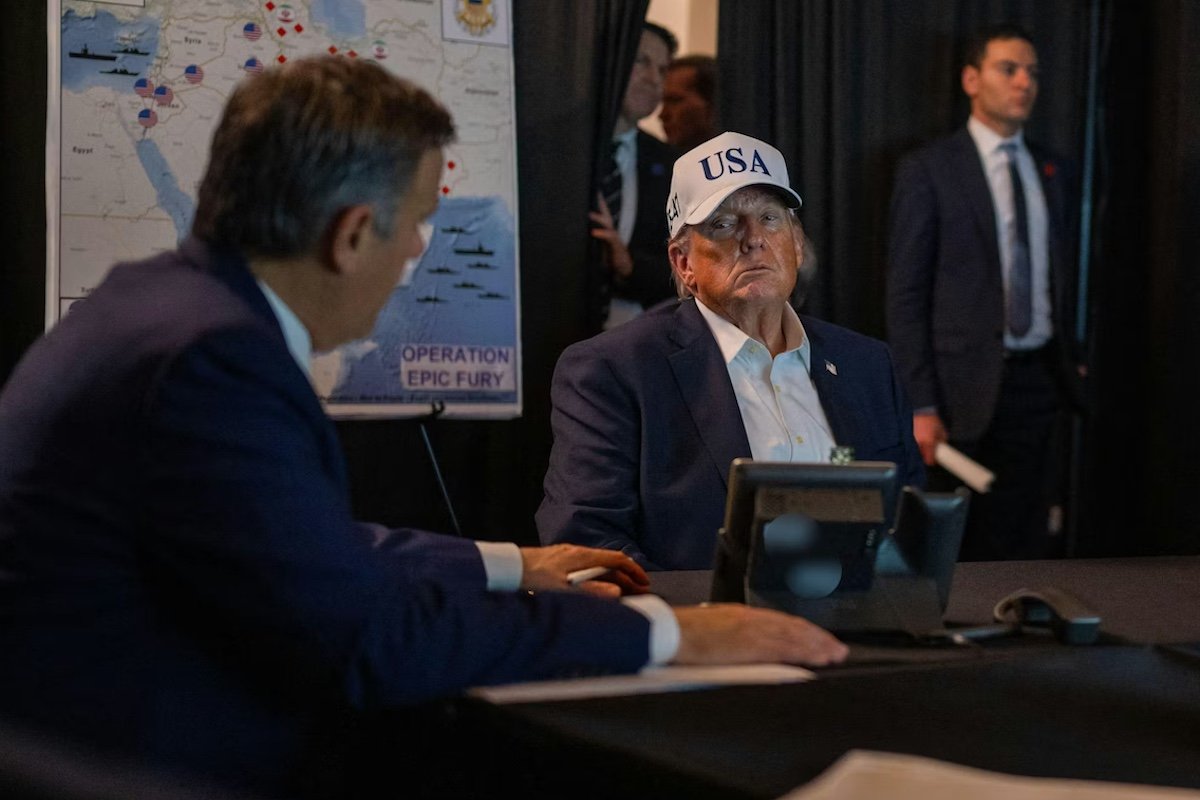

The language of power often reveals more than it intends. In a rare moment of candor on March 7, US President Donald Trump described the confrontation with Iran as “a great game of chess at a very high level … I’m dealing with very smart players … high-level intellect. People with high, very high IQ.”
If Iran is, by Trump’s own admission, a “high-level” adversary, then the sudden resurgence of a 15 point plan previously rejected by Iran a year ago suggests a disconnect between how the adversary is understood and how it is being approached. It is a plan already considered in negotiations by Iran and rejected as unrealistic and coercive.
Despite this, the Trump administration is once again defining the “roadmap” as a path to de-escalation. Tehran has once again dismissed the game as Washington “negotiating with itself – reinforcing the perception that the US is trying to impose conditions rather than negotiate them.
The US president is right about one thing – Iran is not an adversary that can be easily dismissed or defeated. Trump’s description itself is a tacit admission that this is a far more capable and complex adversary than those the US has faced in past Middle East wars, such as Iraq. And that is why the odds are increasingly stacked against the United States and Israel.
This conflict reflects a familiar but mistaken imperial assumption: that overwhelming military force can compensate for strategic misunderstanding. The US and Israel seem to have misjudged not only Iran’s capabilities, but the political, economic and historical terrain in which this war is taking place.
Unlike Iraq, Iran is a deeply embedded and adaptable regional power. It has resilient institutions, networks of influence, and the capacity to impose asymmetric costs across multiple theaters. I know how to manage maximum pressure.
The most immediate problem is lack of legitimacy. This war is not authorized either by the United Nations or, in the case of America, by the US Congress. Further, U.S. intelligence assessments indicate that Iran was not rebuilding its nuclear program after the previous attacks — contradicting one of Washington’s justifications for the war.
of resignation of Joe Kent as head of the National Counterterrorism Center on March 17, was even more revealing. In his resignation letter, Kent insisted that Iran did not pose any immediate threat. This effectively demolishes one of the original narratives underpinning the US decision to go to war – a further blow to legitimacy.
Most Americans oppose the warreflecting deep fatigue after Iraq and Afghanistan – hardly ideal conditions for what increasingly looks like another “eternal war” in the Middle East. CURRENT VOTING shows that Trump’s Republicans are trailing Democrats ahead of the all-important midterm elections in November.
The war is both militarily uncertain and politically volatile. The support of international allies is also eroding. The United Kingdom – often trumpeted as Washington’s closest partner – has been limited to defense coordination, while Germany and France have distanced themselves from offensive operations.
European allies too rejected a US request to deploy naval forces to secure the Strait of Hormuz. This reflects not just disagreements, but a deeper loss of confidence in US leadership and strategic judgment.
US influence has long depended on legitimacy as much as on strength. That tank is now rapidly emptying. Global confidence is plummeting as images of civilian casualties – including over 160 schoolchildren – emerge killed in an airstrike on the first day of the war – shocked international viewers. Instead of strengthening leadership, this war is hastening its erosion.
Israel faces a parallel crisis of legitimacy – one that began in Gaza and has now deepened. The war in Gaza severely damaged its global standingwith sustained civilian casualties and humanitarian devastation that have drawn unprecedented criticism, even among traditional allies. This confrontation with Iran worsens.
Hitting Iran during active negotiations – for the second time – reinforces the perception that escalation is preferred over diplomacy. The issue is no longer just behavior, but credibility.
Strategic failure, narrative defeat
The development of the war complicates the problem. The assassinations of Iranian leaders, described as tactical victories, are strategic failures. They have united rather than destabilized Iran. Massive pro-regime demonstrations illustrate how external aggression can consolidate internal legitimacy.
The issue is no longer just the development of the war, but the credibility of the conflict itself. As impressive as the US and Israeli military are, it does not make up for the loss of reputation.
When building support for a conflict like this – domestically and internationally – legitimacy is a strategic asset. Once eroded through multiple conflicts, it is extremely difficult to rebuild.
Instead of stabilizing the system, US actions are fragmenting it. Allies are distancing themselves, adversaries are adapting and neutral states are defending.
The most decisive factor may be economic. The war is already on destabilizing global markets – rising oil prices, inflation and volatility to levels that combine the effects of the 1970s and the oil shocks of the war in Ukraine.
This is a war that cannot be contained geographically or economically. Placement of 2500 US Navy in the Middle East (and reports that until another 3000 paratroopers will also be sent), it is said that with plans to secure Kharg Island – and with it Iran’s most important oil infrastructure – it would be a dangerous escalation.
For the Gulf states, the assumption that the US can guarantee security is increasingly being questioned. Some countries are said to be now looking to diversify their partnerships and turning towards China and RussiaREFLECTING the changes after Iraqwhen the failure of the US opened space for alternative powers.
Iran holds the cards
Wars are won not only by destroying capabilities, but by securing lasting and legitimate political outcomes. On both counts, the US and Israel are failing.
Iran, by contrast, does not need military victory. She just has to endure, impose costs and resist her opponents. This is the logic of asymmetric conflict: the weaker power wins by not losing, while the stronger loses when the costs of continuation become unsustainable.
This dynamic is already evident. Escalating rapidly, Trump now appears to be looking for a lift off the platform — reviving proposals and signaling openness to negotiations. But he is doing so from a position of reduced leverage.
By contrast, Iran’s ability to threaten power flows, absorb pressure and shape the pace of escalation means that it increasingly holds the key strategic cards. The longer the war goes on, the more that balance tilts.
Empires rarely know when they begin to lose. They escalate, double down and insist that victory is near. But by the time the costs become undeniable – economic crisis, political fragmentation, global isolation – it’s already too late.
US and Israel can win battles. But they may be losing the battle that matters for legitimacy, stability and long-term influence. And, as history suggests, that loss may not only define the limits of their power, but mark a broader shift in how power itself is judged, limited, and resisted.
Bamo Nouri is an honorary researcher, Department of International Politics, City St George’s, University of London AND Inderjeet Parmar is a professor in international politics, City St George’s, University of London
This article was reprinted from Conversation under a Creative Commons license. Read on original article.



