
India’s growth in cash transfers reflects both political economy realities and developmental constraints. The question is not whether transfers should continue, but how. If they support families while aiding structural transformation, they can strengthen inclusive growth. If they simply entrench dependency, they risk fiscal stress and reduced dynamism.
The fate of India’s welfare state will be measured not by the scale of transfers, but by their alignment with a sustainable growth trajectory. India is making structural adjustments to its welfare architecture. Unconditional cash transfers – especially for women and vulnerable families – have moved from side strategies to central policy instruments. The scale alone is staggering. By 2025-26, States are projected to spend about Rs 1.7 lakh-crore on unconditional cash transfers for women annually (roughly 0.5% of GDP) – currently operating in over a dozen states and having over 100 million beneficiaries. At the national level, the Direct Benefit Transfer (DBT) architecture, attested to by more than 1,200 schemes, has greatly increased efficiency, reduced leakages and ensured last-mile delivery.
From a design perspective, it’s a huge success in governance. There is also a clear welfare logic with empirical evidence that cash transfers drive household consumption, reduce vulnerability and provide women with financial agency. Funds are typically spent on food, education and health care, with little evidence of negative labor supply implications. Cashless transfers, even free bus travel for women, are now generating tangible income savings and increased mobility. Similarly, conditional transfers – such as West Bengal’s Kanyashree initiative – have been shown to reduce child marriage by 6.7% and increase secondary education by 6%. But the macroeconomic effects are murkier.
Expanding India’s cash transfer regime is not simply a matter of welfare intent but of fiscal design. The critical issue is whether states have the revenue power to support such commitments without compromising long-term investment. A comparison between the leading states reveals a clear divergence between welfare ambition and fiscal capacity.
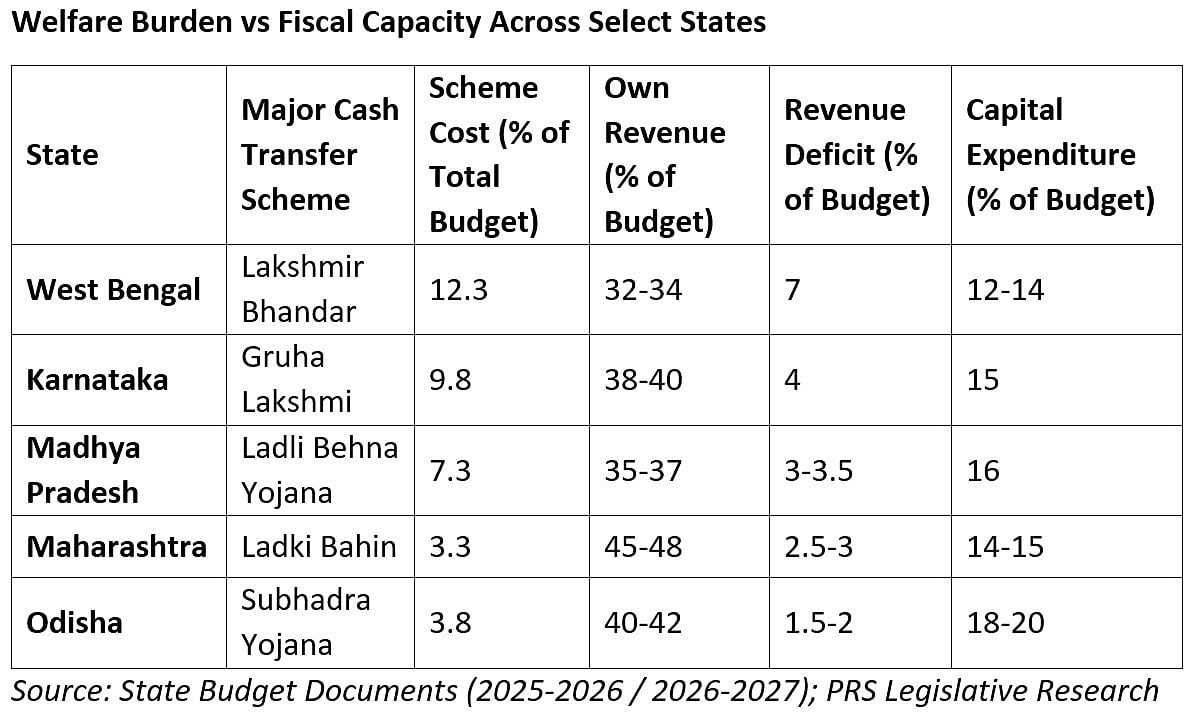
The contrast is instructive. West Bengal allocates over 12% of its total expenditure to a single cash transfer scheme, while generating a relatively modest portion of its budget through its own revenue. Coupled with a higher revenue deficit, this indicates a tighter structural fiscal position, where welfare expansion risks hampering capital spending. In contrast, Maharashtra and Odisha combine lower welfare burdens with stronger domestic revenue generation and lower deficits, while retaining greater fiscal space for infrastructure and growth-oriented spending. Karnataka and Madhya Pradesh occupy an intermediate position, where welfare commitments are significant but partially offset by stronger revenue bases. The model suggests that the sustainability of cash transfers is not uniform across countries; it depends on the underlying fiscal capacity.
The picture is further complicated by employment. India’s labor market, especially for skilled youth, remains structurally weak. High unemployment reflects a mismatch between education and labor market needs, accompanied by limited growth in labor-intensive sectors. In this context, income transfers – such as youth stipends in West Bengal and Madhya Pradesh – are reactive, not structural. They deal with symptoms, not causes. This distinction is important.
Cash transfers are consumption-driven: they can stimulate local demand and stabilize the economy, but their multiplier effects remain limited unless linked to productive activity. In contrast, investments in manufacturing clusters, logistics, urban infrastructure and human capital generate sustainable gains in jobs and production. The risk is that states will rely on visible political transfers, while investing less in less visible but essential sectors for economic development.
Labeling these schemes ‘free’ oversimplifies their role. In a country characterized by informality and income instability, they function as social security. Remittances stabilize households, increase well-being, and in the right circumstances can even boost labor market participation. The challenge lies in design and balance. Transfers work best when they complement rather than replace growth strategies. Time-limited support can be related to skills training, internships or work placements. Wage subsidies for first-time workers in MSMEs can reduce employment risk and expand formal employment. Sector-specific industrial policies—textiles, food processing, electronics, and services—could spur job-intensive growth.
Parallel investments in urban infrastructure and the care economy will absorb excess power while meeting social needs. Ultimately, the balance between well-being and economic development is not automatic, but depends on policy choices.
Debdulal Thakur is Professor, Vinayaka Mission School of Economics and Public Policy, Chennai. Shrabani Mukherjee is a freelance researcher, economics and public policy, Chennai.
(Disclaimer: The views expressed above are the author’s own. They do not necessarily reflect the views of DH.)