

The event marked the Continental Army’s first major victory in the Revolutionary War, ending an 11-month siege of Boston and securing the city for the American cause.
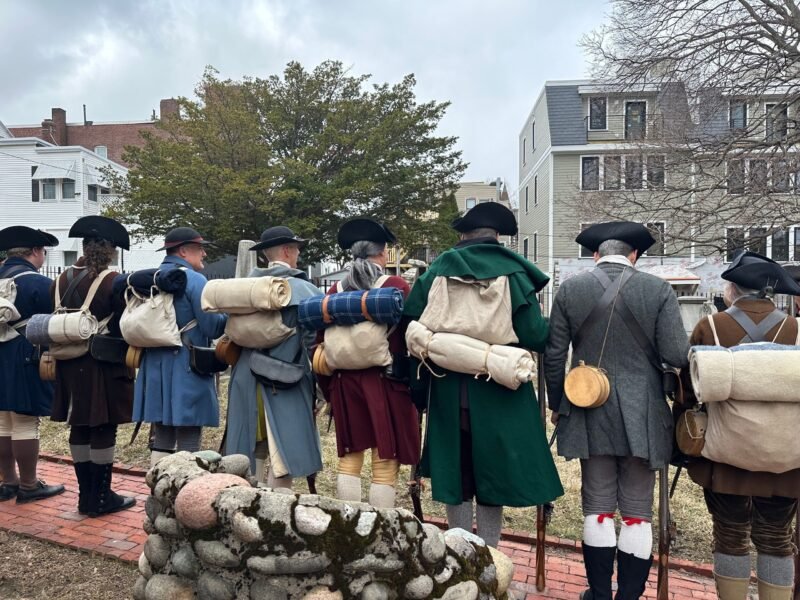
BOSTON (AP) — Revivalists in 18th-century military coats and tricorn hats filled the pews of one of the nation’s oldest Catholic churches Tuesday before firing muskets outside and marching through neighborhood streets, marking the 250th anniversary of the day British forces evacuated the city.
Men, horses and even cattle moved through the hills of South Boston in the morning breeze as residents watched from their seats – some in pajamas and wrapped in blankets, apparently awakened by the sound of drums and bagpipes.
Evacuation Day commemorates March 17, 1776, when British troops withdrew from Boston. The breakthrough came when General George Washington fortified Dorchester Heights with artillery drawn from Fort Ticonderoga by Colonel Henry Knox, prompting the British evacuation.
The event marked the Continental Army’s first major victory in the Revolutionary War, ending an 11-month siege of Boston and securing the city for the American cause.
The anniversary also traditionally falls on St. Patrick’s Day, a pairing that has shaped Boston’s celebrations for decades and was marked again with a combined parade in South Boston last weekend.
The ceremony began Tuesday at St. Augustine’s Chapel and Cemetery, where participants gathered for Mass in the 1818 building before forming a procession that moved through South Boston to Dorchester Heights, the hill where colonial forces positioned artillery overlooking the harbor. A monument there, recently renovated in a $37 million project, has reopened to the public.
Ronald White of Milton, dressed in colonial garb, stood with reenactors firing replica muskets in the church cemetery after the service and said the anniversary has personal meaning.
A member of the New Hampshire Sons of the American Revolution, he traces his ancestry to an ancestor who fought in the war. He got teary-eyed Tuesday as he talked about how inspired he feels by the country’s founders.
“To think that 250 years ago Henry Knox made such a bold stand, I get choked up thinking about it,” White said. “They were really going up against a force – it was kind of a suicidal idea to go up against Great Britain. And we did it. We’re remembering it here.”
Richard Vige, who lives in a Boston suburb, said he came to Dorchester Heights for the first time to mark the 250th anniversary, despite a lifelong interest in American history.
“I’ve always been interested in history, really since high school,” he said. “I’ve visited a lot of the places along the Freedom Trail, but I’d never been here before. I wanted to take advantage of the 250th to see what was going on.”
He said attending the commemoration offered a chance to reflect on how far the country has come since its founding – from a group of colonies across the Atlantic to a nation of more than 340 million people.
Greta Gaffin, a theology student at Boston University who studies American religious history, said the Catholic service struck her as historically ironic.
Holding a Catholic mass to mark the anniversary is a scene the nation’s founders might not have imagined. Colonial Massachusetts had long restricted Catholic worship, and churches did not take root in Boston until after the Revolution, as religious freedoms expanded and Irish immigration reshaped the city.
“I’m here because I think having a Catholic mass in honor of Evacuation Day is conceptually absurd,” she said. “They would have hated that – I had to see it.
“And I like parades,” she added.
Anti-Catholic sentiment was widespread in colonial New England, although it had begun to change by the Revolutionary War, when the American cause was supported in part by Catholic France. The Quebec Act, which protected Catholicism in neighboring Quebec, was seen by some colonists as a threat and is reflected in complaints in the Declaration of Independence.
__
By LEAH WILLINGHAM Associated Press
Subscribe to our free newsletters
Our weekly newsletter Closing arguments provides the latest on ongoing trials, major litigation and decisions in courts around the US and the world, while monthly Under the lights feeds legal dirt from Hollywood, sports, Big Tech and the arts.



