
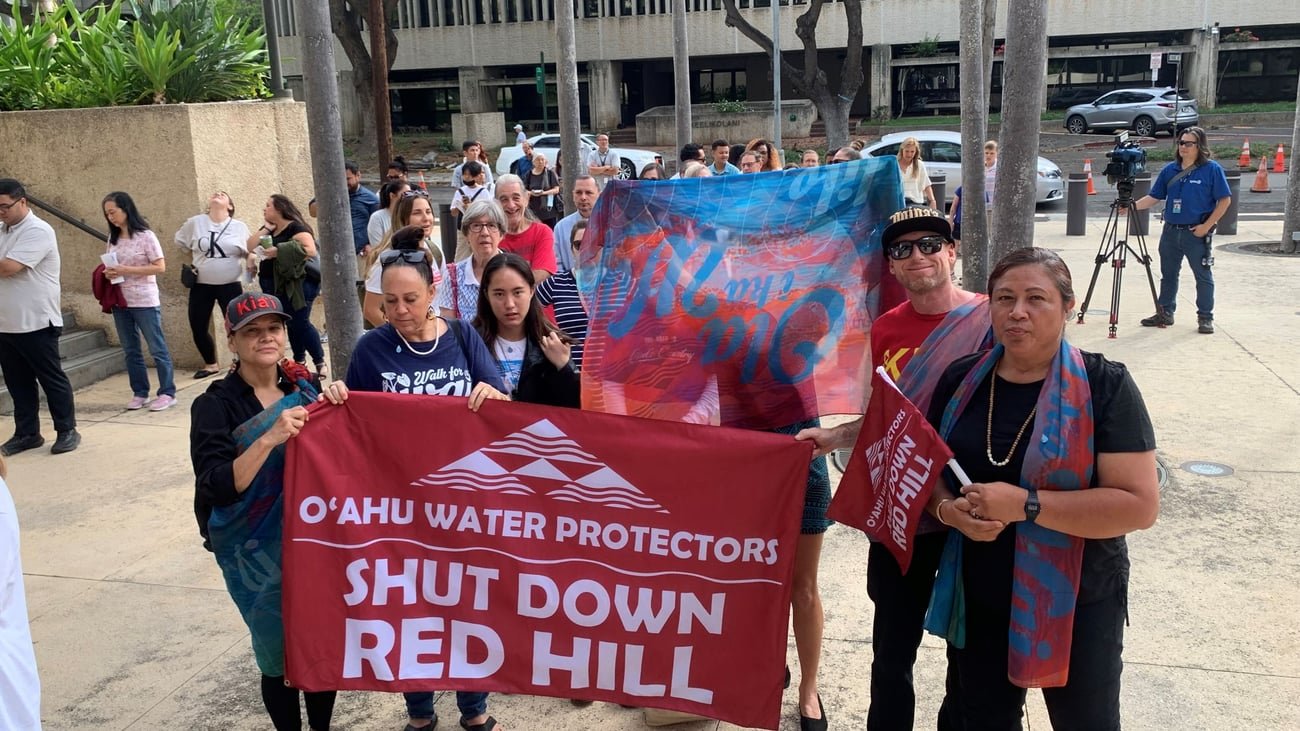

HONOLULU (CN) – When jet fuel seeped into the tap water at Joint Base Pearl Harbor-Hickam in 2021, thousands of military families bathed in it, cooked with it and gave it to their children to drink. Now, the US government is arguing that these actions count as occurring during the course of military service.
On Thursday, U.S. District Judge Leslie Kobayashi in Honolulu, Hawaii, presided over a hearing on a motion to dismiss one of several lawsuits stemming from the 2021 Red Hill water pollution disaster — this one brought by active-duty service members.
The government says that when service members cooked, bathed and washed babies’ bottles with fuel-contaminated water in their homes, they were performing military duties.
In November 2021, fuel from the Navy’s Red Hill fuel storage facility, a World War II-era underground complex near Pearl Harbor, leaked into the water system serving tens of thousands of Oahu residents. Residents reported a wide range of health problems, including skin rashes, neurological symptoms, vomiting and hair loss.
In the 1950 decision in *Feres v. US,* the US Supreme Court barred service members from suing the federal government for injuries caused by military service.
Retired Army Colonel Jessica Whaley served as a certified nurse midwife at Tripler Army Medical Center in Honolulu. She was transferred to the Aliamanu Military Reservation in May 2021 and has described tasting jet fuel in a neighbor’s water, then continuing to cook and bathe with water from her tap, which she said only smelled, even though she became ill.
She and her husband have three children, including a child with Down syndrome and a child with autism.
The government’s motion to dismiss came more than three years after Whaley’s lawsuit was filed and five months after Kobayashi awarded roughly $660,000 in damages and attorney fees to affected civilians in a related case.
At Thursday’s hearing, plaintiffs’ attorney Kristina Baehr focused on how the Ninth Circuit interprets Helldoctrine, arguing that it requires a close, activity-by-activity analysis rather than a broad look at why a service member happened to be in a particular location.
“The Ninth Circuit focuses on these words: ‘under orders,'” Baehr said.
She argued that housing where service members were exposed to jet fuel-contaminated water was privatized in the 1990s and opened to non-military tenants, including Hawaii police officers, state employees and civilian contractors.
“Could a civilian have rented this house? And it turns out the answer is ‘yes,'” Baehr said.
Kobayashi pushed back, pushing Baehr whether that argument could hold up given that the housing benefit itself flowed directly from military service.
“The housing they were in was only because of their military service, right? So how do I reconcile this language, ‘arising out of or during activity incident to service?'” she asked.
Baehr compared the situation to a 2022 Ninth Circuit sexual assault case, Splitstoser v. USA, in which the court refused to apply Feres even though the government had paid for the victim’s housing because the attack itself was a private activity and not a military function.
She also pointed to the base housing allowance, arguing that because service members can choose to live off base and use the pay for a private mortgage, they aren’t really mandated to be in any particular home.
“When I keep saying, are they under orders, the Ninth Circuit is asking: do they have an election here?” Baehr said.
Justice Department attorney Eric Rey argued for the dismissal, telling the court that Feres the doctrine has been consistently applied in cases involving the contamination of military housing, and plaintiff’s own complaint defines the housing as a military benefit.
“These people would not have been there but for their service to the United States,” Rey said.
Rey also argued that the court should look at what the plaintiffs were doing in general — living in military housing — rather than their specific activities at the time of exposure.
He told about Feres case, in which a soldier died in a fire while sleeping in military barracks.
“There was no analysis of what he was doing at the exact time the fire happened,” Rey said.
Kobayashi, who earlier expressed concern with the results of Feresdoctrine applied in this crisis, raised these concerns again on Thursday.
“It bothers me that it’s apparently a pretty harsh result of the doctrine, but I’d still have to enforce it,” she said.
In her closing argument, Baehr asked the court to allow the claims to proceed.
“In many cases, we have to reach an unjust result. But here in the Ninth Circuit, because of this case law that focuses on access to civilians and this question of whether they were under warrants, we can and should reach the just result here,” Baehr said.
Kobayashi took the matter under advisement.

Subscribe to our free newsletters
Our weekly newsletter Closing arguments provides the latest on ongoing trials, major litigation and decisions in courts around the US and the world, while monthly Under the lights feeds legal dirt from Hollywood, sports, Big Tech and the arts.



