
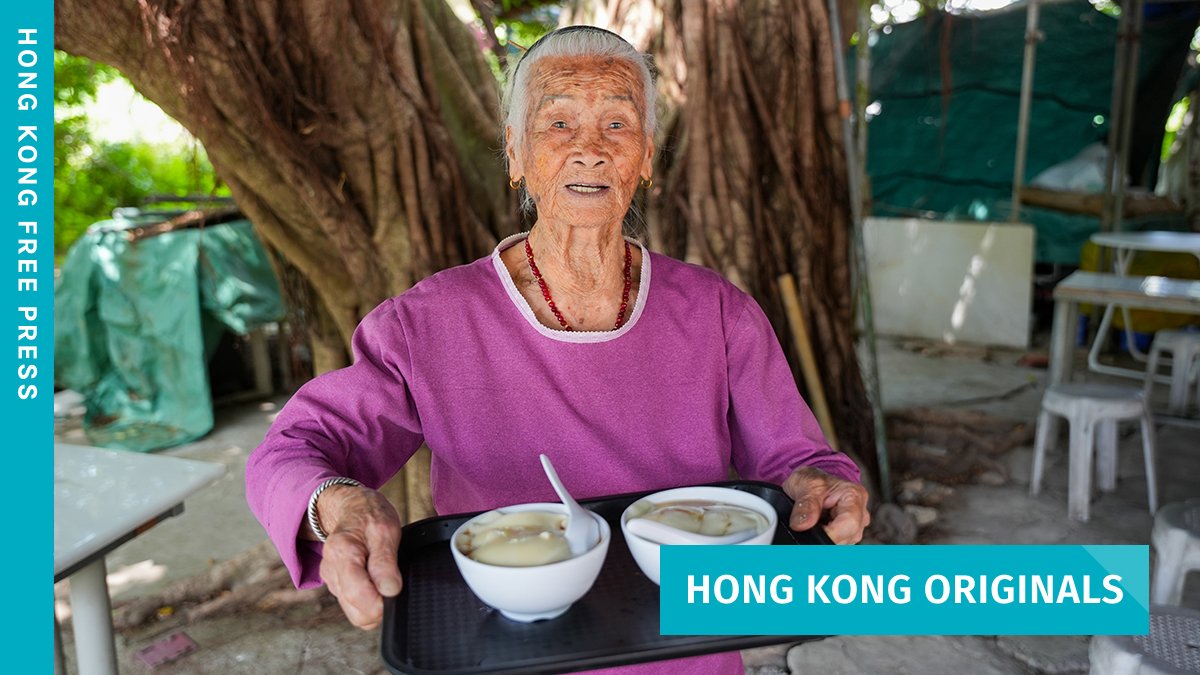

| As Hong Kong’s economic boom faded and manufacturing moved to China, some long-established family companies maintained their traditions while others innovated to survive. In our new series, HKFP documents the craftsmanship and spirit behind goods that are still proudly “Made in Hong Kong”. |
Passing through the winding paths of Lamma Island’s main village, Yung Shue Wan, which translates as Banyan Bay, day hikers will come to a junction and then a small bridge that spans a stream.

There, as they leave the island’s bustling countryside for its tranquil hills and beaches, is an inaccessible tarp-covered shack selling sweet silken tofu pudding under the shade of a sprawling banyan tree.
On weekends and holidays, dozens of people line up in front of the stand for a bowl tofu faa traditional Chinese dessert made from soybeans.

With cameras at the ready, tourists and vloggers sit on the metal worktop while a small, thin old woman scoops pudding out of a metal pot with a shallow spoon.
She fills a bowl to the brim, layer by layer. Then she takes a large pot and drenches the tofu pudding with the sweet caramel-colored ginger syrup.
Grandma Ching, or “Ching Por Por” in Cantonese, runs the dessert stand – officially called “Kin Hing Ah Por Tofu Fa” but also known as “Tofu Garden”.

The hut, furnished with various plastic tables and benches, as well as a large round mahogany table, has been a fixture on Lamma Island for nearly half a century.
Grandma Ching thinks she’s 92, but she’s not entirely sure. “I don’t know what year I was born,” she told HKFP, speaking in a Cantonese dialect spoken in Lufeng, a city in southeastern Guangdong province, where she hails from.

Grandma Ching’s story follows the trajectory of many Hongkongers. She was among the waves of immigrants who arrived in the city in the 1960s and 1970s – legally and illegally – fleeing the poverty and turmoil of the Cultural Revolution in mainland China in search of a better life in the British colony.
Before coming to Hong Kong, she – like millions of others – worked and lived in agricultural communes, where every aspect of life was dictated by the Chinese Communist Party. Grandma Ching received little formal education and remains illiterate today.
“There was work to do but nothing to eat,” she said, recalling her life in her home village. She grew sweet potatoes on a communal farm, but all the produce had to be surrendered, after which the farmers were left with nothing to eat.

Together with her husband and their son, grandmother Ching – then aged around 33 – arrived on the shores of Pok Fu Lam in 1966 after an overnight journey in the tub of a fishing boat. They started a new life in Lamma, joining her uncle, who already lived on the island.
In Lamma, she found work as a farmer, doing odd jobs in a field in almost the same place as her tofu center today, just a few hundred meters from the power plant. She earned a salary of HK$7 per day.

Grandma Ching said she opened her tofu cake stand around the time Hong Kong Electric, one of the city’s utility giants, began building a power station on Lamma Island. This would have been in 1978, but she can no longer remember the exact year.
At the time, Hong Kong’s urban areas were hungry for more energy to fuel the city’s rapid industrialization.
The construction of the Lamma power station, which brought many workers to the quiet island, along with the growing population of the island, provided a new opportunity to earn more money.

Grandma Ching’s older brother, who also moved to Hong Kong, taught her how to tofu fawhich means “flower head” in English. The recipe was simple and required only a few inexpensive ingredients: water, soybeans, cornmeal, and gypsum powder—the common name for calcium sulfate.
Soon, she began offering the popular dessert to island workers and residents in need of refreshments, charging a dollar a bowl. For a time, she even took her dessert in buckets to the power plant, selling it to the workers on their tea breaks.

“It’s very easy. There’s no secret, no trick,” she said, as if stating the obvious.
“The only thing is to soak the soybeans for a long enough time. When the weather is warm, I start soaking them at 2 a.m., and when the weather is cold, I start soaking them the night before, at 9 p.m.,” she said.
“Then, around 5 a.m., I start grinding the beans,” she said. She doesn’t watch the clock or use a thermometer; everything goes with feeling.

The cooking process takes place in the makeshift outdoor kitchen near Grandma Ching’s house, across the path from the stand.
The soaked soybeans are first ground into a paste by a machine. The paste is passed through a large sheet of cotton cloth hung over a wooden cross suspended from the ceiling.
The raw soy milk that is extracted is then boiled in a giant wok sitting on top of a traditional clay stove, once fueled by a wood fire but now connected to a kerosene burner.
After boiling, the liquid should be quickly poured into a pot, where it is mixed with cornmeal and gypsum powder. The impact will help gelatinize the mixture and within a few minutes the pudding is formed. The process takes no more than an hour.

Over the course of five decades, a bowl of tofu pudding went from costing a dollar to HK$18 today, the latest price written directly above the earlier “$17” on a trailside sign.
The giant banyan tree that grows above the fabric roof is still standing despite several super typhoons in recent years.
Grandma Ching planted the tree herself.
“The tree was so tall when I stuck it on the ground,” said Grandma Ching, gesturing and pointing to her waist. “I didn’t need to water it or fertilize it. Now its roots have broken through the cement in the soil.”

Grandma Ching tofu fa it is popular among tourists looking for an authentic island experience, although reviews of its taste are mixed.
The owner said that the stand’s bloom is long gone. “I used to sell 20 or 30 buckets a day, now only three or four buckets,” she said.
Today, Grandma Ching’s daughter-in-law is in charge of most of the business.

The stand will be moving for the first time, from under the banyan tree to a spot near her home – although Grandma Ching doesn’t know exactly when.
Their owner is taking the land back, she said. Workers were laying a new cement slab on the ground when HKFP visited.
“I’ve sold as much as I’ve made, that’s all. I have no feelings about it. Just look at my hands,” said Grandma Ching. She showed HKFP her aging hands, the joints more visibly deformed on the right than the left, caused by arthritis and years of childbearing.





