

Iran reportedly struck and destroyed the American AN/TPY-2 radar stationed in Jordan during its ongoing war with the United States and Israel.
What makes the AN/TPY-2 special is that, despite operating in the X-band of the electromagnetic spectrum – which is generally suitable for fire control (directing weapons to their target) – can also perform long-range surveillance functions.
This capability is attributed to the large phased array radar antenna, high transmit power and advanced beamforming techniques. As a result, the AN/TPY-2 is an expensive platform, costing just under half a billion dollars, and only 13 such systems have been produced.
The destruction of the AN/TPY-2 underscores the difficulty China faces in achieving information dominance in the South China Sea (SCS), despite massive investment in intelligence, surveillance and reconnaissance (ISR) capabilities there.
Although China has developed multilayered, overlapping ISR coverage in the SCS, it has yet to establish a well-networked system-of-systems architecture—a gap that presents an opportunity for Southeast Asian claimant states, the United States, and its allies to challenge China’s “information warfare” in any SCS conflict.
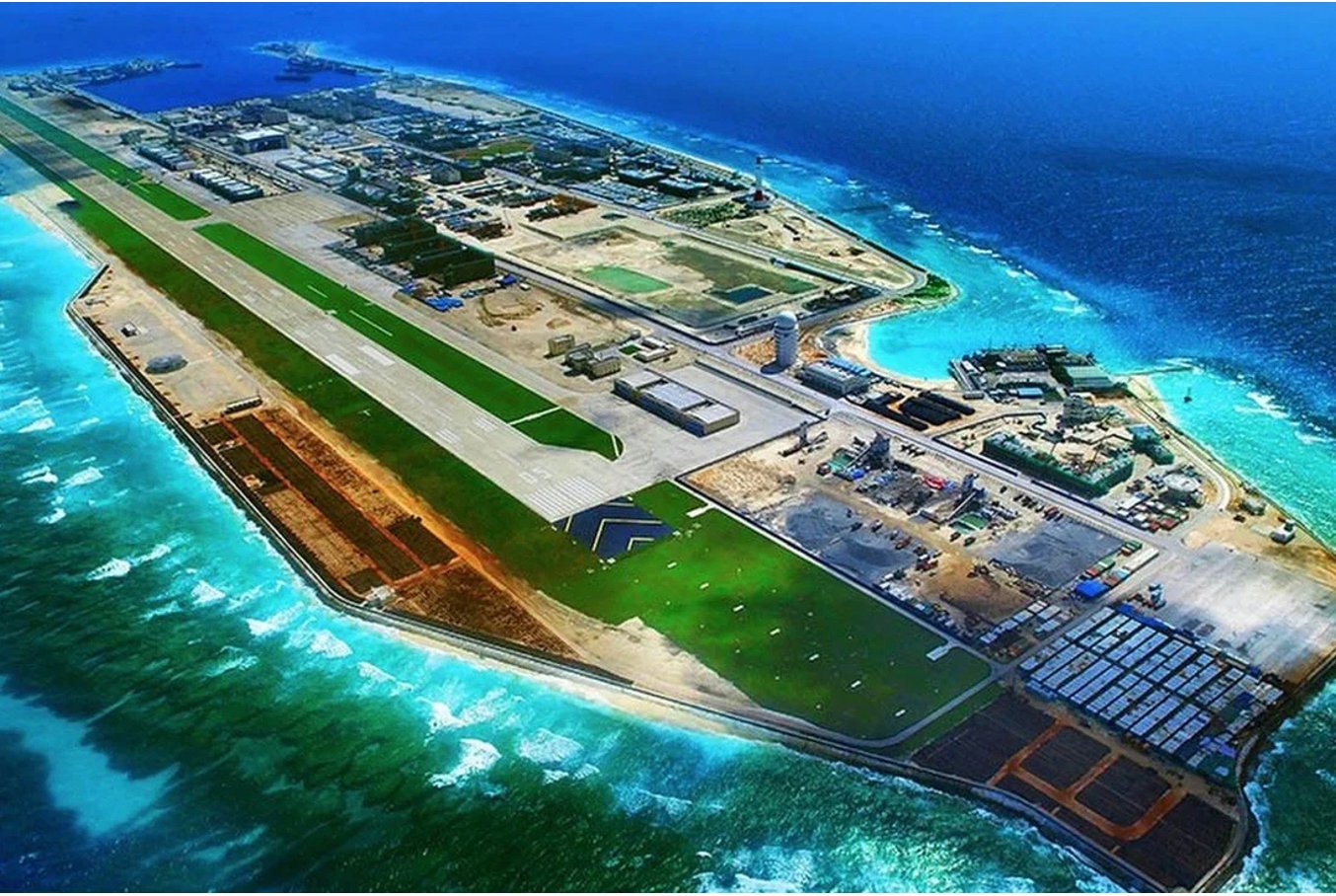
According to the CSIS Asia Maritime Transparency Initiative (AMTI), as of 2022, China has built several new facilities to enhance its ISR and electronic warfare (EW) capabilities on its Spratly Island properties.
These equipment include mobile ISR and EW systems and antenna arrays on all three of China’s major Spratly features, namely Fiery Cross, Subi and Mischief reefs. A pair of ISR radomes, each with a small forward antenna, were also built on Subi Reef; similar radomes have been in place at Fiery Cross and Mischief Reef since 2017. These investments reflect China’s efforts to achieve information dominance in the SCS.
However, achieving information dominance is easier said than done. The geography of the SCS, combined with the physics underlying the radar’s operation, limits China’s ISR coverage.
Because SCS features are built on submerged reefs, they lack hills or mountains, so the radars must be located at low altitude. The radar emits electromagnetic waves that propagate along the line of sight, which means that the curvature of the Earth limits the coverage of low-altitude radar installations.
This limited detection distance is known as the radar horizon. The AN/TPY-2 is reported to have a radar range of up to 3,000 km, but according to a calculation by Jaganath Sankaran and Bryan Fearey, it would have a maximum range of 800 km even under the most optimistic conditions.
Over-the-horizon (OTH) radars can detect beyond the radar horizon, but are unsuitable for fire control. The best way to extend radar coverage is therefore to use external radars – such as airborne or space-based systems – and relay the data back to the gunner for target engagement.
The transmission of targeting data from an external radar back to the gunner is known as cooperative engagement capability (CEC). Implementing the CEC is an extremely challenging task, given the dense networking it requires between different systems to form an effective system-of-systems.
One possible reason Iran was able to strike such a formidable radar system is that it was not integrated with other systems capable of protecting it from incoming threats. Radar, as an active emitter of electromagnetic radiation, is inherently vulnerable to counterattack and must be placed under a protective umbrella of air, sea, or land systems to defend against incoming threats.
The AN/TPY-2 was deployed to Muwaffaq Salti Air Base in Jordan, just over 800km from Iran – within reported radar range – yet it was unable to deter the next attack. Although the details of the Iranian attack remain unknown, integration with airborne or ground-based radar systems would have improved its chances of doing so.
Therefore, a well-networked system-of-systems architecture is essential to achieving information dominance—no individual system can operate at its full potential in isolation, leaving exploitable gaps that only seamless integration can close.
China, however, has yet to integrate air, sea and land-based radar systems for real-time operations. Although it has developed multi-layered, overlapping ISR coverage, without a well-networked system-of-systems architecture, those systems can only operate in isolation, providing minimal support to each other.
This presents an opportunity for Southeast Asian claimant states, the United States and its allies to challenge China’s “information warfare”—and its EW capabilities—to prevent China from achieving information dominance in any SCS conflict.
Just as Iran was able to hit and destroy Jordan’s AN/TPY-2 deployed without the protection of a well-networked system-of-systems architecture, China’s adversaries could exploit the same vulnerabilities to defeat its fragmented ISR capabilities in the SCS.
Harshit Prajapati is a PhD candidate at the Center for Indo-Pacific Studies, Jawaharlal Nehru University, New Delhi.



