
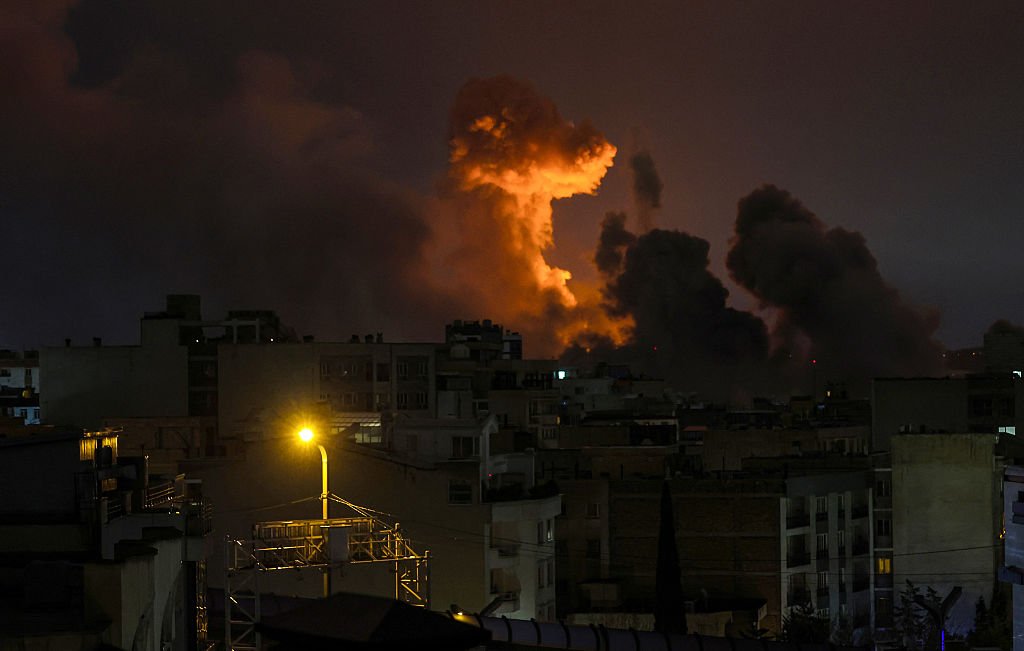

Iran on Sunday claimed attacks on two major aluminum factories in the Persian Gulf, further raising the economic stakes of the Middle East war after Iran-backed Yemen’s Houthis joined the conflict.
The war that began on February 28 with US-Israeli attacks on Iran has mushroomed across the region, sending world energy markets into a tailspin and threatening to torpedo the global economy.
With the official status of talks between Washington and Tehran uncertain, daily attacks across the region have continued unabated.
In the Iranian capital Tehran, two blasts rocked northern areas of the city early Sunday, according to an AFP journalist, although it was not clear what was targeted.
Iran in turn fired a barrage of missiles and drones at factories belonging to two of the world’s biggest aluminum producers in Bahrain and the United Arab Emirates, the country’s Revolutionary Guards said on Sunday, targeting what they described as industries linked to the US military.
Emirates Global Aluminum (EGA) said an Iranian attack injured six and caused significant damage to its factory, while Bahrain’s state media said two employees of Bahrain Aluminum (ALBA) were injured in a second Iranian attack, without giving further details.
As the specter of a widening conflict grew, Yemen’s Houthis launched their first attack of the war on Saturday, before the rebels said they fired “a barrage of cruise missiles and drones” at strategic sites in Israel.
The attacks raised concerns about the war spilling over into the Red Sea, with Saudi Arabia redirecting most of its oil exports there to avoid the Strait of Hormuz, which Iran says it has closed to shipping from hostile powers.
During Israel’s recent war on Gaza, the Houthis, claiming solidarity with the Palestinians, attacked shipping in the Red Sea and Gulf of Aden, forcing companies to make costly diversions.
‘Full Attacks’
The explosions in Tehran came a day after Israel’s military said it struck the headquarters of Iran’s Maritime Industries Organization in the capital, saying the facility developed “a wide range of naval weaponry”.
An Israeli military spokesman said attacks on Iran’s military industry had intensified and “within a few days, we will complete attacks on all critical components.”
“I miss a good night’s sleep,” an artist in Tehran told AFP, saying last night’s attacks were “so intense that it felt like all of Tehran was shaking.”
Israel, on the other hand, said a new wave of missiles was fired by Iran at its territory on Sunday, after Gulf countries Kuwait and the United Arab Emirates reported new missile and drone attacks.
On the US side, Vice President JD Vance said in an interview with podcaster Benny Johnson published on Saturday that the US has “met all of its military objectives” in Iran, but the war must go on “a little bit longer”.
His comments came after The Washington Post reported that the Pentagon was preparing plans for weeks of ground operations in Iran — potentially including raids on Kharg Island and areas near the Strait of Hormuz — although President Donald Trump has yet to approve any deployment.
Iran’s Revolutionary Guards, meanwhile, threatened on Sunday to strike US university campuses in the Middle East if Washington did not formally condemn the US-Israeli attacks on two Iranian universities.
Several American institutions operate campuses throughout the Gulf region, including Texas A&M in Qatar and New York University in the United Arab Emirates.
mediation of Pakistan
Pakistan, acting as a mediator for Washington and Tehran, will host foreign ministers from Saudi Arabia, Turkey and Egypt in Islamabad on Monday for talks on the crisis.
Iranian President Masoud Pezeshkian thanked Islamabad “for its mediation efforts to stop the aggression”, while German Foreign Minister Johann Wadephul said on Friday that he expected a direct US-Iran meeting in Pakistan “very soon”.
Trump’s special envoy Steve Witkoff said such a meeting could take place soon and promoted a 15-point plan that Washington says “could solve it all.”
However, the USS Tripoli, an amphibious assault ship carrying about 3,500 Marines and sailors, arrived in the Middle East on Friday amid speculation over a possible US ground deployment to Iran.
Three journalists killed
On another front, Israeli attacks have continued in Lebanon, which was embroiled in conflict when Tehran-backed Hezbollah fired rockets into Israeli territory on March 2.
On Saturday, the Israeli military killed three journalists in the south, including Al Manar correspondent Ali Shoeib, one of the network’s most prominent war correspondents, who had covered Israeli attacks in Lebanon for decades.
Lebanese authorities, including President Joseph Aoun and Prime Minister Nawaf Salam, condemned the killings as war crimes.
Israel also carried out raids in southern Lebanon that killed nine paramedics, according to the health ministry.
On Sunday, the Israeli army announced the death in combat of one of its soldiers in southern Lebanon as fighting continues.
At a vocational institute north of the capital Beirut, displaced mother Nasima Ismail registered her children for services despite a lack of resources as war disrupts education for hundreds of thousands of students.
“I want them to finish their education, even if we’re left with nothing,” she said.
“I wish them better days than ours.”
(aw)



