
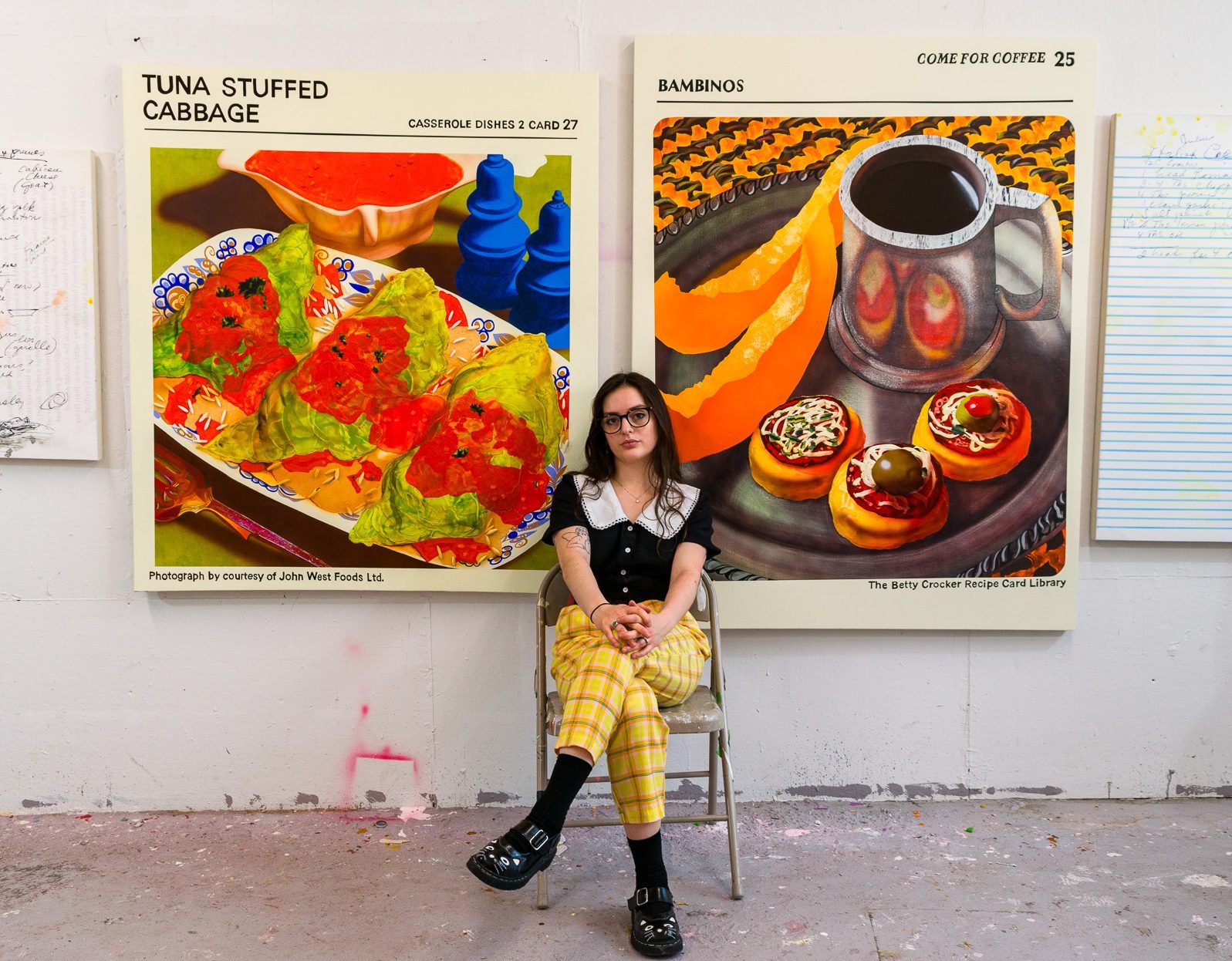


Painter based in the Hudson Valley Abby Kenny works within one of the oldest traditions of art history: the painted still life. Since the Dutch Golden Age, artists have used food to explore themes of abundance, mortality and the passage of time, and Kenny’s approach to the subject similarly transcends mere documentation. Diagnosed with celiac disease in 2021, she developed a deep, personal connection to food – not just as food, but as a cultural object that carries history and meaning. “We lived near St Lawrence Market and as I was shopping I saw it was very beautiful,” she told the Observer. Initially inspired to simply paint her wares in the market, food eventually became a lens through which she could reflect on memory, tradition and personal identity. Her condition made it difficult to participate in certain rituals, and this sense of exclusion heightened her awareness of the cultural and historical significance that food holds, leading her to explore it in her artwork. Food, she said, can be a vessel for bigger ideas.
Over time, her art—which has been exhibited at the Morgan Lehman Gallery in New York City, Collar Works in Troy, New York, and the RISD Museum in Providence, among other places—has shifted from a surface-level exploration of food and memory to a broader and nuanced inquiry into the connections between culture, context, and personal history. Her process is an intricate blend of personal history and technical exploration—often, she uses her family’s recipes as a starting point. The act of painting not only the dishes, but the recipe cards themselves, allowed Kenny to connect with her grandmother’s memory. As she painted, she found herself deciphering hidden aspects of her grandmother’s life and character, revealing a deeper side of her that she hadn’t fully understood before. The worn, often weathered paper on which the recipes were written—sometimes accompanied by coffee stains or handwritten notes to family members—added layers of meaning, reflecting not only the recipes themselves, but also the person behind them.

What began with a focus on family recipes has expanded into a broader exploration of the forces that shape those recipes, the cultural histories embedded in them, and how they connect people across generations. Those curious to see her work in person can visit her upcoming solo show at Main Projects in Richmond opening on June 4th, or catch her work in a group show at the Morgan Lehman Gallery opening next week on June 11th. Not long ago, we caught up with Kenny to ask about memory, ink-making and what a recipe for a lifetime can reveal.
You explore recipes as part of your process and can make a recipe several times before painting it. Why?
I have a few different ways of finding or creating my reference images. I have all of my grandmother’s recipes, many of them handwritten, so I worked and painted them. In some cases, instead of painting directly from the recipe, I’ll set up a meal and create a still life, photograph it multiple times, and stitch the images together in Photoshop to create a composition that reflects the perspective I want to emphasize. This way, I can show relationships between objects. I’m actually working on a new idea based on my grandmother’s Italian recipes. I will cook a red sauce that my mother taught me and one of my grandmother’s recipes. We’ll set up the scene with her props and some weird stuff I found on eBay, and I’ll photograph it before creating the painting.
What about painting the recipes themselves? This is something I had never seen before.
I started painting the recipes shortly after my grandmother died. She was an important person in my life and when she passed, I had all these recipes and I didn’t know what to do with them. I wanted to do something with them, so I started painting them. It felt like a way to decipher her, see a side of her I didn’t always see, and almost embody her hand as I painted each word. I would paint them to a different scale than the original recipe, which distorts them. It was an interesting way to get to know him better and it gave me peace. I also discovered that many of the recipes were written on old paper, such as e-mails to her sisters or printed articles. It was fascinating to see what he was looking at at the time. Some recipes even had coffee stains or other signs of life on them, and I would paint both sides to capture that essence. It’s a way for me to immerse myself in someone else’s experience and bring it to life through my practice.

You make your own pigments and inks. Can you tell me more about this?
I do most of my own paints. I use a system where I mix pigments, either in dispersion or as dry pigment, with an acrylic binder. This gives me a lot of control over the texture and finish of my paints. I can make them glossy, matte, or really saturated, depending on what I need for the painting. I also learn materials and techniques, which allows me to share this process with others. It’s interesting because it allows me to step out of the box and explore different things that I wouldn’t normally use in my paintings. I also do oil paint, but I don’t use it in my work. However, I enjoy teaching my students how to do it because it gives them a deeper understanding of what goes into the materials they use.
You are also a lecturer of painting and drawing at Purchase College, SUNY. How do your students react when you introduce painting into your classrooms?
Some students get really excited when they realize how much they have to immerse themselves in it. Last semester, one student really embraced it and it was amazing to watch his practice grow. Others find it tedious, but they walk away with a better appreciation for the materials and the story behind them. They begin to understand how much care goes into creating paint and how much history lies behind something we take for granted. It’s rewarding to see them get excited and messy, just having fun with the process.

How do you think your work has evolved over time?
I think when I first started, I was a little superficial about it, not quite understanding what attracted me, but I knew there was something there. Over time, I’ve become more focused on connections—seeing how things overlap. For a while, I painted in threes, how to compare the same recipe from different sources. One might be my grandmother’s handwritten recipe, another from a Betty Crocker card, and a third from a cookbook. I would create these pieces side by side. I’ve been playing around with collage and incorporating those little elements that drew me to recipes in the first place. Now, I’m thinking more broadly, not just about food, but also about context.

More interviews on the Arts




