
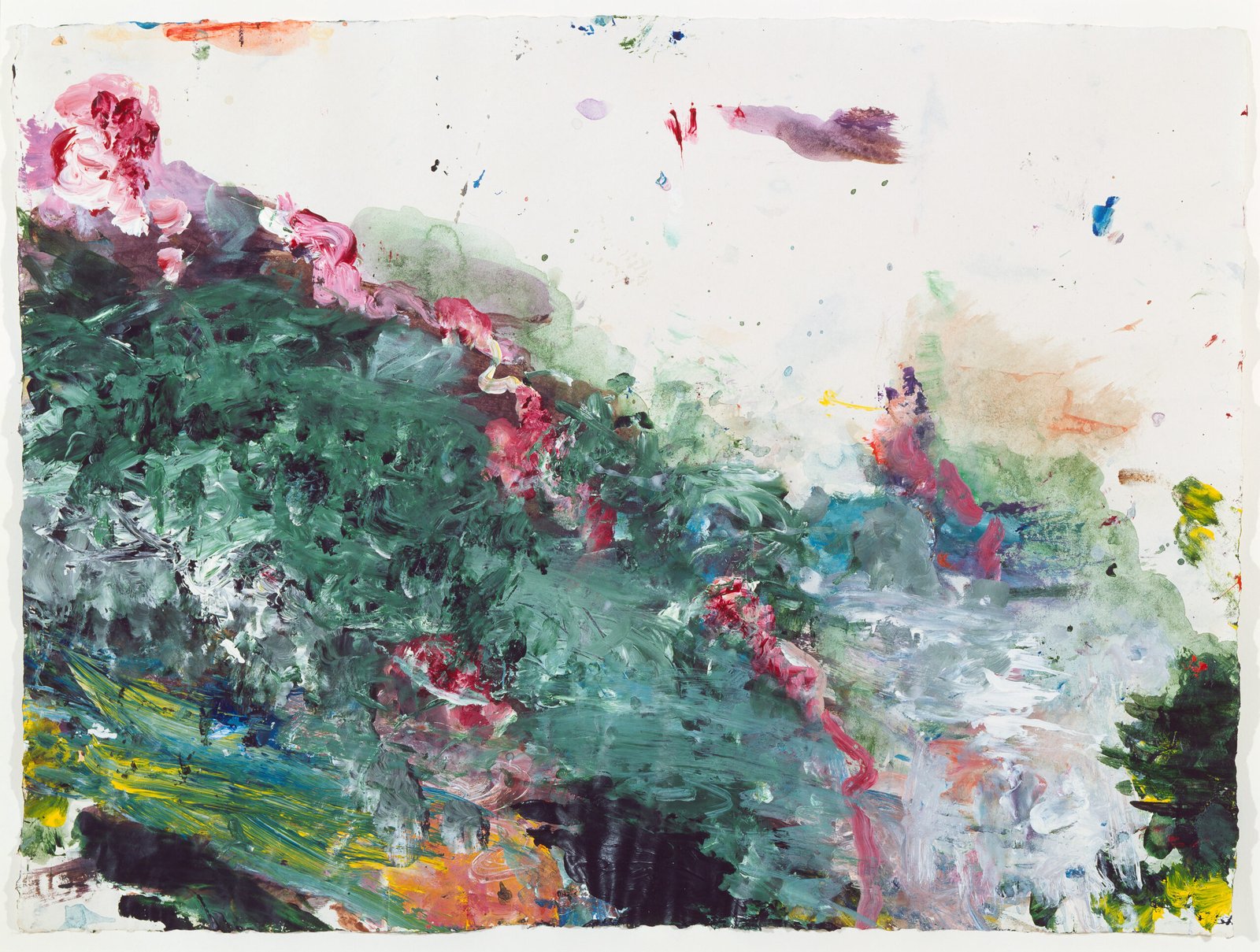


John and Dominique de Menilfor which the esteemed Houston-based Menil collection is named, had a long relationship with Cy Twombly dates back to the 1960s when they began collecting the idiosyncratic artist’s work. Today, the museum houses the largest Twombly collection in North America, including a freestanding gallery designed by Renzo Piano and dedicated to the artist. Last year, the collection grew significantly when the Cy Twombly Foundation donated 121 works, none of which had previously appeared in the US, 27 of which constitute “Drawing Gift: Cy Twombly“, until August 9.
The works span roughly four decades, from the mid-1950s to the mid-1980s, and include some from 2005, six years before the artist’s death. Among them is a collage with the title Narcissus (1975), which, at first glance, appears to be just the name written in colored crayons on a stained white surface. But a closer look reveals two pieces of paper, making up a collage in the technical sense, with the name inscribed twice, one on top of the other, like a reflection, thus gesturing to the titular mythological hunter fascinated by his face.

Narcissus it resembles a drawing more than a collage, somehow fitting in with the bulk of the offering, which is mostly drawings and paintings on paper. “On the drawing side, we had a number of works, but there was a big gaping hole, and now we can tell the whole Twombly story across media and over the years.” Edward Koppthe chief curator of the Menil Drawing Institute told the Observer.
Included are abstract landscapes painted in acrylic and oil on handmade paper. Hinting at the works of Claude Monettheir texture also references Twombly’s gray paintings from the 1980s (also included), which were shown at the Venice Biennale. “The paint is applied thickly, the brush is interesting and gestural, the impasto is not in all places, not evenly, but because of this, the paper is really wavy”, this is how Kopp describes the landscapes. “The texture is very subtle and the colors very warm and soothing, and intense in energy and vigor … they’re a little unsettling.”
“Disturbing” is a polite way to describe how viewers often interpret Twombly’s work; “scribble-scribble” is another. Minimalist artist and critic Donald Judd called Twombly’s 1964 show at the Castelli Gallery a fiasco, writing in Arts Magazine: “In these paintings, there are a few swirls of red paint mixed with a little yellow and white and set high on a medium gray surface. There are a few dots and splatters and an occasional pencil line. There is nothing to paint.”
“I think it got his attention,” Kopp said of Judd’s scathing review. “People who don’t know his art well might criticize it at first, and the other criticism might be how elusive it is. He’s interested in the act of de-skilling—getting away from academic skills and seeing what happens on paper or canvas if you try to unlearn what you’ve learned.”

To do this, he explored the element of chance in his work, sometimes retreating into total darkness, relying on instincts and primal forces to guide his hand. “You leave your mind and your hand and it can be completely unconscious,” Kopp said, noting that several such works in the collection date back to 1954, when Twombly was working as a cryptologist for the US Army. “When you do a blind drawing, it’s the exact opposite of doing an academic drawing where you know exactly what you’re trying to achieve. Here, you don’t know what you’re going to achieve. The act of drawing becomes an act of discovery. So you let chance take its toll. Then you decipher to see what you’ve done.”
Born in Lexington, Virginia, Twombly was named a legendary pitcher Cy Young from his father, who was a pitcher for the Chicago White Sox. Educated at Boston’s School of the Museum of Fine Arts and Lexington’s Washington and Lee University, he also studied at the Art Students League of New York, where he became romantically involved with Robert Rauschenbergwho suggested he study at Black Mountain College in North Carolina. There, he met artists like Franz Kline, Robert Motherwell, Ben Shahn AND John Cage before moving to Rome in 1957, where he spent most of his career.
At the age of 24, he wrote in a grant application, “What I’m trying to establish is that modern art is not dislocated, it’s something with roots, tradition and continuity. For me, the past is the source. Because all art is rightfully contemporary.”

Narcissus is just one example of his works named after mythological figures. Not included here are his 1962 pieces, Leda and the swan AND The Birth of Venus. Another example is his Fifty Days in Iliama 10-part cycle completed in the 1970s and inspired by Homer Iliad. “He’s a contemporary artist, but he’s also deeply connected to the past,” Kopp noted. “He was fascinated by going back to the origins of humanity, the origins of art. So for me, he’s always between the past and the present.”
Twombly’s references in some ways predate the ancients, reaching back to cave paintings, primitive markings, wild untitled scrawls, and asemic messages that place the burden of meaning on the viewer.
“With the art of drawing, he was interested in relating to the earlier histories of man, the primal qualities and the gesture of drawing. He is not trying to communicate clearly. He is trying to communicate a field of illusion, a state of interrogation. He is of a generation that was interested in the idea of the open world, the idea of Umberto Eco” Kopp said, referring to the Italian semiotician’s concept of “open text” introduced in his 1962 collection of essays, Open jobwho proposes that literary works are active, dynamic fields of meaning.
“Twombly is interested in creating work where the viewer is a full participant. You have to bring your body, your gaze, some knowledge, and he’ll give you fragments, some paths and maybe a title,” Kopp offered, adding after a pause, “though most of his work is untitled.”

More exhibition reviews



