
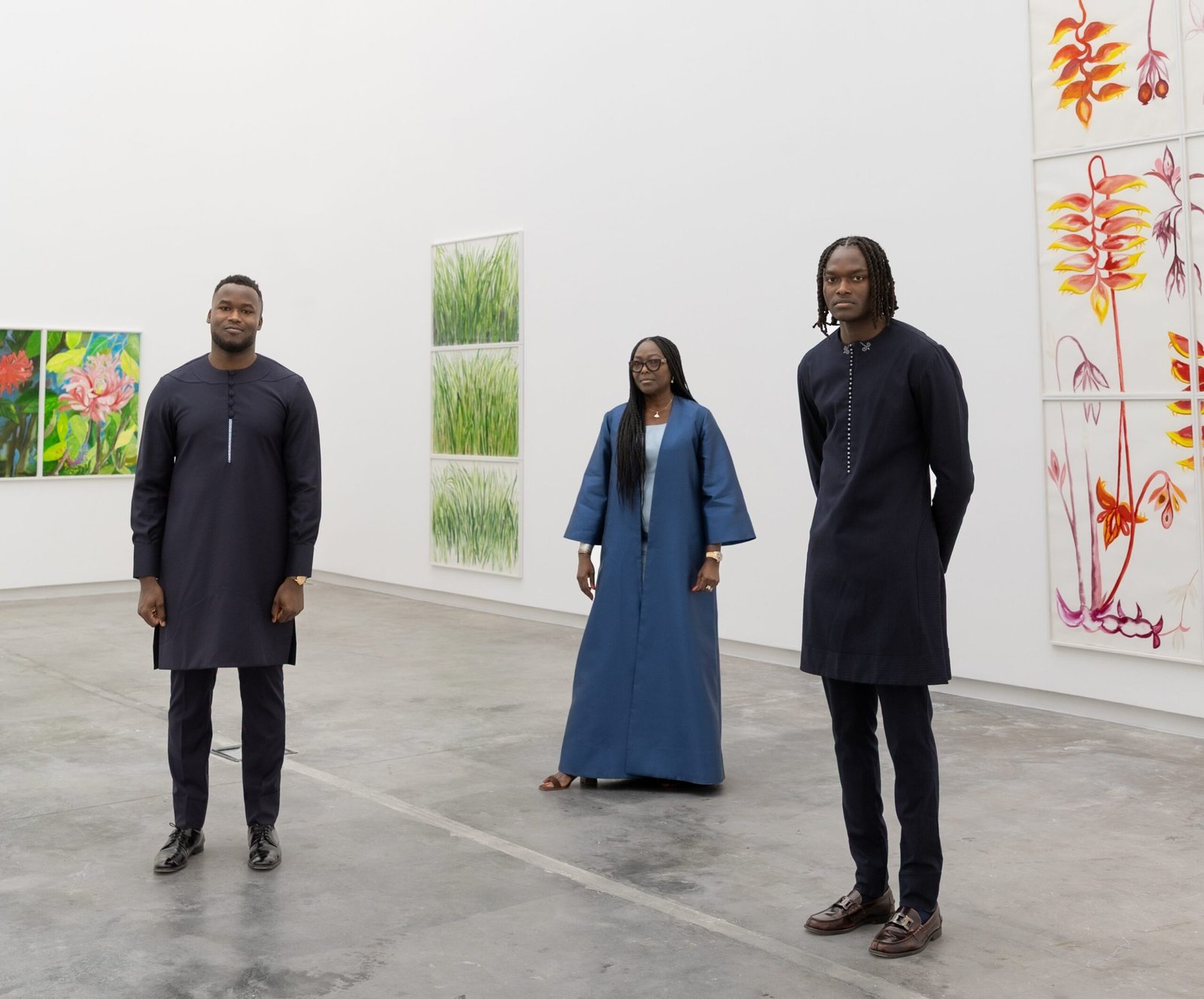


“Many of our artists are happy for us to represent them because we are the same. As Africans, we understand what story they are telling and who they are talking to.” Kwame Mintahthe Ghanaian cultural entrepreneur, collector and co-founder of Dubai-based contemporary gallery Efie tells the Observer. “There can be a disconnect between the person selling and the thing being sold.” In 2021, Kwame, his brother Kobi, and their mother, Valentina, opened Efie with the goal of supporting and showcasing the work of artists from Africa and its Middle Eastern diaspora. Since then, they have extended the mandate. “Often, what it meant to be a global artist was to be exhibited in New York… The Middle East was almost ignored,” he says. “Even for our main artists – Maria Magdalena Campos-Pons, El Anatsui AND Abdoulaye Konaté— this is a new region unlocked for them. Then for young artists, the moment they exhibit their work here, they become international artists.”
Efie Gallery hosted the debut Middle Eastern solo exhibitions of renowned multidisciplinary Afro-Cuban artist Campos-Pons and Malian icon Konaté in April 2025 and October 2024, respectively. The gallery hosted Anatsu’s first Dubai solo in March 2020 and also the gallery’s first show dedicated to the work of the pioneering Ghanaian photographer JK Bruce-Vanderpuije (1899-1989) in December 2023. Efie Gallery also represents the London-based Nigerian artist HealthyGhanaian artist Yaw OwusuKenyan sculptor Maggie Otieno and Ethiopian photographer Aida Mulunehwhose solo show will run until April 5.

Starting a gallery wasn’t necessarily something Kwame planned to do. This happened unintentionally after the Mintah family was invited to attend the All Africa Festival, an annual event that celebrates all things from the continent including fashion, music, food, film and photography. Kwame and Kobi thought of exhibiting rare vinyl records from around the world – pieces they had been collecting for years – before expanding the idea to include a visual art exhibition as part of the festival.
In October 2021, a show curated by the brothers with Afia Owusua Afriyie opened at Burj Plaza by Emaar in a site-specific pavilion designed by the Ghanaian architect Alice Asafu-Adjayewith works by Anatsui, Owusu, Otieno, Slawn, Betty Acquah, Isaac Ismail, Larry Otoo, Theresah Ankomah, Chrissa Amuah, Kwaku Yaro AND James Barnor. The show was well received and extended beyond the originally planned three days, and this success inspired the family to open a gallery. Efie means home in Ghanaian, and the Mintah family discussed opening in Ghana, where they founded e-Ananse, a library focused on African literature that also hosts live literary events in East Legon and Accra Central. They ultimately chose Dubai instead, citing the region’s potential to raise the profile and expand the practice of established and emerging artists. It was also an opportunity to foster cross-cultural exchange and highlight common values – such as the idea of community – that exist between Africa and the Middle East.

Efie Gallery opened a permanent space in March 2022 on Al Khayat Avenue, an artistic hub, and approximately three years later moved to a new two-story, 4,400-square-meter space, which includes a 1,500-square-meter main exhibition area on the ground floor with 30-meter-high working ceilings for the higher Avenue. an arts and culture district. The gallery has grown into a premier institution representing and supporting contemporary art from Africa and its diaspora, with programming that includes exhibitions, a residency program, participation in the art fair and the Record Gallery, which displays thousands of vinyl and shellac records dating from the 1940s to the present, collected by Kwame and Kobi. The space also hosts film screenings of films from Africa in collaboration with Bootleg Griot, an independent public library project, along with a library and café.

The Mintah family collect art, initially “more of a passion”, with a focus on Ghanaian legends such as James Barnor and Dump Glover. The collection has expanded significantly to include the work of artists from across the African continent and its diaspora – among them African-American and black British artists – who “fit with who we are”, says Kwame, in line with the gallery’s aim “to expand what people see as African art”.
Kwame and Kobi also collect vinyl. A few years before they started Efie Gallery, they planned to launch a reissue label called Efie Records, with the aim of making old albums by African artists and bands, among them. My dear sisterOpambuo International Band and AB Crentsil— available on streaming platforms like Spotify AND Apple Music. With their mother’s support, the brothers secured a deal with Crentsil’s Super Sweet Talks International. But the murky world of music rights and licensing, especially for dead bands and artists, forced them to put that dream on hold. “We were young at the time and we realized it was a whole different beast,” Kwame recalls. “We said ‘okay, we don’t want to go down that road’ so we pretty much shelved that idea, but we had still amassed quite a large collection of vinyl records.”
In 2017, Kobi bought a reissue of an album from the Ghanaian highlife legend Ebo Taylorwhich marked the beginning of the brothers’ journey into vinyl collecting. About two years later, Kwame heard the Afro-funk album “Only You” by the pioneering Nigerian singer-songwriter. Steve Monite at a friend’s house and assumed it was by an American artist. “When I heard this song, I was like, what is this?… so I started researching. And I said, ‘okay, how can I get these songs?… That immediately opened my mind to what’s out there especially from the African continent. That’s what started the journey of collecting vinyl.’ For about seven years, the brothers collected more than 2,000 vinyl records, mostly by artists from Africa.

The last exhibition of the Efie Gallery “The shape of things to come,” curated by the Japan-based American curator Dexter Wimberlyincluding jobs from Americans Carrie Mae Weems AND Adam Pendleton. “We were very intentional in our act of presenting African-American artists as Africans, in presenting Egyptian artists as Africans, in presenting black British artists as Africans, because we really want to make sure that people understand how big Africa is as a continent and how influential we are. Often when people say that African artists are new, they neglect that African artists have always been part of history.” Board of Purchase. “We really want to help change that narrative and people’s mindsets on what African art is and expand the genre so that African artists can be as bold or risk-taking as their counterparts.”
Next up at Efie Gallery’s Dubai space is In Abstracto, In Concreto, curated by Brice Arsène Yonkeuframing contemporary practices that extend both figuration and abstraction. Scheduled to open on May 21, the exhibit will feature paintings and works on paper by Lagos-born, US-based Luke Agada; Nigerian artist born in London, based in New York Tunji Adeniyi-Jones; Cameroonian-born, US-based artist Ludovik Nkoth; and Gabonese artist based in New York and Accra Naila Opiangah.
The gallery will participate in this year’s Art Dubai (now postponed to mid-May) with a group presentation of work by Abdoulaye Konaté, Maria Magdalena Campos-Pons, Yaw Owusu, Maggie Otieno, Aida Muluneh, Samuel Fosso AND Kelani Abbass. A piece of work by Campos-Pons, as one of the main artists chosen by the late curator Koyo Kouohwill be shown at the Giardini as part of this year’s Venice Biennale. “We want to continue to elevate our artists. If an artist says they are represented by Efie Gallery, we want that to mean something both in the way we support them and from a creative space,” says Kwame. “And almost like a stamp of approval from a collector, you don’t even have to see the work of an artist represented by the gallery; you know you’re going to get quality work.”

More interviews on the Arts



