
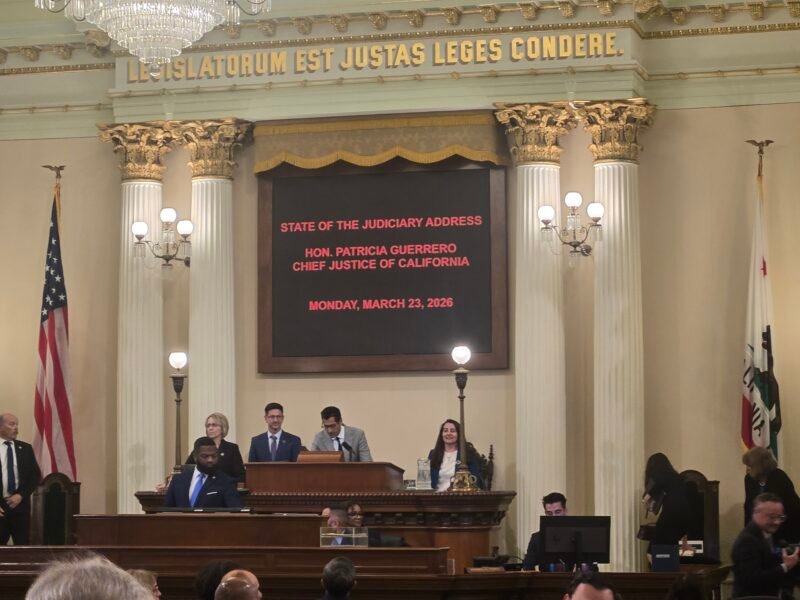

SACRAMENTO, Calif.
But Chief Justice Patricia Guerrero didn’t shy away from addressing the problems she sees affecting the most populous state’s judicial system.
Speaking Monday on the floor of the state Assembly, Guerrero called out the 250th anniversary the country will celebrate this July 4. She noted that the country’s founders voiced their grievances against a tyrannical king who had obstructed justice and made judges subject to his will.
“This year, the judicial branch plans to celebrate the unique role we play, and the privilege we have, to uphold the rule of law for all who appear before us — without fear or favor, with courage and unwavering commitment to the oath we took to uphold our constitutions,” Guerrero said.
The chief justice used her speech to highlight challenges facing the judiciary, such as artificial intelligence and the need for more judges, as well as the money to fund those positions. She thanked Gov. Gavin Newsom for proposing $70 million in increased testing costs. However, the need for judges is great. An October 2022 report indicated a need for 98 more judges.
In addition, she told lawmakers, judges’ salaries need a raise, as there is a growing gap between them and state and local government attorneys’ salaries.
Guerrero also pointed to federal immigration enforcement in state courts as a major concern.
She accepted that the federal government has a right to carry out its work in a way that does not interfere with state obligations – but that has not happened, the chief justice said. Instead, she said, public fear has grown as federal authorities have been present in at least 17 state courthouses.
“These developments raise profound questions about access to justice, community trust and the safety of individuals seeking legal remedies,” Guerrero said.
The state judiciary has responded to the actions of the federal government over the past year: it has provided training on federal executive orders, explained the legal implications of immigration enforcement in the courts, and provided information on state laws intended to uphold the principle of equal justice.
Guerrero said the judicial branch has also collected data on these operations, which the California Judicial Council will review next month. The Council will consider formalizing its collection of information about civil arrests in courts. It will then rely on that information when considering steps to take against the federal offense and ensure the courts are open to all, Guerrero said.
The chief justice also highlighted what she called negative rhetoric about judges, including from elected officials. The judiciary welcomes scrutiny and transparency, although Guerrero noted that this does not include inaccurate descriptions of their role. This only distorts the public’s understanding of its branch of government and undermines faith in democracy, she said.
“And we must speak out against the normalization of personal attacks against judges – for all of us,” she added.
Guerrero pointed to two examples she said show how government should work: remote procedures and the implementation of the Community Assistance, Recovery and Empowerment Act.
According to Guerrero, over 6 million remote litigations have occurred since March 2022. That’s 7,000 every day from September 2024 to August 2025.
The public overwhelmingly supports it, although Guerrero noted that the law enabling remote procedures will expire at the end of the year without a change in the law.
“For the benefit of all Californians who see the advantages of technology and choose to appear remotely, I look forward to working with you to meet the needs and expectations of Californians in this area,” Guerrero said.
Addressing the CARE Court, the chief justice praised the legal framework the courts use to get people help for substance abuse and mental health disorders. She said over 3,800 claims were filed between October 2023 and January 2026. Of those, courts have issued 925 agreements and plans.
It’s not a panacea, Guerrero said, although people who go through the process — and “graduate” from supervision — have greatly improved lives. And the program is expanding from its initial criteria of schizophrenia spectrum disorders to include bipolar disorder with psychotic features.
Guerrero pointed to 15 senators and 22 members of the Assembly who have visited various courts since she spoke with lawmakers last year. These visits are key because they give lawmakers a first-hand look at the challenges and successes the courts are having.
“We hope that, through these visits, you can see what I know to be true – we have a strong foundation to overcome the real challenges we face,” she added.
The chief justice ended her speech as she began: by focusing on the birth of the nation and the principles of justice for equality, justice and the rule of law.
“With your help, we have made great strides in upholding these principles,” she said. “And the judiciary remains committed to navigating the obstacles I’ve highlighted and protecting these principles for all future generations.”
State Sen. Tony Strickland, a Huntington Beach Republican, said in a statement to Courthouse News that he appreciated hearing Guerrero’s position.
“When Californians turn to the courts, they deserve a system they can trust, one that is fair, impartial and applies the law equally to everyone,” he added.
Subscribe to our free newsletters
Our weekly newsletter Closing arguments provides the latest on ongoing trials, major litigation and decisions in courts around the US and the world, while monthly Under the lights feeds legal dirt from Hollywood, sports, Big Tech and the arts.



