
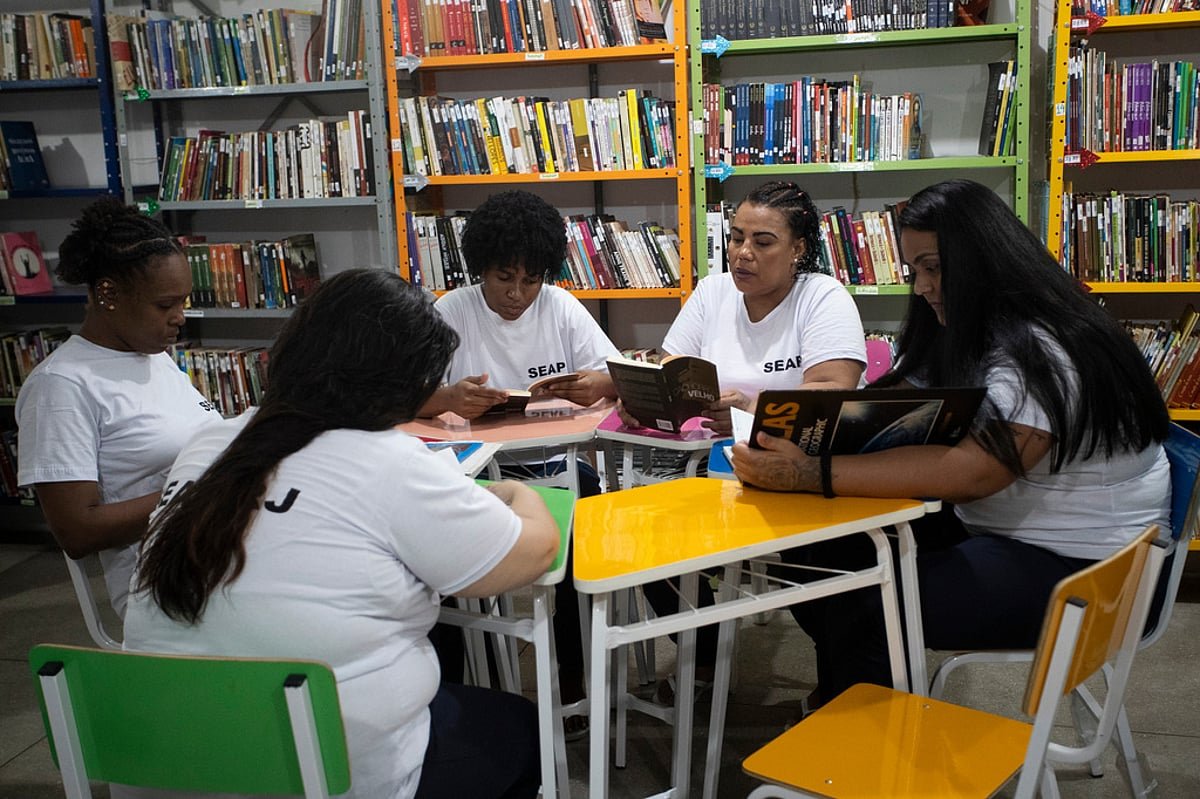

Participants choose or are given a book in the initial activity. They then discuss their book at the next meeting, and finally, at a third meeting, they produce an outline or a drawing that demonstrates understanding.
The detainees have read “Captain of the Sand” by the famous Brazilian author Jorge Amado, “Crime and Punishment” by Fyodor Dostoevsky and “The Color Purple” by Alice Walker.
A well-liked favorite among participants is the illustrated book “Father Francisco,” by Marina Miyazaki Araujo, which tells the story of an incarcerated father from the child’s perspective, Tonani said. Many inmates in Brazilian prisons come from poor backgrounds and have not completed basic education.
Several participants in a recent March seminar at Djanira Dolores de Oliveira prison were reading “The Disobedient Tears of Women” by Brazilian writer Conceição Evaristo — including Celina Maria de Conceição, a 50-year-old woman originally from the northern state of Pernambuco.
De Conceição, who attended the workshops last year and enrolled again, said she developed a taste for reading thanks to the project.
“It helps a lot because we’re locked in and it gets very stressful, very loud,” she said. “We need to go somewhere else, interact with other people and talk about good things, like the book we’re studying.”
Unequal access
But she said she had to drop Evaristo’s book, which explores the impact of violence on the lives of black women, because it upset her.
“It wasn’t good for me because it gets our emotions going and we’re in a place where the environment is already really tough,” she said.
Brazilian prisons are notorious for overcrowding and harsh conditions. In 2023, the Supreme Court recognized massive human rights violations in the prison system and ordered the federal government to develop a plan to resolve the situation. Called “Just Punishment”, it was launched in 2025 and aims, among other things, to expand study and work opportunities.
While progress has been made, access to getting time off from reading remains uneven across Brazil, said Rodrigo Dias, head of education, culture and sports at the country’s National Penal Policy Secretariat.
In the northeastern state of Alagoa, some inmates were given a Kindle with 300 works of literature, while other more conservative states have heavy bureaucracy that prevents access, Dias said.
A 2023 government report found that about 30% of Brazilian prison units do not have adequate libraries or reading spaces. But Dias pointed to the secretariat’s data, which shows that the number of requests for clemency by reading has increased sevenfold since 2021.
Like de Conceição, once people start participating, they often want to continue. “The book gives them the opportunity to dream and often ‘talk’ to other people – not those who are incarcerated or who work at the facility, but the characters in the stories,” said Dias.
‘More than one mistake’
While Elionaldo Fernandes Julião, co-author of the book “Leaving the sentence through reading in Brazil: The right to education in competition” and professor at the Federal University of Fluminense, underlines the importance of access to books in prisons, he argues that often the programs of reducing the sentence in Brazil through reading are used as a greater access to education for the development of the cost.
Julião also said that access to policies and books often depends on local projects. “Unfortunately, these are very easy to eliminate or shut down as quickly as possible,” he said.
During the last workshop, de Souza read aloud a poem written by former imprisoned Argentine writer Liliana Cabrera. One of the lines asserts that the narrator is “Also something more / than the bold letters / of a court case”.
De Souza said the words resonated deeply.
“Someone knew how to explain in beautiful terms (…) that I am much more than a court case, much more than the mistake I made, that I am a man with my story,” she said.



