

In the war between Iran, the United States and Israel, the economy has become as much a weapon as missiles, bombs and drones. Iran’s current control over the flow of a fifth of the world’s oil supply through the narrow Strait of Hormuz between Iran and Oman is indeed a threat to use fears of recession and inflation in America as a means to force Donald Trump to declare victory and initiate a ceasefire.
However, the real danger to the world is that we will get many of the worst outcomes all together:
- a truce that, if at all, turns out to be only temporary;
- an initial boost to financial markets, but then a global recession in any case; AND
- high inflation continued.
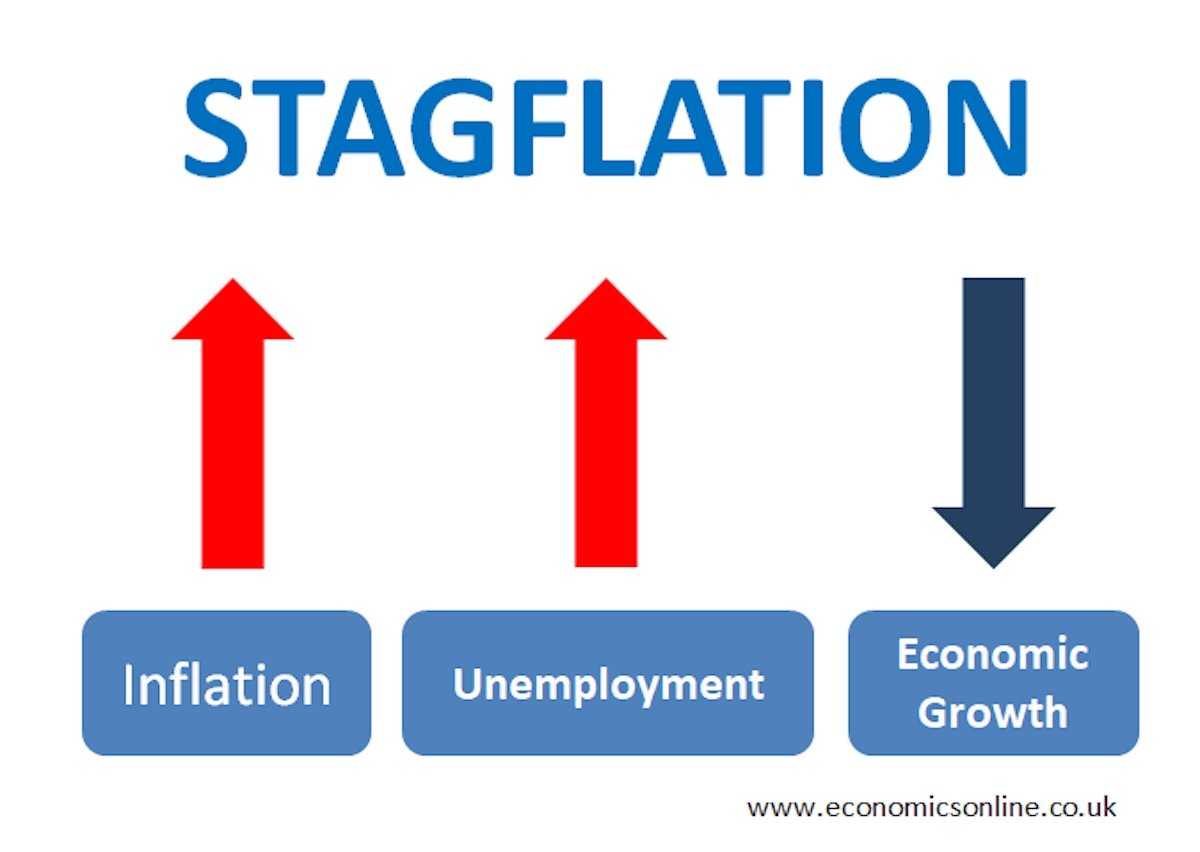
When the first major oil shock hit the world fifty-three years ago in 1973, a new word was coined to describe the economic consequences: stagflation, the combination of high inflation and economic stagnation.
Until then, economic theory had implied that stagflation was not possible because price inflation would only occur when economic growth was booming and demand for goods and services exceeded supply. A recession or stagnant growth should mean that demand would fall, and so the upward pressure on prices would also diminish.
The problem with that economic theory was that it didn’t take politics into account. In the 1970s, policy intervened in two ways to make stagflation possible.
First, the Arab oil producers, who then dominated the global oil supply, chose to restrict the supply of oil and force prices to continue rising, regardless of the state of the global economy, because for political reasons they wanted to use their control over the supply to their advantage.
And the second way that politics intervened was that in America and Europe, the major oil-consuming countries of that era, governments intervened to try to keep economies growing. This exacerbated price inflation.
As things stand, history looks like it’s preparing to repeat itself. If Iran manages to maintain its control over Hormuz and the flow of oil, then it will have an interest in keeping oil prices high for as long as it can.
It may agree to allow enough oil to prevent a catastrophic rise in prices, but it will want to earn its own oil revenue in order to rebuild its bombed-out cities, and it will want to discourage America or Israel from resuming their attacks. The way to do that will be for Iran to continue to prove it has influence.
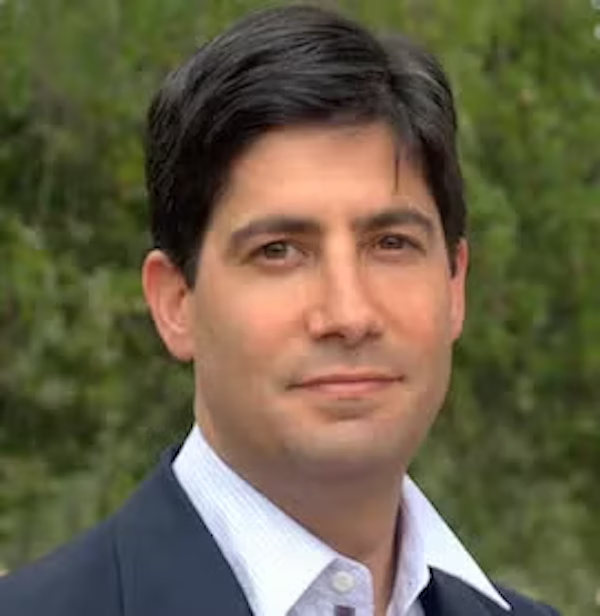
In May of this year, if he is confirmed by the Senate, Kevin Warsh, who is Trump’s pick for chairman of the Federal Reserve, will take over.
He will immediately lobby his new colleagues to lower the Fed’s interest rates in order to support economic growth, because that’s what his boss wants him to do
Depending on how successful Warsh is in lowering interest rates, this could turn out to be inflationary, just as it did in the 1970s.
In this scenario, Iranian policy will prolong the oil price shock and US policy will produce policy responses to weakening economic growth that will exacerbate inflation. We’re going to start using the word stagflation again to describe the economic trap we’re in.
Is this likely? The policy response to an inflation resulting from an oil price shock is indeed difficult. If the European Central Bank, the Bank of England or the Federal Reserve were to raise interest rates in an attempt to control inflation, it would risk causing the very recession they want to avoid. But if interest rates are cut aggressively to counter recessionary trends, it risks making inflation much worse.
The risks of this policy mistake stoking the inflation fire are much lower in Europe than in the United States. The independence from national policy of the European Central Bank and the Bank of England means they will be better able to maintain monetary discipline than a US Federal Reserve, which regularly comes under political pressure from Trump. While interest rates in the US could be cut sharply if a recession becomes likely, in Europe central banks will take a more cautious approach.
An oil price shock today will be much less damaging than the sharp rise in oil prices in the 1970s because our economies are less dependent on fossil fuels now than they were then, with services playing a much larger role in all economies, even those famous for their manufacturing like Germany and Italy.
In essence, however, the most important question about an oil price shock today is the same as it was in 1973: how long will it last? An oil price shock that lasts a month or two can be absorbed: but if it lasts much longer, even for several years, the effects will be more profound.
At the moment, the biggest shadow over the world economy, then, is not the oil price shock itself, but the uncertainty of how long the war in Iran will last and what the long-term effect may be on the supply of oil and other commodities. Such sharp uncertainty over the cost of energy in one, two or three years makes it difficult to make investment decisions.
With Trump simultaneously stating that the US is negotiating productively with Iran and that he is sending more troops and naval vessels to the Persian Gulf, while Iran itself denies that any negotiations are underway, uncertainty about the potential duration of both the conflict and the oil price shock is growing daily. The gap between Trump’s official positions and the Iranian regime seems too far to make any serious negotiations possible.
Meanwhile, Israel will continue to feel threatened as long as Iran’s theocratic dictatorship remains in power. So it has every interest in continuing to attack Iran to further degrade its military capabilities and make the regime’s eventual fall more likely.
Financial markets appear to be reacting with hope to any sign that negotiations may be underway and that Trump’s deadlines for a deal continue to be pushed back. This looks dangerously like wishful thinking based on the notion that Trump is bringing in more troops in order to force Iran to accept a deal, and that what he really wants is a way to declare victory and end the war.
But until there is a real basis for negotiations on some kind of lasting compromise agreement, the prospect of peace seems remote. All sides have an incentive to further escalate the conflict, either through strikes by a US ground force, intense Israeli bombardment, or by Iran further tightening its grip on oil supplies.
The economic impact of a protracted conflict could be much worse and more prolonged than most people currently seem to expect. It is better to prepare for the worst and hope for the best than the other way around.
Bill Emmott is a former longtime editor-in-chief of The Economist.
First published in Italian translation by La Stampa and reprinted with permission, this article is among the offerings available in the author’s Substack newsletter, Bill Emmott’s Global View.



