
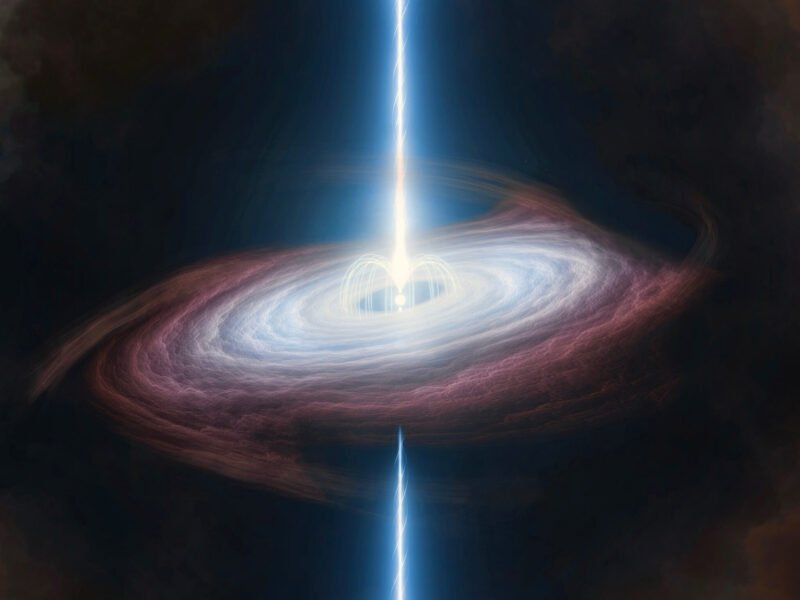

(CN) – Astronomers have confirmed that the source of energy behind some of the brightest supernovae in the night sky comes from the creation of highly magnetized, rotating neutron stars known as magnetars after recording the birth of one of them, according to a new study published in the journal Nature on Wednesday.
These superluminous supernovae can be at least 10 times brighter than the average supernova and have puzzled astronomers since they were discovered in the early 2000s. Initially, astronomers believed they were the end result of a massive explosion of stars 25 times the mass of our sun, but their brightness remained much longer than expected as their iron cores collapsed and their outer layers were thrown into wind.
A supernova is a massive explosion that occurs when a star collapses at the end of its life, releasing energy and light as its core shrinks into a dense ball, like a magnetar, fueling bright events in the cosmos.
The study published Wednesday confirms a theory first proposed by University of California, Berkeley astrophysicist Dan Kasen in 2010 that magnetars were powering persistent superluminous supernovae. It also establishes a new phenomenon in supernova light curves that researchers describe as “chirps” or bangs.
“For years the magnet idea has felt almost like a theorist’s magic trick – hiding a powerful engine behind layers of supernova debris,” Kasen said in a press release. “There was a natural explanation for the extraordinary brightness of these explosions, but we couldn’t see it directly. The chirp in this supernova signal is like that engine that pulls back the curtain and reveals that it’s really there.”
Kasen theorized, at the suggestion of physicist Stanford Woosley, that when a massive star collapsed, it turned most of its mass into a neutron star. But if the star had a strong magnetic field, it would intensify during its collapse and form a magnetar, becoming exponentially more powerful than typical neutron stars.
The magnets, which are only about 10 miles in diameter, can spin up to 1,000 times per second. As they do so, their magnetic field can accelerate charged particles that crash into debris from an exploding supernova, thereby increasing their brightness, the researchers explain.
UC Santa Barbara graduate student Joseph Farah confirmed the link between magnets and superluminous supernovae after analyzing data at Las Cumbres Observatory from an exploding star discovered in December 2024. Scientists tracked and monitored the supernova, located about 1 billion light-years from Earth, for more than 200 days.
Farah, lead author of the Nature study, noted that the supernova’s brightness peaked about 50 days after the explosion, but it did not gradually fade. Instead, the brightness shifted downward, producing an unprecedented series of four chirps in its light curve.
Farah and his 13 co-authors proposed that general relativity could explain the unusual bumps in the supernova’s light curve that connect it to a magnetar.
The research is definitive proof of the formation of a magnetar as a result of a supernova core collapse, said Alex Filippenko, a professor of astronomy at UC Berkeley who co-authored the new study.
“The basis of Dan Kasen and Stan Woosley’s model is that all you need is the magnetar’s energy deep inside and a good portion of it will be absorbed and that will explain why the thing is superluminous,” he said in the release. “What hadn’t been demonstrated was that a magnetar actually formed in the middle of the supernova, and that’s what Joseph’s paper shows.”
The researchers observed that some of the debris from the 2024 supernova explosion fell back toward the newborn magnetar, creating an asymmetric disk of material that rotates at an oblique angle, leading to a distortion of the magnetar’s spin axis. Because a spinning object drags spacetime with it, known as lens-Thirring precession, the magnetar caused its debris disk — which blocks and reflects light — to oscillate, ultimately creating the chirping effect, the scientists write.
“We tested several ideas, including purely Newtonian effects and precession driven by the magnetar’s magnetic fields, but only Lense-Thirring precession matched the timing perfectly,” Farah said in a release. “It is the first time that general relativity is needed to describe the mechanics of a supernova.”
Farah said he anticipates the discovery of dozens more supernova tweets in the cosmos after the new Vera C. Rubin Observatory, located in Chile, is expected to come online this year.
“This is the most exciting thing I’ve ever had the privilege to be a part of,” said Farah. “This is the science I dreamed about as a child. It’s the universe telling us loudly and in our faces that we still don’t fully understand it, and challenging us to explain it.”
Subscribe to our free newsletters
Our weekly newsletter Closing arguments provides the latest on ongoing trials, major litigation and decisions in courts around the US and the world, while monthly Under the lights feeds legal dirt from Hollywood, sports, Big Tech and the arts.



