
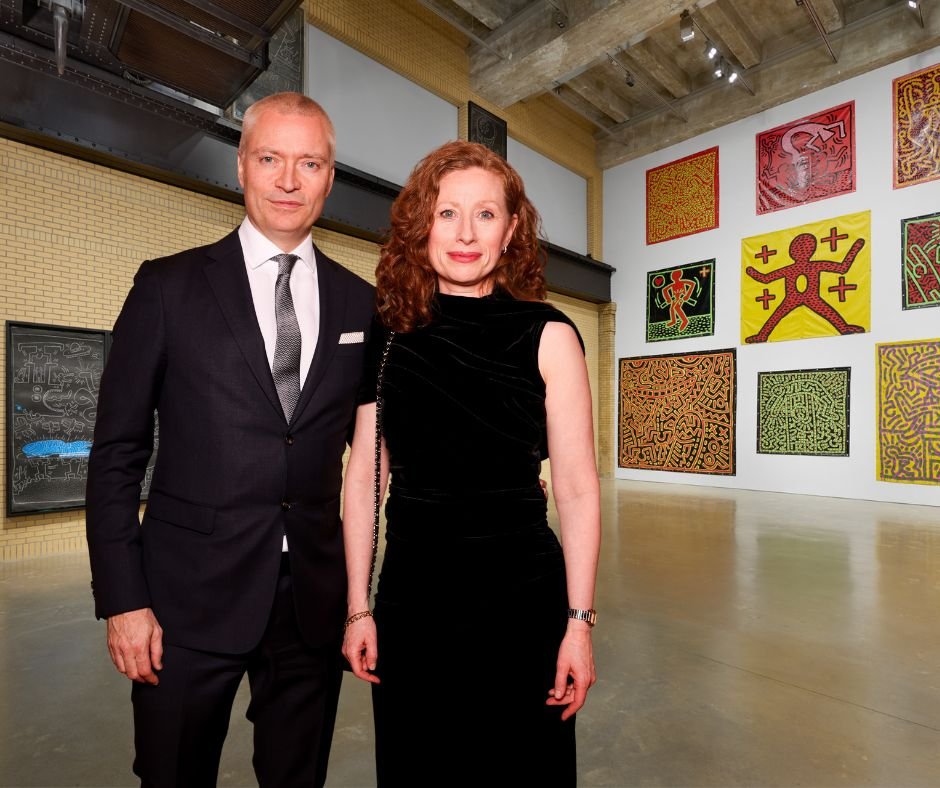


Last week, the Brant Foundation opened “Keith Haring“, an exhibition examining the artist’s early years on the New York City Center stage. The show collects works made between 1980 and 1983, an important period in Haring’s life which saw him go from graffiti joker to gallery darling. We met the co-curators of the show Dr. Dieter Buchhart and Dr. Anna Karina Hofbauer to hear more about this current exhibition.
This exhibition focuses on the early years of Keith HaringHis career, roughly 1980-1983. What made this short period the most compelling target to revisit Haring today?
Dr. Dieter Buchhart: These years contain the moment in which Haring’s entire visual language was born. Between 1980 and 1983, you can watch him invent, condense, test and sharpen the pictorial vocabulary that later became globally recognized: the radiant baby, the barking dog, the activated body, the glowing line, the theatrical silhouette, the hieroglyphic compression of meaning of the complex sign. For us, this is the most exciting point of entry, because it is the stage in which the work is still fundamentally open, experimental and connected to the city as a living laboratory.
Anna Karina Hofbauer: It is also the period before Haring became fixated on a simplistic public image. Today, many people think they already know it, but when you go back to the early years, you rediscover how daring, volatile and exploratory this work really was. Subway drawings, early canvases, fluorescent paintings and the first major exhibitions show an artist who was not repeating a formula but building a language in real time. This makes the period feel remarkably contemporary again, because it speaks to how images circulate, how symbols are read, and how a public visual code can appear almost overnight.
Haring’s work quickly moved from the subway to the gallery. This show includes key works from major historical exhibitions such as Tony Shafrazi Gallery show and FUN Gallery presentation. Why were those shows important and how did they come into the art world at the time?
DB: Tony Shafrazi’s 1982 exhibition was crucial because it made it abundantly clear that Haring was not just a talented street phenom, but a fully formed artist capable of transforming the gallery into an immersive environment. The Blacklight Room was particularly important in this regard: it was not just a show of paintings, but an atmospheric, almost total installation in which fluorescent color, music, body movements and drawing came together. It showed that Haring could translate the energy of the street into a new spatial experience without losing its urgency.
AKH: The FUN Gallery show of 1983 mattered in a different but equally essential way. FUN took root in the East Village and a newer, riskier, more hybrid scene in which graffiti, club culture, music, performance, and painting were in constant exchange. Haring’s presence there affirmed that he never belonged solely to the gallery-sanctioned world. He moved between different audiences. At the time, these shows sat with tremendous energy because they challenged inherited hierarchies: the line between subway and gallery, between so-called high art and popular culture, between downtown experiment and market visibility, suddenly became porous.
Is there any work in this show that you feel gives particular insight into the aesthetic of this crucial early period of his career?
AKH: Some works are particularly revealing because they show how quickly Haring achieved a remarkable degree of visual condensation. The 1981 smiley face in enamel baked on metal is such a work for me. It looks disarmingly simple, but it already shows his ability to create an image that is immediately legible and yet not exhausted by legibility. It oscillates between humor, signage, convenience, and pure picturesqueness.
DB: For me, the works associated with Blacklight Room are equally crucial because they expose the expanded aesthetic field of early Haring. They discover that his line was never just graphic; it was spatial, performative and environmental. Mickey Mouse’s early dog barking and variations are also essential because they show how he could take an image from cartoons or mass culture and reactivate it through rhythm, repetition and context. In Haring, meaning is never fixed. A sign behaves differently depending on its surroundings. This semiotic instability is one of the most profound qualities of the early work.
The set often balances playful imagery with pressing political concerns—from the AIDS crisis to drug culture. We live in an age where artists are encouraged, or even expected, to always be pretty political in everything they do. To what extent did Haring serve as a model for this kind of blending of art and activism?
DB: Haring is an important role model, but not because he turned art into an illustration or a slogan. What makes him exemplary is that the politics in his work is embedded in the line itself: the political line. He understood that a visual language can be seductive and resistant, playful and alarming. His pictograms are blunt enough to invite broad identification, yet precise enough to carry critiques of racism, authoritarianism, the nuclear threat, homophobia, consumerism, drug addiction, and later the devastation of AIDS. He did not separate ethics from aesthetics.
AKH: What is particularly important today is that Haring never used activism as a cultural decoration. He communicated urgently because he believed that images could enter everyday life and reach people outside the discourse of elite art. This is why posters, street interventions, public murals and later the Pop Shop mattered to him. In this sense, he absolutely prefigures the contemporary expectation that artists engage with the world. He also reminds us that political art must remain formally persuasive; otherwise, it loses consistency. Haring’s achievement is that his humanity is inseparable from the vitality of his line.
What would you say have been the main changes in the East Village since Haring’s time, and how does your exhibit respond to them?
AKH: The early years of Haring’s East Village were precarious, rough, heterogeneous and economically accessible in a way that allowed for experimentation. It wasn’t romantic; it was difficult, and sometimes violent. But precisely because rents were low and social boundaries were unstable, artists, musicians, writers, club figures, immigrants, and activists could coexist in a dense cultural ecology. Much of that has changed. The neighborhood has been profoundly transformed by gentrification, professionalization and real estate pressure.
DB: Our exhibition responds by returning Haring’s work to the neighborhood where that language first took shape. We wanted the show to work not as nostalgia, but as a sort of historical reenactment. Returning these works to the East Village allows viewers to understand that this art emerged from a very specific urban energy: from public space, from speed, from danger, from community, and from conflict. It is also a reminder that cultural innovation is always tied to the material conditions that allow it to happen.
The press release compares Haring’s iconography to “the spirit of today’s Emoji euphoria.” Can you expand on that idea?
DB: What we mean is that Haring realized earlier than most artists that modern life is increasingly dependent on compressed, rapidly circulating visual cues. His images function almost like an emotional and social shorthand: they are instantly graspable, easily replicable and capable of traveling across linguistic boundaries. In this sense, they envision a world in which communication is often pictographic, accelerated, and collective. He created a universal language.
AKH: But the comparison should not flatten the work. Haring’s signs are much richer than emoji because they are never simply neutral or fixed. A radiant child can stand for life, hope, vulnerability, energy, or an almost cosmic beginning; a dog can be cheerful, aggressive, protective, authoritative or absurd depending on the context. This is why the notion of an alphabet and the idea of a universal language is so useful. Haring created a visual lexicon, but one in which syntax and situation constantly change meaning. He envisioned the logic of image-based communication, while also exposing its instability.
For me, one of his main lasting legacies would surround his embrace of merchandising with his Pop Shop. Should we blame Haring for the fact that people believe a KAWS t-shirt to be a real work of art?
AKH: No, I would be very careful with that conclusion. Haring did not open the Pop Shop to cynically blur the distinction between artwork and merchandise. He did it because he wanted access. He realized that as his paintings became more expensive, the audience that had built up around the subway drawings could easily be excluded again. The Pop Shop was therefore an attempt to maintain a democratic impulse within a rapidly commercializing art world.
DB: Exactly. Haring’s gesture was not merely commercial; it was a continuation of his public practice by other means. One must look at the purpose, ethics and historical context. He loved children, teenagers and people without access to the gallery system to live with his images. This is very different from a purely branded luxury logic. Certainly, contemporary culture has normalized artistic goods in ways that could be seen as superficial. But Haring is not to be blamed for this. If anything, it set a much more demanding standard: accessibility without sacrificing artistic integrity.
More interviews on the Arts




