

TOKYO (AP) — Senior U.S. and Japanese officials tend to avoid all but the most cautious public comment about Japan’s 1941 secret attack on U.S. forces at Pearl Harbor. So there was embarrassment, confusion and concern on Saturday in Japan President Donald Trump casually used the World War II attack to justify his secrecy before launching the war against Iran.
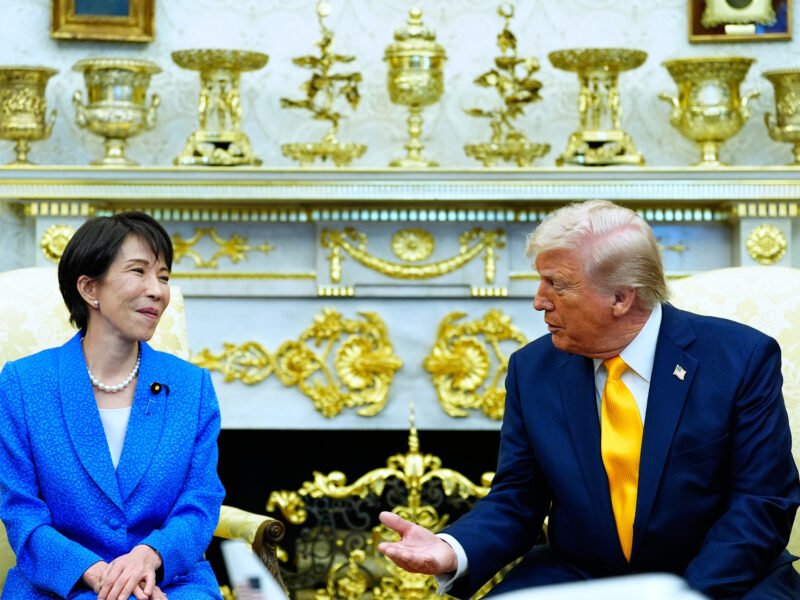
The Japanese embarrassment was compounded by the fact that the Japanese Prime Minister Sanae Takaichi sat uncomfortably at Trump’s side as he spoke.
In part, the reaction is related to the crucial security and economic role the US plays for Japan, its main ally in the region. Simply put, Japan needs to make sure that relations with the US flourish. That’s why Takaichi was in Washington.
But it’s also a reflection of how fresh the political debate about Japan’s role in World War II remains here, 80 years after it ended.
Senior leaders, including Takaichi, have argued that Japan has apologized enough for what happened in the war. Takaichi himself has recently hinted at visiting Tokyo’s controversial Yasukuni Shrine, where Japanese war criminals are honored among the 2.5 million war dead.
However, it is somewhat surprising for Japan to see these questions of history spread at a White House summit.
On Thursday, when asked by a Japanese reporter why he did not tell allies in Europe and Asia before the US attack on Iran, Trump cited Pearl Harbor to defend his decision, saying: “Who knows surprise better than Japan?” Why didn’t you tell me about Pearl Harbor, okay?”
The liberal-leaning Asahi newspaper said in an editorial on Saturday that Trump’s comments “should not be overlooked.”
“Making such a remark to justify a sneak attack and brag about its outcome is a piece of nonsense that ignores the lessons of history,” Asahi said.
Allegations of rudeness
Social media reaction has ranged from accusations of ignorance and rudeness by the US president to claims that he does not see Japan as an equal partner. There were calls for Japan to protest what Trump said.
Tsuneo Watanabe, a senior fellow at the Sasakawa Peace Foundation, said in an online opinion piece published in the Nikkei newspaper on Saturday that the comment signaled that Trump was “not bound by existing American common sense.”
“I get the impression that the comment was intended to co-opt the Japanese journalist (who asked the question) or Ms. Takaichi in order to justify his ‘sneak attack’ on Iran during diplomatic negotiations and without telling allied countries,” Watanabe said.
There is also a sense that there is an unspoken understanding between American and Japanese leaders to tread carefully on the subject. Both sides need each other, with Washington relying on Japan to host 50,000 troops and an array of powerful high-tech weapons, and Japan relying on the US nuclear umbrella to deter hostile, nuclear-armed neighbors.
Japan after World War II the constitution prohibits the use of force except for its own self-defense, but Takaichi and other officials are now looking to expand the military’s role.
When it comes to US-Japan reconciliation, many here look to the example of former leaders Barack Obama and Shinzo Abe, who in 2016 paid tribute together at the Arizona Memorial in Pearl Harbor and Hiroshima Peace Park.
Mixed reactions to the Japanese leader
Takaichi, a hardline conservative, was praised for not reacting to Trump’s comments, letting them pass with an eye roll and a glance at her ministers sitting nearby.
After all, the purpose of its summit was to deepen ties with its most important ally, not the World War II debate. It arrived shortly after Trump suggested that Japan was among the nations that did not quickly join his call to help defend the country Strait of Hormuz.
Some, however, criticized Takaichi for not speaking up.
Hitoshi Tanaka, a former diplomat and a special adviser at the Japan Research Institute, wrote in X that he felt embarrassed to see Takaichi flattering Trump.
“As national leaders, they are equals. … Making an equal relationship is not flattering,” he said. “To just do what Trump likes and call it a success if you don’t get hurt is very sad.”
The journalist criticized
Initially, social media blamed the Japanese journalist for asking the question that prompted Trump’s Pearl Harbor comment.
The journalist, Morio Chijiiwa with TV Asahi, later said on a talk show that he asked the question to represent the feelings of Japanese people who are not happy about Trump’s unilateral attack on Iran and because other countries, including Japan, are being asked to help.
“So that’s why I asked the question. I meant, why didn’t you tell us, why are you bothering us?” he said. “Then President Trump retaliated with the attack on Pearl Harbor… I found it extremely awkward for him to change the subject.”
Junji Miyako, 53, said Takaichi flattering Trump felt more demeaning to him than the President’s Pearl Harbor comment.
“I was very frustrated to see that Takaichi didn’t even say anything to Trump to stop the war,” he said. “I think Trump’s Pearl Harbor comment was stupid, but to me the war he started is a much bigger problem.”
By FOSTER KLUG and MARI YAMAGUCHI Associated Press
Subscribe to our free newsletters
Our weekly newsletter Closing arguments provides the latest on ongoing trials, major litigation and decisions in courts around the US and the world, while monthly Under the lights feeds legal dirt from Hollywood, sports, Big Tech and the arts.



