


In January, French musician Sebastien Tellier released his seventh album, “Kiss the Beast.” On the cover, in a frontal portrait by Jean-Baptiste MondinoTellier is replete with guru-long hair that his white button-up can’t hold. “I’m ‘Kiss’ and ‘Beast,'” Tellier explains over Zoom, wearing a rhinestone baseball cap. (He clarifies, for those who are literal: “It’s not a beast in the woods. It’s the beast inside you.”) It’s a call to “embrace your wild side.”
Embracing his identity is not something he always felt he could do. “I was a sad teenager,” he reflects, as a traveler who grew up in Cergy-Pontoise, the homogeneously built northwest suburbs of Paris (“no charm, no class”). But he’s had quite a run since he started making his music on a four-track recorder. His first outing as a professional musician was a quarter of a century ago, when he was the first act signed to the new Air Record Makers label, through his 2001 album L’Incroyable Vérité. He then followed Air on tour.
His famous song, the lively but melancholy and poignant “La Ritournelle” (which had many lives in soundtracks and commercials), hinges on piano, bass, drums and strings; considers it untimely. “It’s not a matter of production,” he adds. “The feeling is not old.” it played it livesinging in front of a piano and accompanied by a string orchestra, at the Opening Ceremony of the 2024 Paralympics in Paris.
Tellier has released albums every few years: “Politics” (2004), “Sexuality” (2008), “My God Is Blue” (2012), “L’Aventura” (2014) and “Domesticated” (2020). Looking back at his discography, he says, “each album is a representation of how (I’ve grown): my new state of mind, my new vision of the world.” In a true grown-up chart, his previous album reflects on what it means to become a family and the banality of cleaning up after chaotic children. “I don’t care that I’m not young anymore. I never bet on my youth and so I feel good about being 50.”

His process begins with composition and lyrics; in the studio he does all the demos alone. He plays the flute until he hears something “that tickles my ear,” often just three or four notes. “It’s a mix between luck and chaos,” he admits. “It’s chord by chord… sometimes I can compose a song in 10 minutes, and sometimes it can take two weeks.”
Once he has his melody, he tries to sing in English, French, Spanish, and sometimes Italian, looking for the language that will help his melody soar. He finds that energetic songs are better suited to English, while French is better suited to the English language. confidential music and romantic feelings. (“I do my sad song in French and my happy song in English.”)
Artist and pop singer, Tellier is very fond of nostalgia. “My heart is still stuck in the ’80s,” he admits. His favorite synthesizer, the Prophet-5, dates from 1977. “I want to keep the best of the past, but… I try to discover something new,” he says, and that innovation comes from trying “to find something without a name. It’s a feeling; it’s a matter of style.”

In his latest work, the level of autotone is high (“I’m not like Christina Aguilera or Beyoncé,” he once said). He wanted to The shock of the night to be a hit; to get a major underwriting, he wondered “who’s the big hit maker right now? The guy who worked with The Weeknd is good! I was like, ‘Okay, I gotta call this guy out.'” Oscar Holterthe mind behind The Weeknd’s “Blinding Lights.” Features Tellier’s inspiring and synth tracks Slayyter AND Neil Rodgers.
He still loves French electronic music (like Daft Punk and Justice), and French hip hop and rap (like PNL and Booba). “But I think in the new world, we don’t really care where the music comes from,” he says. “Now it’s not a matter of country, it’s a matter of feelings and sensations. Country doesn’t matter anymore because the French can sing in English, a Spanish singer can sing in English … it’s just an international game.” Said by a former Eurovision participant! (He sang “divine,” a track from an album co-produced by Daft Punk’s Guy-Manuel de Homem-Christoafter arriving on stage in a golf cart, wearing a sparkly blazer and inhaling from a helium balloon. He was ranked 19th.)
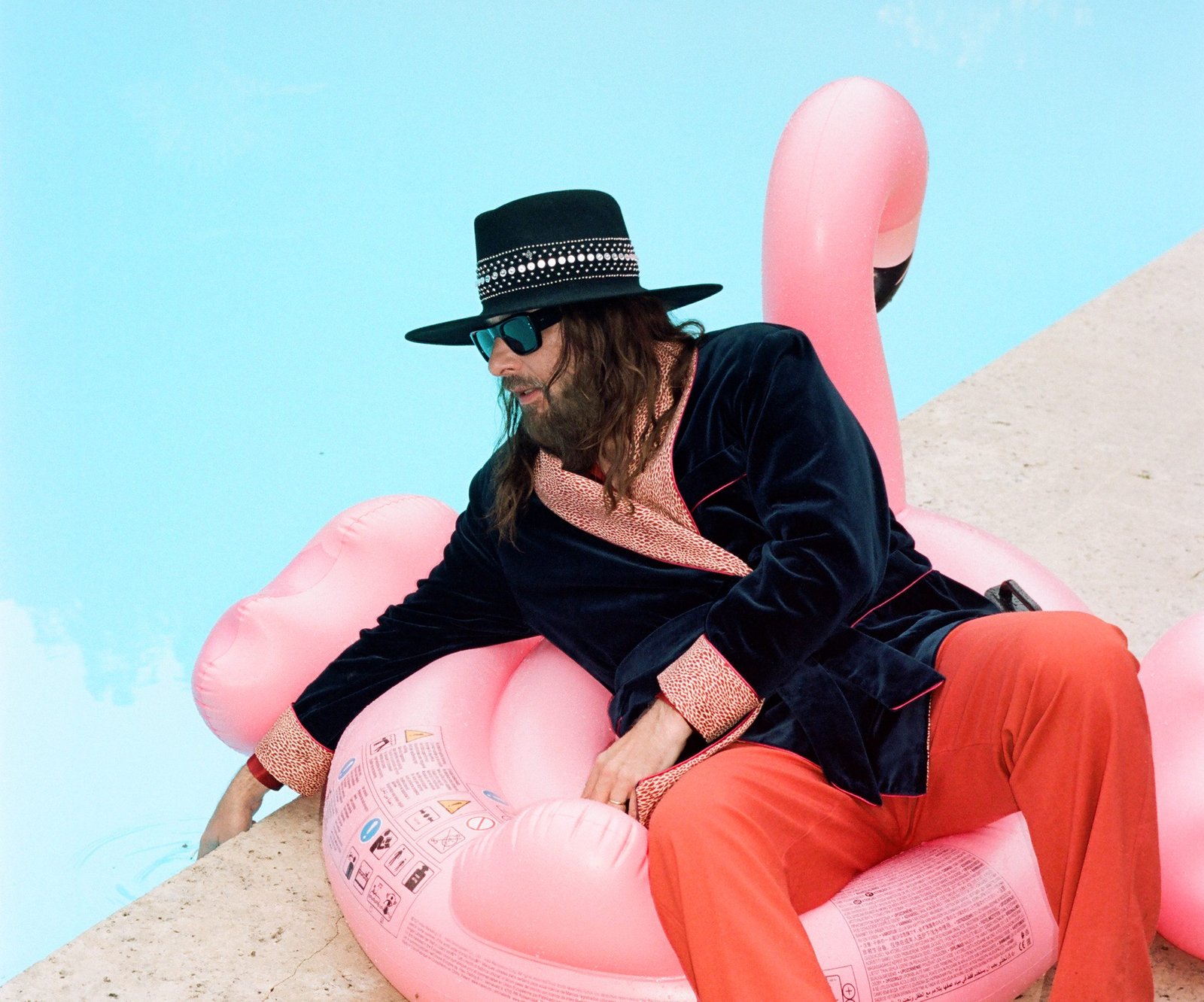
In conversation, Tellier is refreshingly low-key. He talks about how much he loves flowers – which fill his home – and describes himself as “sensitive”. Tenderness, or candyof his approach can be found in his music, but it is clothed in a kind of aestheticized masculinity. In most articles about the French musician, the adjective “louche” is inevitably dropped, as is a reference to the infamous musician/baggina Serge Gainsbourg, in the face of antecedent vibes. French magazine of pop culture Les Inrocks called Tellier”the singer with the legendary beard.” In a slip, Tellier called his album “Kiss the Bitch”.

Tellier clearly plays with his image. As a fan of Salvador Dalí, he rightly likes to exaggerate his personality – sometimes, in ways that might seem questionable. His 2012 video for “City of Pigs it’s full of naked bodies and violence against women, but it’s framed as a cult cosplay. of cover for “Sexuality” features a small man riding a donkey about to ride the torso of a larger-than-life nude woman, like something Terry Gilliam may have been dreaming. Pitchfork once described Tellier as exuding “a particularly retro kind of theatrical laziness distilled from early VHS-era porn.”
Show toys with this. In fact, his look was exhibited in January in Paris, where he appeared in Perrotin as a museum. (Something is in the air with the musicians in the gallery. Elsewhere in the Marais, his associate on the track “Amnesia,” Kid Cudiné Scotty Ramon, has recently shown painting in Ruttkowski;68.) The Perrotin show was a kind of eye-catching marketing extravaganza at the beginning of “Kiss the Beast”, a mix of huge guitars and stylized photo shoots created in collaboration with the French artist. Xavier VeilhanTellier’s old friend.
Tellier’s relationship with the art world is closely related to Veilhan, with whom he first collaborated 20 years ago. “I went to his studio with my keyboard and composed the film’s music in front of him,” he recalls. They worked together on the French pavilion at the Venice Biennale in 2017, which was imagined as a recording-sculpture studio; Tellier was one of the performers invited to do a one-off performance for the audience. Down the line, Veilhan became his son’s godfather, and Tellier owns several works of art by his friend. Tellier also collects works by the Hungarian-French artist op Victor Vasarely. “I’m a bit of a collector,” he sneers. “I miss the big bucks.”
In today’s world, it seems like embracing the wild side or “kissing the beast” is an attitude now widespread and often with alarming effect. At least Tellier’s opinion is a reassuring point of view.
More Cultural Interviews



