
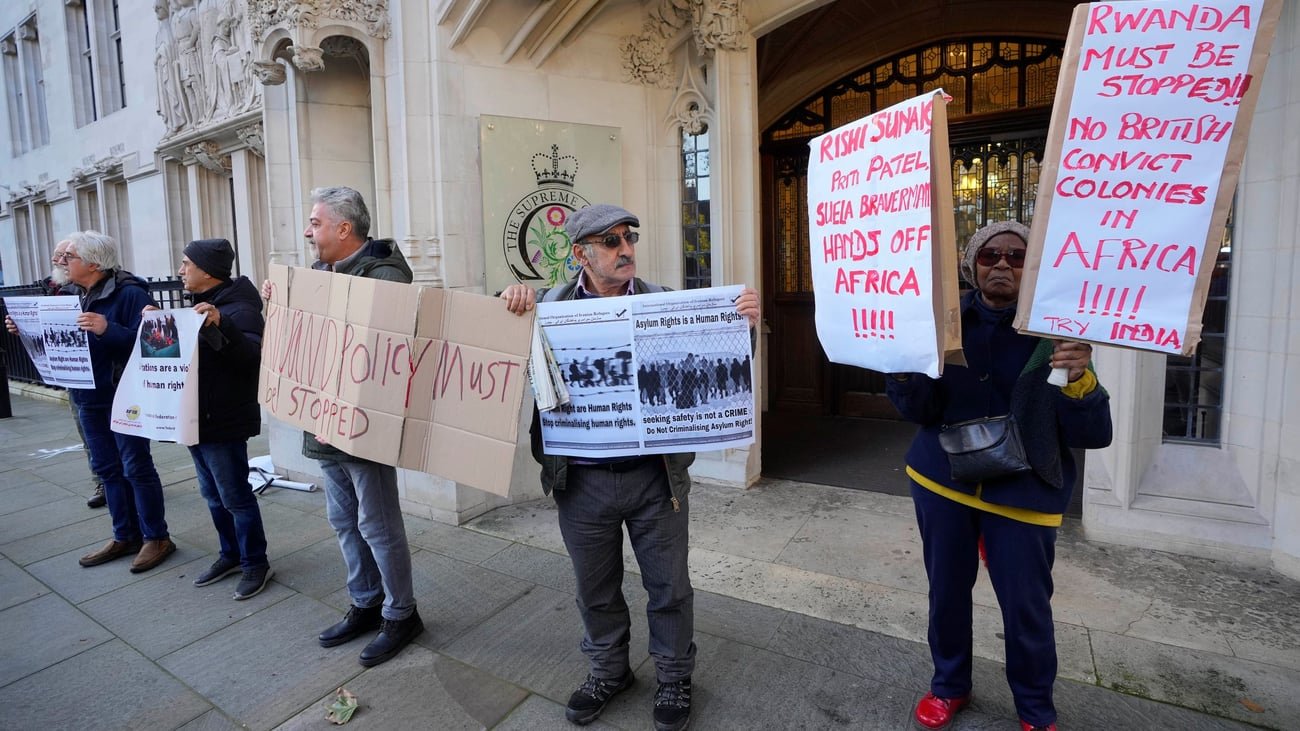

In 2022, the United Kingdom signed an agreement to send migrants arriving in small boats or trucks to Rwanda. But the country’s Supreme Court eventually struck down the scheme as illegal.
THE HAGUE, Netherlands (AFP) – Britain and Rwanda crossed swords at an international court on Wednesday, with Kigali seeking more than 100 million pounds (about $133 million) it says London still owes from a scrapped migrant deportation deal.
Officials from the two countries clashed at the Permanent Court of Arbitration in The Hague, established in 1899 to settle contractual disputes between nations.
Representing Rwanda, Justice Minister Emmanuel Ugirashebuja said his country “regretted” having to take Britain to court to recover “considerable sums of money that Rwanda has been deprived of”.
“However, the UK’s non-compliance … has left Rwanda with no other option to protect its rights,” Ugirashebuja told the three-judge panel.
The two countries are already at loggerheads after Britain cut aid to Rwanda, accusing it of supporting the M23 rebels in the Democratic Republic of Congo.
In 2022, then-prime minister Boris Johnson signed a deal with Kigali to send migrants arriving in Britain via “dangerous or illegal journeys” in small boats or trucks to Rwanda.
But the scheme hit legal and political hurdles from the start, with the UK’s High Court eventually ruling it illegal.
When Keir Starmer became prime minister in July 2024, he declared the plan “dead and buried” on his first full day in office, dismissing it as a “fraud”.
The then Home Secretary Yvette Cooper called it “the most appalling waste of taxpayers’ money I have ever seen”.
In the two years before the scheme was cancelled, only four people went to Rwanda, according to the current UK government, all voluntarily.
According to the UK government’s website, around £290 million has already been paid to Rwanda, but Kigali argued in its submissions before the PCA hearing that two annual payments of £50 million were still outstanding.
“The UK’s termination (of the agreement) does not alter the UK’s obligation to pay any amounts that were already due and payable,” Rwanda said in its 37-page case.
‘Rightfully upset’
Rwanda is also claiming an extra £6 million, after it says the UK breached a reciprocal agreement to host its “most vulnerable refugees”, mostly fleeing the war in Congo.
He put the cost of housing these individuals at £6 million.
Finally, Rwanda asked the judges to order Britain to formally apologize for violating the agreement.
“Rwanda considers that it was wrong for the United Kingdom to withdraw from its obligations … simply because its domestic political assessment of the ease of the agreement had changed,” its statement said. “Rwanda is rightly upset by the UK’s behavior and apologises.”
Britain’s response points to “obvious weaknesses” in Rwanda’s legal argument, adding: “Rwanda cannot really seek to justify any alleged legal rights through these claims.”
London claimed Rwanda’s “real motivation” was a response to Britain’s decision last year to suspend most financial aid because of Kigali’s support for the M23 group’s offensive in Congo.
On the same day this was announced, according to Britain’s submission, Rwanda suddenly reneged on its agreement to waive future payments from the migrant deal.
Officials from Rwanda presented their case on Wednesday, with British lawyers responding on Thursday. Both sides brief Friday.
The PCA is likely to take several months to issue its decision.
“The timing of the Rwanda v UK case is clearly deliberate, as the country draws increasing criticism for its support for the M23,” said Phil Clark, a professor of international politics at SOAS University of London who specializes in conflict and post-conflict issues.
“Rwanda wants to tap the international community in the foot and remind its global partners of its immense value in the areas of migration and peacekeeping that matter so much to the UK and the EU,” Clark said.
–
By Richard CARTER Agence France-Presse
Subscribe to our free newsletters
Our weekly newsletter Closing arguments provides the latest on ongoing trials, major litigation and decisions in courts around the US and the world, while monthly Under the lights feeds legal dirt from Hollywood, sports, Big Tech and the arts.



