
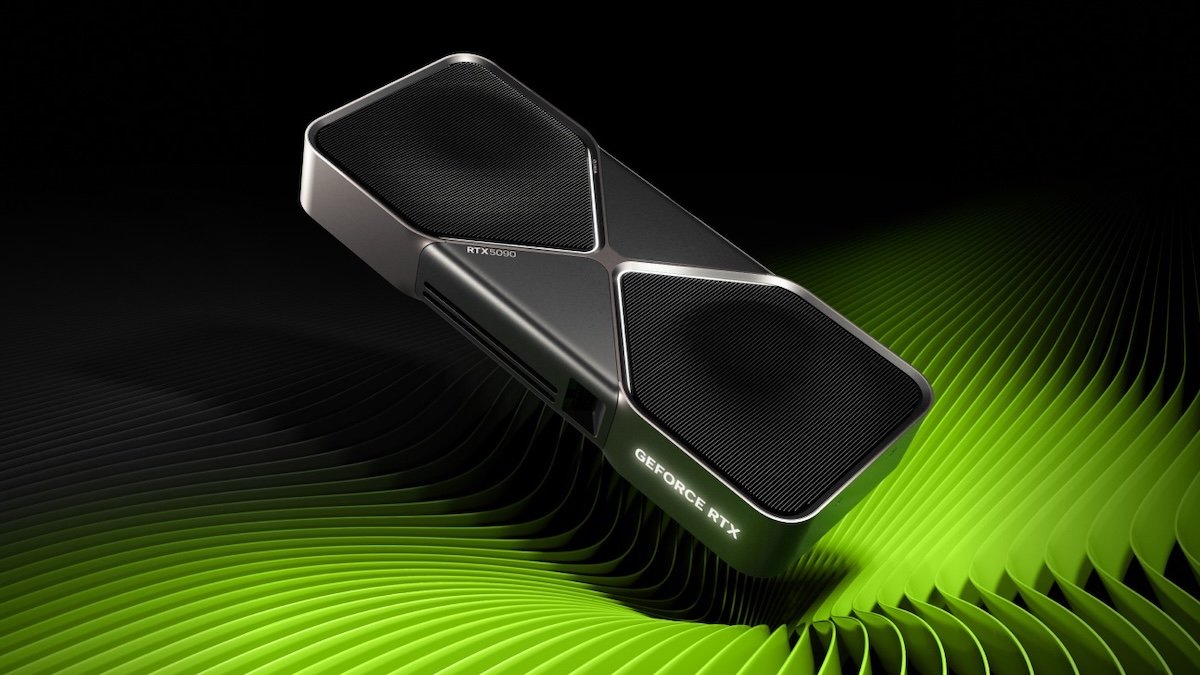

Chinese online gamers and hobbyist artificial intelligence (AI) developers have been hampered after Beijing banned the import of Nvidia’s GeForce RTX 5090D V2, a graphics card designed specifically for the Chinese market in compliance with United States export rules, dealing another blow to the country’s tech community already caught in escalating war tensions.
The RTX 5090D V2 was added to Beijing’s list of banned goods during last week’s summit between US President Donald Trump and Chinese President Xi Jinping, according to a Financial Times. REPORT. Built on Nvidia’s Blackwell architecture, the chip was released for sale in the Chinese market last August.
Beijing’s ban adds to broader pressure on Nvidia in China, where the government has asked local tech firms to prioritize domestic chips over Nvidia’s H200 and H20 AI offerings. Analysts say the H200 alone represents more than $14 billion in potential annual revenue for the US chipmaker.
The ban came as a surprise because the last-minute inclusion of Nvidia Chief Executive Jensen Huang in US President Donald Trump’s May 13-15 delegation to China had fueled market expectations that he could secure Beijing’s approval to sell H200 chips in the country.
During the Trump-Xi summit in Beijing, US Treasury Secretary Scott Bessent said Washington and Beijing had opened talks on deploying AI “defensive arms”, with both sides seeking to prevent the most advanced AI models from falling into the hands of criminal or terrorist groups, keeping the door open for continued technological development.
Bessent said the US was comfortable engaging in such discussions because it held a commanding lead in AI technology over China. He added that delegations from the two countries were expected to begin formal consultations on how the two superpowers could agree on common security protocols without hindering the growth of the industry.
According to US Trade Representative Jamieson Greer, the chip export controls He did are not evident in the Trump-Xi talks.
“That was not a major topic of discussion in the bilateral meeting. We did not talk about chip export controls in the meeting,” Greer told media last week, adding that US chief executives raised their companies’ concerns during the summit.
He stressed that the decision on whether to allow imports of the H200 was ultimately Beijing’s.
As Washington waited for the chip wars to de-escalate, China further tightened its grip. Chinese customs began blocking imports of the RTX 5090D V2 on May 15, the day Trump’s delegation left Beijing.
Some commentators say the ban affects not only Chinese online gamers, but also hobbyist AI developers who use their graphics cards to run large open-source language models (LLM) at home, such as Meta’s Llama series, Google’s Gemma and China’s DeepSeek.
“Although the RTX 5090D V2 appears to be a gaming graphics card, its actual uses go far beyond that.” writes a columnist for Kdnet.net, a newspaper based in Hainan. “Because access to Nvidia’s most powerful AI graphics processing units (GPUs) has been limited, many Chinese AI developers have used the RTX 5090D V2 to leverage the computing power of Nvidia’s Blackwell architecture for AI training and inference tasks.”
“In other words, banning this card is tantamount to cutting off a back channel that allowed indirect access to Blackwell computing power by bypassing export controls,” he says. “What’s unfolding points in a clear direction. The US is using export controls to pressure China, while China has decided it no longer wants even reduced versions of foreign chips, turning to domestic alternatives.”
He said the episode marked a new phase in the US-China chip competition, although where it would eventually lead remained to be seen.
Local producers
In October 2022, the Biden administration unveiled a comprehensive set of export controls that banned the sale of Nvidia’s A100 and H100 chips to China. Nvidia responded by launching scaled-down versions, the A800 and H800, tailored for the Chinese market.
In October 2023, Washington tightly rules further, banning the A800 and H800 chips, as well as RTX 4090 graphics cards from being shipped to China. Nvidia again tried to save its position in the market, launching other reduced versions, including H20. Although the Trump administration had once banned H20 exports to China in 2025, it later gave the green light to exports of H20 and H200 chips.
But then, Beijing MOVED Chinese tech firms will prioritize domestic chips, such as Huawei’s Ascend 910B, resulting in zero imports of H200 chips to date.
A similar pattern plays out in the graphics card segment.
When Nvidia launched the RTX 5090 in January 2025, it planned a scaled-down version, the RTX 5090D, for China, but Washington blocked that shipment as well. A further scaled-down iteration, the RTX 5090D V2, eventually went on sale in China last August. Now Beijing has banned that version as well, leaving greater market opportunities for domestic manufacturers such as Lisuan Technology, Moore Threads and Biren Technology.
A columnist based in Henan who writes under the pen name “Renjian Siliang” says most online gamers wouldn’t notice a difference between the RTX 5090 and its scaled-down version when running games at 4K resolution, as Nvidia reduced only a few non-core features. However, he says that if the reduced card is used for 8K gaming or handling large volumes of three-dimensional images, its performance becomes unstable.
He adds that the difference would also be noticeable when hobbyists use the reduced card for small-scale AI training and inference at home.
Meanwhile, some observers are doubtful whether the RTX 5090D V2 ban will push Chinese consumers towards local graphics cards.
In fact, Chinese consumers can still buy and install Nvidia’s RTX 5080, which falls outside the scope of US export controls against China. The media reports said The RTX 5090 runs 30% to 68% faster than the RTX 5080, but the latter remains several times faster than the best Chinese graphics card.
Lisuan Technology has recently GOING LX 7G100, which is said to be equivalent to Nvidia’s RTX 4080, a last-generation graphics card.
Read: Trump-Xi summit puts US exports, Iran at center of reset bid
Follow Jeff Pao at X at @jeffpao3



