
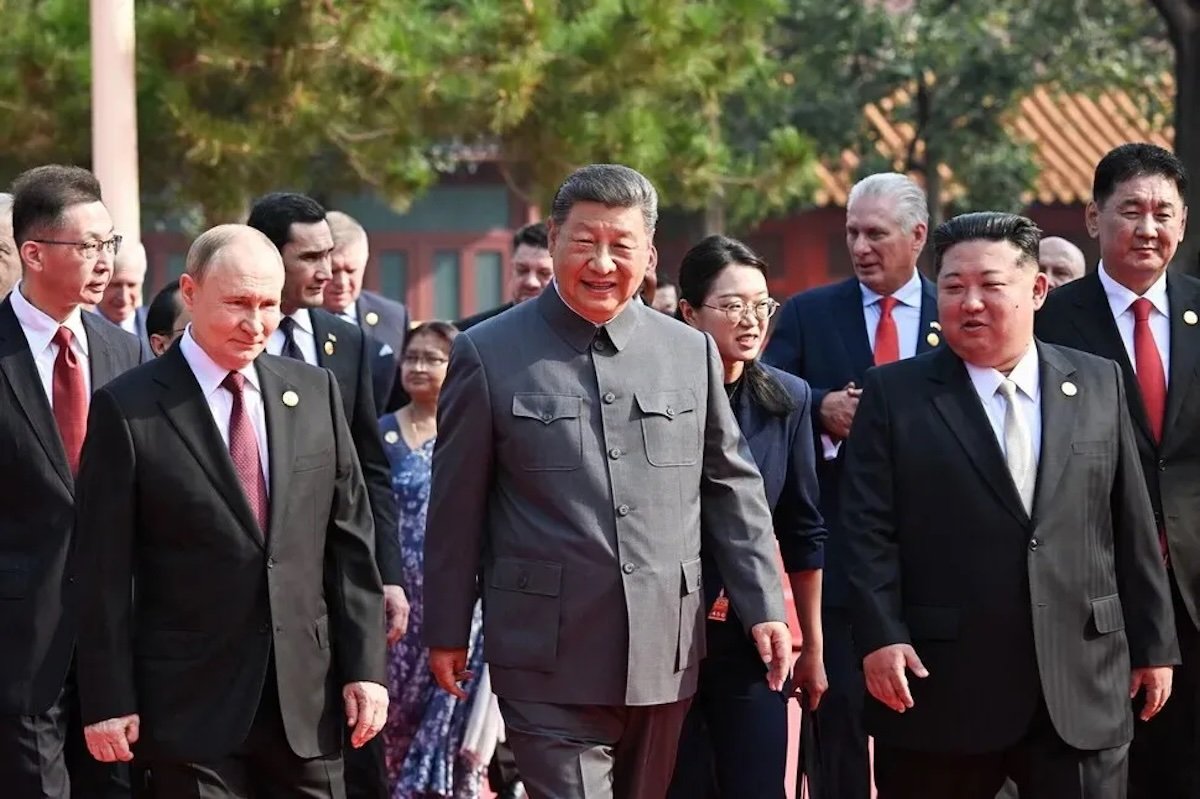

The Trump-Xi summit in Beijing may have predicted calm at the leadership level, but it should not be confused with strategic convergence. Whatever one makes of the new language of “constructive strategic stability,” the underlying reality is one of limited rivalry, not cooperation. This distinction is very important when it comes to North Korea.
The Trump administration’s China policy increasingly resembles limited strategic competition rather than unlimited confrontation. This is not appeasement in the Cold War sense. It is a transactional effort to reduce the immediate risks of conflict while maintaining long-term competitiveness in military power, advanced technology, and geopolitical influence. Both Washington and Beijing appear intent on buying time.
For Xi Jinping, such stability serves a clear purpose. It aligns with China’s broader strategy of economic resilience, technological advancement and continued military modernization under the 15th Five-Year Plan. It also reinforces Beijing’s preferred global narrative: China as the responsible stabilizer, America as the disruptive military power.
Xi’s nominal endorsement of freedom of navigation through the Strait of Hormuz fits nicely into this story, but without any corresponding commitment to use China’s influence with Iran to restore maritime security. Tehran seems to understand this dynamic well. Iran’s appointment of a senior hardline political figure as a special envoy to Beijing suggests not faith in Chinese crisis diplomacy, but recognition that China offers political cover, economic leverage and diplomatic legitimacy without pressure or meaningful conditions.
Ceremony, however, is not strategy. Summit atmospheres have a short lifespan when not accompanied by concrete agreements.
Even if Washington and Beijing maintain a temporary trade truce or moderate tensions over technology and security issues, structural competition remains intact. The administration’s actions elsewhere suggest as much. From efforts to limit China’s turf in Panama and the Western Hemisphere to resource competition in Greenland, the broader race continues unabated.
Indeed, armed interdependence has become the defining operating system of US-China relations. Semiconductors, rare earths, supply chains and AI infrastructure are no longer just economic concerns. They are instruments of national power and strategic coercion.
Mutual dependence no longer provides; creates vulnerability. The governance of AI may be discussed diplomatically, but beneath the rhetoric both powers increasingly see AI as a crucial source of military advantage and geopolitical leverage.
Nowhere is the strategic divide more evident than in Taiwan.
If the summit showed anything, it’s that Beijing sees Taiwan not as a secondary irritant but as the central test of US-China relations and perhaps the clearest measure of whether America’s alliances still mean what they say. This is precisely why hopes for greater US-China cooperation in North Korea remain unrealistic.
Taiwan and Korea have long been linked in the logic of US credibility and Asian balance of power politics. The issue that divides Washington and Beijing is not fundamentally trade or diplomatic rhetoric. It is the future distribution of power in Asia.
Strategic ambiguity has helped keep the peace for decades by deterring both Chinese aggression and Taiwan’s unilateral moves toward formal independence. But the latest signals have brought uncertainty.
Trump’s criticism of Taiwan, calls for greater burden sharing and suggestions that arms sales could serve as negotiating leverage may be intended as tactical posturing, but allies hear something else: shaky commitment. Prevention depends not only on skills, but also on confidence. The tactical calm today may simply reflect Beijing’s decision to buy time by expanding its influence for a future move.
The same logic applies to North Korea.
Leader-level de-escalation between Washington and Beijing does not translate into strategic alignment on the Korean Peninsula because their interests differ fundamentally. Avoiding war can be a common goal. Advancing each other’s strategic interests is not.
China will not hand over North Korea to Washington.
Beijing may prefer stability on the peninsula, but its deepest priority is limiting American strategic advantage. The era when denuclearization served as a common diplomatic slogan has faded. For Beijing, North Korea increasingly functions less as a proliferation challenge than as a geopolitical buffer and a potential source of leverage against the United States and its allies.
This does not mean that diplomacy with Pyongyang is impossible. President Trump may seek renewed summit diplomacy with Kim Jong Un. But expectations about China’s role must be disciplined. At most, Beijing can support tactical crisis management to prevent war or regime collapse. It is unlikely to put significant pressure on Pyongyang in ways that strengthen US influence, weaken North Korea’s strategic utility, or advance true denuclearization.
Nor would Kim turn to diplomacy out of weakness.
Today’s Kim Jong Un is not the leader Trump met in 2018. He now operates with greater nuclear confidence, stronger constitutional legitimacy, Russian political and military support, and a clearer long-term dynastic vision.
North Korea seeks recognition as a permanent nuclear-weapon state while simultaneously strengthening its nuclear and conventional military capabilities, helped in part by Moscow’s wartime dependence on North Korean munitions and manpower.
The strategic environment has changed.
The emerging order in Asia is not one of reconciliation but of managed rivalry—stability without trust, deterrence without resolution, and diplomacy without convergence. This is precisely why strengthening the US-ROK alliance and trilateral cooperation with Japan remain imperative. Not because diplomacy has failed, but because diplomacy now unfolds in a much more dangerous strategic landscape.
Dr. Patrick M. Cronin is Chair of Asia-Pacific Security at the Hudson Institute and Fellow and Fellow at Carnegie Mellon University’s Carnegie Mellon Institute for Strategy and Technology (CMIST).



