

The Supreme Court of India, on May 11, 2026, hearing a petition related to the Pipavav port in Gujarat, said: “Show us even a single project in this country where these so-called environmental activists have said that we welcome this project.”
The statement struck a chord with many citizens, scholars, community leaders, and environmental and social justice advocates across the country. Such criticism is not new, but that it came from India’s highest court, rejecting their decades of work in a country that is witnessing the world’s worst environmental crime, was shocking. Moreover, if you think about it, every city, town and village in the country today has stories that disprove this charge.
In Bengaluru, for example, had it not been for local communities, waste workers, citizen groups and environmental activists who approached the courts repeatedly over the years, the IT/IT city would have drowned in its own waste. If even a small percentage of the city separates waste today, it is because these ordinary people did what they were supposed to do under the Constitution.
Article 51A(g) of the Constitution of India states that it is the fundamental duty of every citizen “to protect and improve the natural environment, including forests, lakes, rivers and wildlife, and to have compassion for living creatures”. Furthermore, the Supreme Court has linked this duty to the right to a clean environment under Article 21, asserting that environmental protection is essential to the right to life.
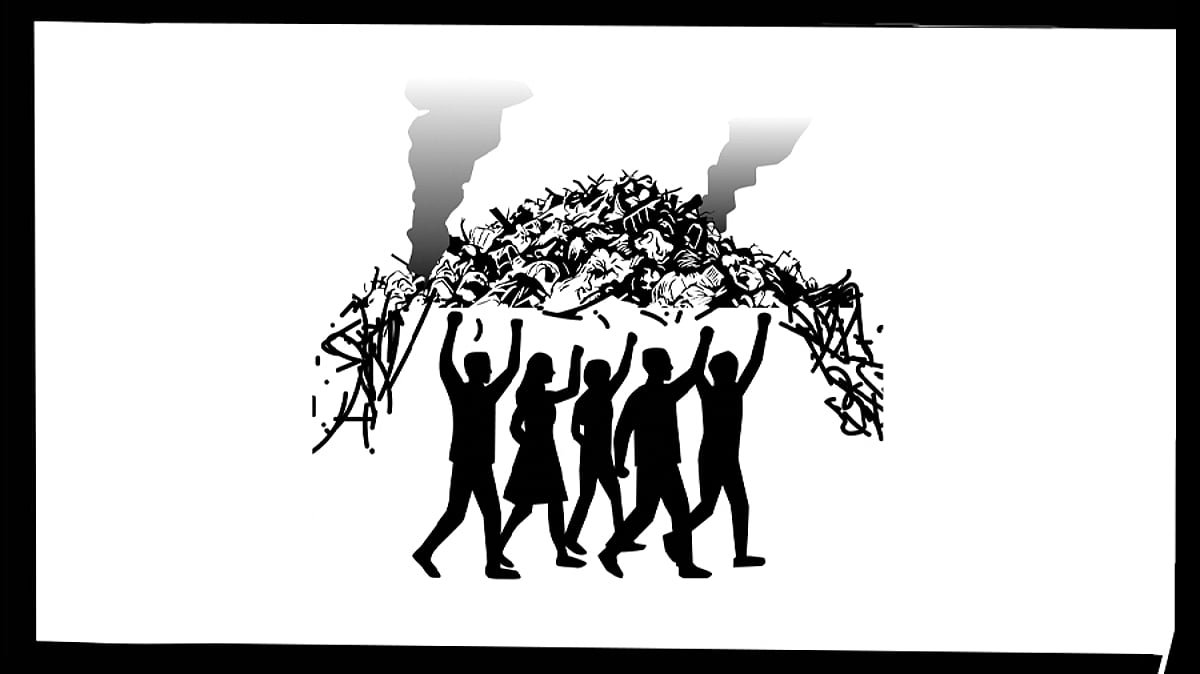
The film Waste and the City, made by Teepoi films, captures this and is certainly not about people opposing development. Around 2012, Bengaluru was facing a serious crisis as the local communities in Mavallipura, having borne the brunt of the landfill menace since the early 2000s, refused to accept any more city waste being dumped illegally and unscientifically in their village. The mountains of mixed waste that were dumped resulted in unbearable stench, contaminated groundwater, gastrointestinal and respiratory diseases, cancer and kidney failure. The destruction of agro-pastoral lands had destroyed their lives and livelihoods. Garbage fires became common. Furthermore, the city’s waste system is clearly collapsing.
It was environmental groups, researchers and affected villagers who brought these cases to courtrooms through public interest litigation. They questioned why a fast-growing global city could not manage its waste responsibly. They challenged the indiscriminate dumping of mixed waste. The Karnataka High Court, which heard the case for more than a decade, looked into the problem, systematically issued interim injunctions and eventually directed the city to source segregation and adopt decentralized waste management systems. The now well-known “Two bins and a bag” framework emerged through these interventions and sustained citizen pressure.
Today, when families separate wet and dry waste, when apartments discuss composting, when dry waste collection centers operate across the city, or when conversations about circular economies appear in policy spaces, or when bio-mining of legacy waste has begun in places such as the Mavallipura landfill, we are witnessing the results of human-led struggles that can be referred to as the “now”. Without these interventions, the garbage crisis in Bengaluru would likely have escalated further into a public health disaster. The framing of people who raise valid questions about environmental issues as enemies of development is deeply troubling.
Local communities in India have often stepped in precisely where governance systems have failed. They have raised issues long before the institutions accepted them. They have recorded critical information much earlier than any academic institution. Their lived experiences have often far outweighed the scientific evidence as well. Were those who raised these concerns anti-development? Or were they among the few who questioned the insatiable development based on consumption and kept a mirror in the city of technology?
This differentiation is important. Contemporary public discourse reduces development to highways, airports, ports, industrial corridors and urbanization. Any logical question of these is called a deadlock. It is important to unpack the word “development” and ask whether it means clean air, water, land, food and good health, access to education, health care, mobility and democratic participation for all.
A dangerous trick
The questions raised by the people are, in fact, based only on the environmental principles often emphasized by the Supreme Court. Especially those of the principle of prevention, the principle of equality between generations, the principle of natural justice, and others.
Stories of environmental litigation from around the country have often strengthened democracy itself. Many landmark decisions in use today emerged when citizens turned to the courts after administrative systems collapsed. Courts have always been the last beacon of hope when all else has failed. This is particularly important in a country like India, where at-risk communities often bear the heaviest environmental burden. Landfills, for example, are rarely located within cities except in elite, upper-class, and high-caste neighborhoods.
The history of waste in Bengaluru is very intertwined. It wasn’t just about landfills; it was about the burden of peri-urban communities, segregation, recycling, public health, the plight of sewer workers and more. People sought processes that reduced ecological damage and created a just and equitable society. Never the language of ‘anti-development’.
The climate crisis has already made life in the subcontinent extremely difficult. By weakening environmental laws and painting questioners as obstructionists, we are walking a dangerous path.
Bengaluru’s story highlights the importance of people asking. They refused to accept the endless toss. Citizens gathered and organized. Communities protested. Environmentalists researched. The lawyers argued. Garbage workers have mobilized. And the courts intervened. This is not against development. This is how courts are expected to function in a constitutional democracy. Listening to citizens when institutions fail, and protecting the rights of the most vulnerable.
(The writer is an independent researcher and educator)
(Disclaimer: The views expressed above are the author’s own. They do not necessarily reflect the views of DH.)



