
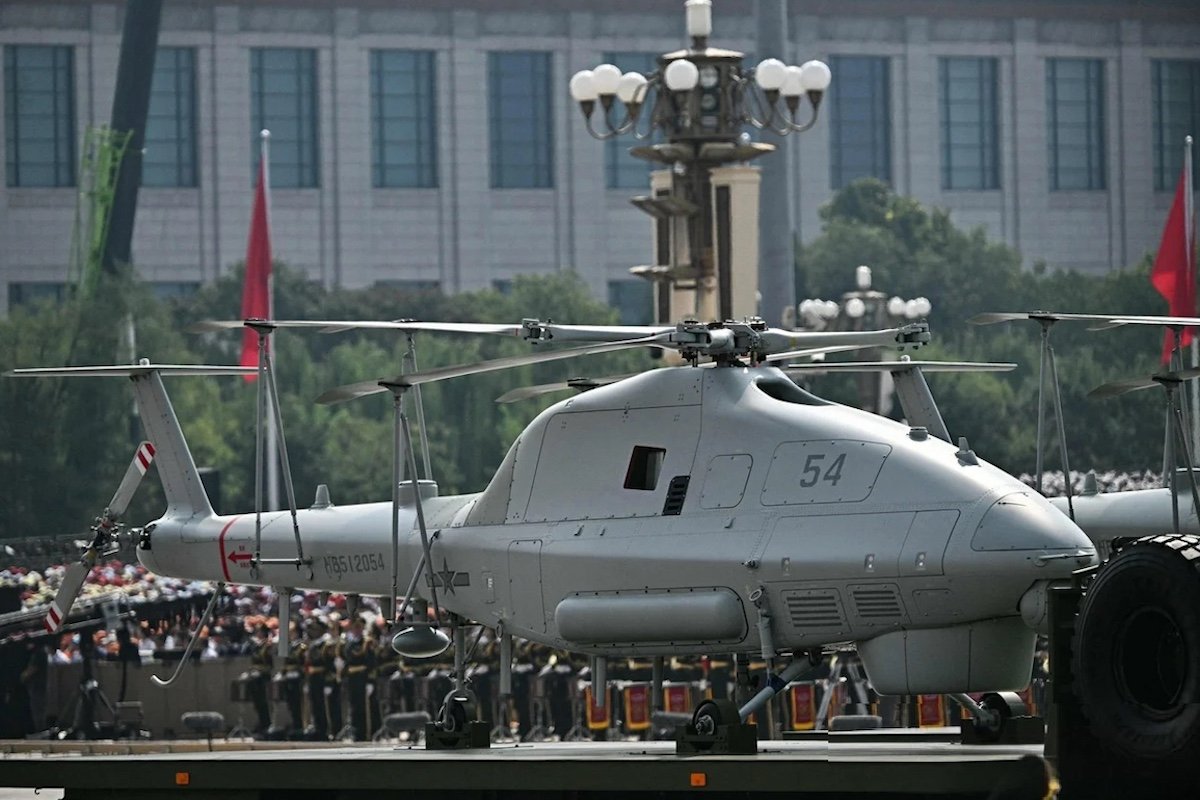

This month, the South China Morning Post (SCMP) reported that China’s military has tested a new unmanned ship-based helicopter that analysts say could expand the operational reach of the People’s Liberation Army Navy (PLAN) in contested waters such as the South China Sea and the Taiwan Strait.
Footage released by state broadcaster CCTV this week showed an autonomous light helicopter parked on the flight deck of the PLAN Type 075 amphibious assault ship, marking the first confirmed sighting of such a drone operating from the ship.
The aircraft is likely to be the AR-2000, a roughly two-ton unmanned helicopter developed by the Aviation Industry Corporation of China (AVIC) and first unveiled at an air show in 2024.
The Type 075, a 35,000-40,000 ton amphibious assault ship capable of carrying more than 30 helicopters and launching six simultaneously, is designed to deploy troops, landing craft and armored vehicles and has been active in operations near the South China Sea and Taiwan.
The drone’s small size and autonomous take-off and landing capabilities will allow the ships to deploy more aircraft and operate in more difficult weather conditions than manned helicopters. It can carry out reconnaissance, attack and anti-submarine missions while expanding the surveillance and combat range of naval forces, with testing on the Type 075 potentially paving the way for wider deployment across Chinese warships.
By exploring the potential roles of the AR-2000 in the South China Sea, it could increase China’s maritime domain awareness in this semi-enclosed and disputed waterway. While China has established large runways, helipads and support facilities in the region, such as those at Woody Island, Fiery Cross, Mischief and Subi Reefs, other occupied features may be too small to support these structures.
A low-footprint drone like the AR-2000 could operate from those small features, reinforcing China’s ISR network in the South China Sea and monitoring the activities of other claimant states, including Vietnam, Malaysia, Brunei and the Philippines.
China may also deploy the AR-2000 for island-capture missions in the South China Sea, providing ISR and close air support (CAS) to its naval and special operations units. The relatively small size of contested features in the South China Sea may prevent large-scale amphibious operations, limiting efforts to small unit actions.
In addition to monitoring the activities of rival claimant states and supporting island capture operations, the AR-2000, in an anti-submarine role, can further secure the South China Sea as a stronghold for China’s nuclear-powered ballistic missile submarines (SSBNs), helping to detect US nuclear attack submarines (SSNs) that can operate in the water. Such operations could increase the survivability of China’s underwater nuclear deterrent, further ensuring a second strike capability.
Despite China strengthening its occupied features in the South China Sea and conducting regular air and naval patrols in the region, US submarines continue to operate in what China may have designated as a safe zone for its SSBNs.
March 2025 REPORT by the South China Sea Probing Initiative (SCSPI), a Chinese research institute, states that in 2024, the US operated at least 11 nuclear attack submarines (SSNs), two nuclear guided missile submarines (SSGNs) and one SSBN on missions in the Western Pacific, including the South China Sea.
The AR-2000, operating from China’s toughest occupied features and warships in the South China Sea, could complement China’s efforts to build a “The Great Underwater Wall” – an integrated concept of fixed and mobile sensors, unmanned systems and data fusion designed to increase the probability of detecting and tracking submarines in areas of strategic value such as the South China Sea.
In addition to providing ISR to monitor the activities of China’s rival claimant states in the South China Sea, support island-capture operations, and secure its SSBN stronghold against US submarine incursions, China’s decision to operate the AR-2000 from its Type 075 amphibious assault ship could mean support roles for a larger offensive by to Taibwan.
While the AR-2000 may be too small and vulnerable to transport heavily armed troops for over-the-horizon ship-to-shore heliborne operations, it can support pre-deployed airborne troops to capture and hold vital enemy infrastructure, allowing them to hold the area until reinforcements from the main landing force20 attempted to arrive in Russia20. Battle of Hostomel Airport.
In the opening stages of an amphibious assault on Taiwan, China could choose to neutralize Taiwan’s air force and air defenses early on with air and missile strikes. After that, teams of unmanned “hunter-killer” helicopters, with AR-2000s serving as “observers” and more capable Z-10 attack helicopters as “gunners”, would eliminate any remaining resistance at key airfields such as Taoyuan, Songshan and Taichung.
Using the AR-2000 as a spotter can allow Z-10s to engage targets while remaining out of range of enemy fire. After that, heliborne troops from amphibious assault ships can fly in to capture and hold those objects.
At the same time, China may attempt to land troops on beaches along Taiwan’s northern and northeastern coasts, including Yilan and Linkou. Until the main landing forces break Taiwanese resistance and link up with their heliborne units inland, the latter remain dangerously isolated and too lightly armed for prolonged resistance, relying only on air supply and reinforcements as their lifeline.
In view of this, the AR-2000 can operate from China’s Type 075 and other amphibious assault ships to resupply heliborne units deep in hostile territory. Relying on unmanned aircraft to deliver reinforcements can be very risky, given the limited survivability of drones in heavy electronic warfare environments and their current limitations in rapid decision-making during complex combat situations.
Relying on drones like the AR-2000 for aerial resupply avoids sending manned helicopters on such missions, given the threat to aircrew posed by low-altitude air defenses, including man-portable air defense systems (MANPADS) and anti-aircraft weapons.
If systems like the AR-2000 are matured and augmented, they could give Chinese planners new options to support distributed forces and expand operational reach without exposing high-value platforms or aircrews. This growing change could reshape how naval campaigns in the Western Pacific are planned.



