
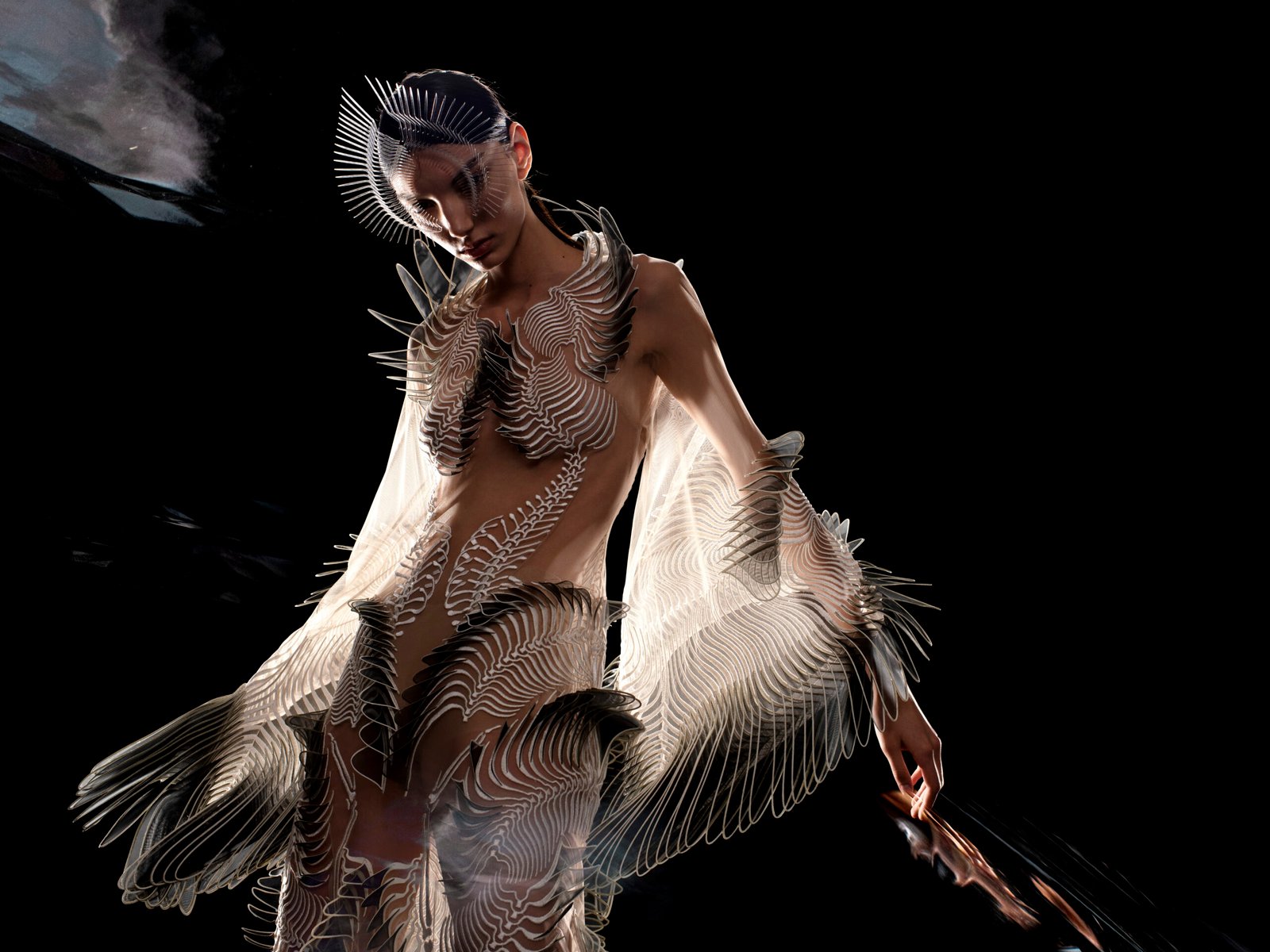


Spend enough time at a fashion show and you start to hear a special kind of conversation. “I’d wear that,” someone says. Or, just as often, “How can you sit in something like that?” These remarks are not accidental. They reveal fashion’s unique ability to draw audiences into dialogue – about the body, about taste and about the objects themselves. Everyone wears clothes; everyone has an opinion. This shared familiarity helps in part to explain the enduring appeal of fashion exhibitions. But it also shows something more compelling. At their best, these exhibitions are not simply about glamour, celebrity or beauty. They are spaces where ideas are tested – about materials, about the body, about technology, and about what “nature” even means today.
What visitors bring with them matters. They arrive shaped by knowledge and experience, but also with something more intuitive—a kind of primordial understanding of the world. For example, across cultures and centuries, people have seen gold and associated it with the sun. In a world before scientific reason, it was believed that gold formed where the sun’s rays and
A museum does something that a runway, store or magazine cannot: it slows down fashion. It creates the conditions for sustained inquiry – for attention – and for establishing “the look” in relation to other systems: design, history and STEAM (Science, Technology, Engineering, Arts and Mathematics). In that slowed down space, little insights can take hold. The museum inherits fashion the moment it loses its living body. On the runway, the clothes move – they are animated by the gestures, by the presence, by the energy of the model. In the gallery, that body disappears. However, what replaces it is not lack, but opportunity: the opportunity to build new contexts, new relationships, and new ways of seeing.

in “Iris van Herpen: Sculpting the senses” (Brooklyn Museum, opening May 16, 2026), this change becomes particularly vivid. At the center of the exhibition is the Alchemical Atelier, a museum-scale evocation of the designer’s studio in Amsterdam. Walls lined with material samples, microscopes that reveal hidden structures, sketches and process videos of experiments draw visitors into a fabrication technique. Craftolution, a newly commissioned installation that magnifies the smallest gestures of of fashion – the joining of materials, the intricacy of embellishment – into something immersive, almost architectural, what is usually invisible becomes a kind of monumental display.
While van Herpen’s work is often associated with advanced technologies – 3D printing, laser cutting, synthetic fabrication – what appears here is not a break from tradition, but rather its continuation. Her work moves fluidly through fashion, biology, digital design and engineering. It asks us to see the body differently: not as fixed, but as dynamic, porous and evolving.
Van Herpen’s fascination with natural forms—the trees and waterways of her childhood in Wamel, insects, cellular structures—doesn’t feel distant or abstract; it feels lived. When placed in dialogue with scientific models and specimens, her work expands beyond fashion into a broader inquiry: how we come to understand life itself – through memory, intuition and learned knowledge alike.
We all have those moments when an image or a sound turns a switch in the mind. Museums quietly curate such encounters. Creating an exhibition like Sculpting the Senses is not just assembling objects. It is to build relationships and introduce moods, to choreograph a passage through handwork and machine, microscopic structures and cosmic forms, and natural phenomena and manufactured materials.

At the Brooklyn Museum, this approach has precedent. The 2012 installation “Connecting Cultures: A World in Brooklyn” brought works from across the museum’s collection into dialogue, encouraging visitors to draw transhistorical and transcultural connections. More recently, Solid Gold, marking the museum’s 200th anniversary, extended this logic, bringing fashion into dialogue with the collection to illuminate new constellations in time, material and meaning. The structure of Sculpting the Senses reflects this way of thinking. Moving through 11 thematic sections, the exhibition progresses like a journey, tracing a path from hidden biological architectures to speculative skins of the future.
What matters is not just what is told, but how it unfolds—how one encounter leads to another, how meaning accumulates. Only information rarely becomes memory. Emotion does. in “Christian Dior: Designer of Dreams” (2021-22), what many visitors remember is not a single look, but a feeling: the progression in space, the crescendo of colors, the mirrored room of infinity, the last hall of dresses hanging in light and sound. The exhibition built towards an experience that lasts long after visitors leave.

Not all experiences now described as “immersive” are created equal. The term has been extended to include everything from museum exhibits to commercial projections that replace objects with images. Museums work differently. Their authority—and their responsibility—lies in working with real objects that occupy space and hold history. In an age shaped by screens, the museum offers something increasingly rare: time, space and dimensionality. What appears on a screen is flat. Fashion is not. The clothes are sculptural. They must be encountered in the round, understood through movement, proximity and presence.
Fashion shows are often underrated. At their best, however, they do more than display what is being worn. They expand the way we see by connecting the intimate scale of the body with larger systems of knowledge, from the microscopic to the cosmic. In doing so, they remind us that what we wear is never just the surface. It is a way of thinking about oneself in the world.
More expert knowledge



