
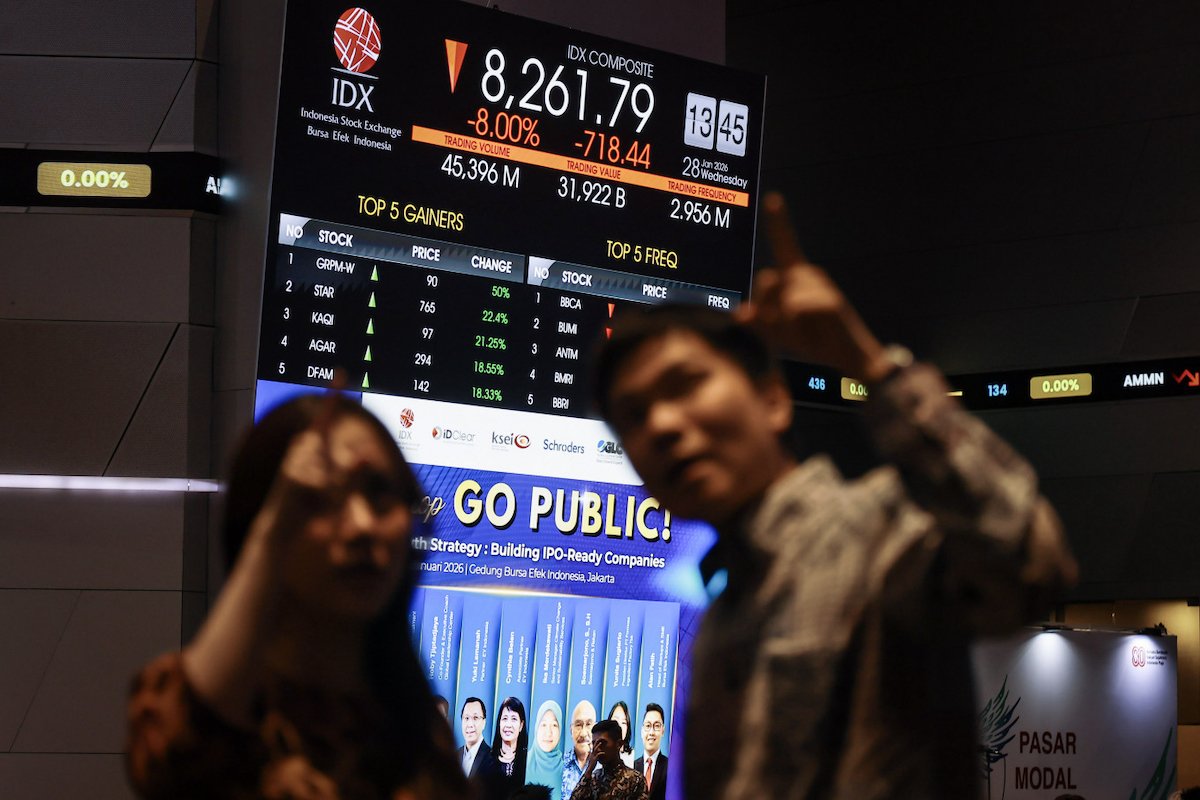

When a private index provider understands a country’s governance gaps better than its regulators, something structurally important has already happened. Indonesia faced that reality on May 13, when MSCI announced the removal of 18 stocks and adding none. The Financial Services Authority had expected two or three write-offs.
The actual result was triple that of the large-cap segment alone. Passive output ratings have been revised upward to $2.5 billion. The gap between Jakarta’s reform narrative and MSCI’s verdict is history itself.
The exit number is the obvious symptom. The structural problem goes deeper. Barito Renewables Energy’s controlling shareholders own 97.31% of the company. Its free public float is 2.69%. Dian Swastatika Sentosa’s figures are similar: 95.76% internally held, 4.24% freely traded.
That means price discovery—the mechanism by which markets gather information and signal value—was working on a portion of the company’s stock. A market that cannot price an asset cannot allocate capital to it efficiently.
MSCI’s High Stock Concentration Framework addresses just that. Applying it to Indonesian stocks this week is not so much a punishment as a diagnosis. It is also a model that the rest of Asia has already navigated. The precedents are instructive – and, on balance, encouraging.
MSCI first included Indian stocks in 1994. India’s weighting in the Emerging Markets Index was 0.3% at that time, with only 15 companies qualified. The real turning point came in 2020, when MSCI switched to a free floating adjusted methodology. Indian regulators had spent the previous decade creating the conditions for that change. Securities and Exchange Board of India simplified KYC norms.
It introduced T+1 settlement – making India the fastest settling capital market in the world. It tightened disclosure requirements and expanded the framework for foreign portfolio investors. By September 2024, India had overtook China as the largest country weight in the MSCI Emerging Markets Investable Market Indexapproximately 19%.
Global pension funds now treat India as a mandatory allocation. This result was not achieved in a single cycle, but was built by treating each MSCI signal as a specific and actionable summary.
Saudi Arabia moved faster. MSCI added Tadawul to its watch list in June 2017. The kingdom was upgraded from Standalone to Emerging Market status by June 2018 — the fastest such advance in the index’s history. The Capital Markets Authority increased foreign ownership limits. It streamlined QFI registration, introduced securities lending and short selling, and aligned governance rules with international standards.
The result was $18 billion in foreign portfolio capital inflows during the year of inclusion alone. MSCI did not cause Vision 2030. But its methodology gave Vision 2030 a ranking logic and a measurable external benchmark that purely domestic policy could not have provided.
Japan and South Korea complete the regional picture. of Tokyo Stock Exchange Directive 2023 above cost of capital compressed the share of Prime Market companies trading below book value from 50% to 27%. Average ROE increased from 8.4% to 9%. Over 90% of Prime Market firms unveiled capital efficiency plans until early 2026.
of South Korea Corporate Value Enhancement Program has produced a 130% gain in the High Value Index since 2024. Neither reform was driven by domestic consensus alone. Both were accelerated by the cost of underperformance of the equity benchmarks used by index-tracking funds.
The economic logic behind these results was rigorously documented long before the current cycle. Geert Bekaert at Columbia Business School and Campbell Harvey at Duke founded them basic work for the liberalization of the stock marketthat opening emerging markets to global capital lowers the cost of capital by approximately 80 to 100 basis points.
A follow-up study by Christian Lundblad showed that stock market liberalization is associated with an increase in annual real GDP growth of approximately one percentage point over the subsequent five years.
These are not marginal effects. Sustained one-point growth, compounded over a decade, is transformative for any developing economy. The mechanism identified by Bekaert and Harvey is straightforward.
Foreign capital requires verifiable transparency. Domestic firms raise standards to enter it. Regulators observe competitive asymmetry and follow up. Reform does not come through legislation, but through the cost of exclusion.
This makes the index provider a distinct structural actor. There is no diplomatic mandate to defend. There is no bilateral relationship that can be negotiated. It does not answer to any local electorate. Its methodology is public. His decisions are based on disclosed criteria.
Therefore, the pressure it generates is precise and difficult to divert through channels that normally absorb regulatory pressure. This is not a commentary on MSCI’s intentions – it is a description of institutional mechanics.
Indonesia has already moved. Free floating demand increased from 7.5% to 15%. The threshold for the declaration of major shareholders was reduced from 5% to 1%. A framework of high concentration of shares was introduced along with the central depository of securities. This week’s deletions confirm that these reforms were necessary but not yet sufficient.
The MSCI accessibility review in June will determine whether the framework is accepted as the start of a sustainable program or treated as a reactive measure. This difference is what separated India’s trajectory from Pakistan’s.
Pakistan upgraded to Emerging Market status in 2017. Governance and capital control slippage followed. The status quo reversed in 2021. Index-level losses exceeded 40% in the subsequent 18 months.
Argentina has moved between frontier and developing classifications more than once. Each cycle has been accompanied by currency volatility that produces grading uncertainty. The model is not so much punitive as mechanical. Capital follows the methodology and countries that meet the methodology accumulate capital. Countries that don’t lose it to those that do.
Indonesia enters this point with an advantage that India and Saudi Arabia did not have at comparable times. Its domestic investor base is 26 million accounts. The figure was below five million in 2020. The depth of retail does not eliminate the importance of foreign institutional capital.
But it provides a floor that neither Mumbai in 1994 nor Riyadh in 2017 could rely on. The June review will be consequential. The structural opportunity is clear, the precedents are well understood, and the quantitative case for reform is no longer theoretical.
For Jakarta, the only remaining variables are pace and reliability.
Irvan Maulana is a researcher at the Center for Economic and Social Innovation Studies (CESIS), a think tank based in Jakarta.



