
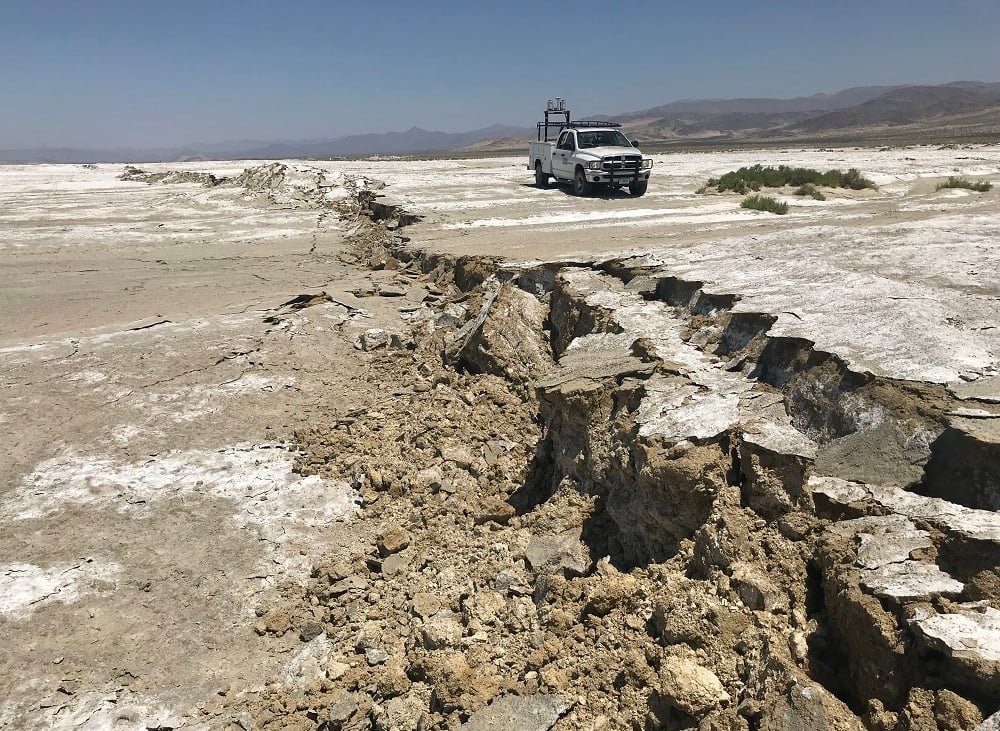

Helium-rich gases rising through hot springs may mark the early stages of continental breakup in southern Africa.
(CN) – Scientists studying geothermal resources in Zambia may have identified the early formation of a new tectonic plate boundary.
In one study published this week in the journal Frontiers in Earth Science, researchers report unusually high helium isotope ratios in geothermal springs along Zambia’s Kafue Rift, evidence they say points to an active continental rift.
The findings suggest that the Southwest African rift zone – a vast network of faults stretching roughly 1,550 miles from Tanzania to Namibia – may be undergoing the first stages of continental breakup. This multi-million year process can separate land masses and create new tectonic plates.
“This is the first time we have geochemical evidence that mantle fluids are reaching the surface in this part of Africa,” study co-author Ruta Karolyte of the University of Oxford said in an email. “If similar signatures are found along other parts of this 2,500 km long zone, the case for an evolving plate boundary becomes very compelling.”
Researchers have long suspected that the Kafue Rift may represent an evolving fault system due to landscape features and elevated geothermal activity. But confirming an active rift required hard evidence such as molten material that had traveled up from the mantle.
To investigate, scientists took gas samples from eight geothermal wells and hot springs across Zambia, including six located within the suspected rift zone.
The team analyzed isotopes, which are chemically identical versions of elements with different atomic masses, to determine where the gases originated. Helium isotopes are particularly useful because mantle-derived helium contains much higher proportions of helium-3 than gases typically found in Earth’s crust or atmosphere.
Samples taken from springs within the Kafue Rift showed helium isotope ratios similar to those measured in the East African Rift System, one of the world’s best-known active continental rifts. Sources outside the rift zone did not exhibit the same signature.
“Hot springs along Zambia’s Kafue Rift have helium isotope signatures that indicate the springs have a direct connection to the Earth’s mantle,” study co-author Mike Daly of the University of Oxford said in a statement.
The researchers also found high levels of carbon dioxide consistent with gases coming from deep mantle fluids. The findings suggest that the rift has broken through the crust enough for mantle material to migrate toward the surface, a hallmark of active tectonic extension.
“A rift can become a plate boundary,” Daly said, although he noted in the statement that many rifts eventually stop developing before the continents completely separate.
However, weaknesses embedded within the ancient crust of the region appear to be favorably related to the stresses generated by the surrounding mid-ocean ridges. This means that the amount of force needed to break the continent could potentially be lower.
The discovery may have economic and geological significance. Early-stage rifts can create more favorable conditions for geothermal energy development. The relatively early stage of the Kafue Rift system may also make those resources easier to access, the researchers said.
However, the researchers caution that this research is only an early glimpse of a massive rift system that stretches widely across southern Africa.
Subscribe to our free newsletters
Our weekly newsletter Closing arguments provides the latest on ongoing trials, major litigation and decisions in courts around the US and the world, while monthly Under the lights feeds legal dirt from Hollywood, sports, Big Tech and the arts.



