
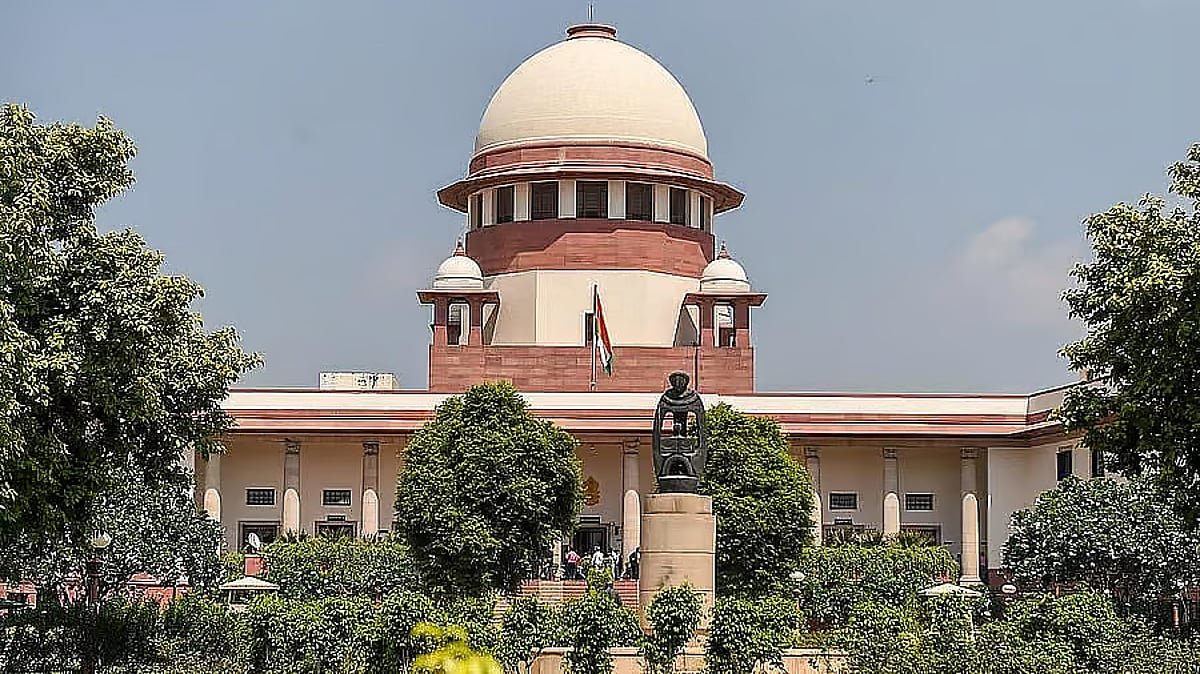

New Delhi: The Supreme Court on Monday asked a petitioner to approach the Center with his plea seeking directions to regulate all institutions imparting religious education or instruction to children below the age of 14 years.
A bench of Justices Dipankar Datta and Satish Chandra Sharma asked the petitioner, Advocate Ashwini Kumar Upadhyay, to make a representation before the Union of India.
“We dispose of this writ petition to Respondent No. 1 (Centre) to consider the petitioner’s representation dated February 4, 2026 and take an appropriate decision thereon. The decision taken will be communicated to the petitioner,” the bench said.
When Upadhyay continued to seek his plea, the panel said: “You are before a bench of judges who are very conservative and traditional. We do not jump the gun.”
The bench further observed, “Justice is not a one-way street. The executive also has a role to play in it.”
The petition, filed through Advocate Ashwani Dubey, had sought directions to “take appropriate steps to register, recognize, supervise and monitor all institutions imparting secular education or religious instruction to children up to the age of 14 years in the spirit of Article 21A read with Article 39(f), 45 and 51-A(k).
The petition stated that Article 30 does not confer any special or additional rights on minorities beyond what is already guaranteed under Article 19(1)(g).
“Direct and declare that Article 30 is a specific reiteration of Article 19(1)(g) and does not confer any additional right, benefit or privilege than the rights guaranteed to citizens under Article 19(1)(g),” the petition said.
“The petitioner is filing a public interest litigation under Article 32 for the registration, recognition, supervision and monitoring of all institutions that provide secular or religious education to children up to 14 years of age in the spirit of Article 21A, 39(f), 45 and 51-A(k).
“The petitioner claims that children are the backbone of the nation’s growth and are also gullible and naive due to their tender age. Therefore, the state has increased its responsibility towards them. This is a matter of national security as young children (who) shape the future of the nation can be brainwashed or manipulated in the unregistered institution,” the statement said.
Upadhyay, in his plea, has claimed that he visited several districts along the Uttar Pradesh border where many unregistered and unknown establishments were allegedly found operating.
He said that unregistered and unknown institutions are spreading throughout the border areas of the country without any effective supervision or regulatory mechanism.



