
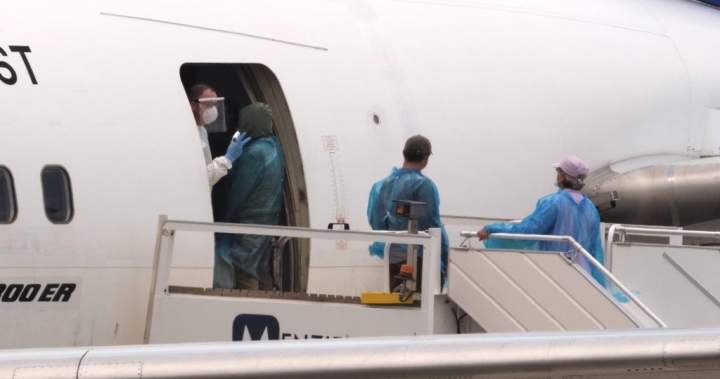

British Columbia’s chief medical officer says the four passengers were returning home from hantavirus– The stricken cruise ship remains in a “critical period”, but stressed that it would not call them “patients” as they are not considered infected.

Henry told reporters they will monitor the four passengers, making sure they are taken care of during the minimum 21-day isolation period.
“We also know that the incubation period of this type of virus can be up to six weeks, so we are really in a critical period,” she said. “We know that the average incubation period is about 15 to 18 days, so we’re still in a period of time where we could see more cases emerge.”
She added that the four people had been exposed to the virus but had not shown symptoms.
“So we treat them as contacts, we hope that none of them are infected and that none of them have the disease,” she said. “But the incubation period, the period between the time you’re exposed and the time you can develop the disease is six weeks, so we have to wait those six weeks to make sure no one has been infected.”
The four individuals were on board the MV Hondius when the outbreak began, with eight cases and three deaths reported from the hantavirus.

Get weekly health news
Get the latest medical news and health information delivered to you every Sunday.
The ship docked in Tenerife, Spain, on Sunday morning and the four BC residents wore protective gear as they climbed the steps of a plane bound for Saguenay-Bagotville Airport, roughly two hours outside of Quebec City.
Global Affairs Canada says they will switch planes for a West Coast flight. Officials declined to identify their destination in B.C
There, Henry said the four Canadians would undergo a health assessment by local public health officials before being transported directly to individual accommodation for them to be isolated.
“At no point do we expect them to be in contact with the public during this arrival process or during their period of isolation,” Henry said.
Oceanwide Expeditions, the ship’s owner, said there were four Canadians among the approximately 130 asymptomatic passengers.
The company says representatives from a number of groups, including the World Health Organization, screened passengers at the port.
According to Henry, the 21-day isolation period goes back to the last possible contact with someone who had the virus, which is believed to be May 6.
After this period ends, local public health officials will reassess the situation on a case-by-case basis and may extend the self-isolation period to a maximum of 42 days in total since the last possible exposure.
If any of the four individuals develop symptoms, Henry said he has detailed plans to be able to safely do evaluations and testing.
She added, if needed, the province has a specialized center to treat the biocontrol unit at Surrey Memorial Hospital that has been used in the past.
“I know they (passengers) are obviously looking forward to getting home to Canada where they can get the care and monitoring they need,” Henry said.
The Canadian Armed Forces are assisting Global Affairs Canada and the Public Health Agency of Canada in the repatriation of the four Canadians, however, their assistance is limited to facilitating the transfer of the four persons on a chartered return flight and their transfer from PHAC to provincial health authorities in BC.
The virus originated in rodents, and the version on the cruise ship – the Andean virus – is the only one known to spread from human to human, although it is not highly contagious.
That is why Henry emphasized that she knows the concerns of people after the COVID-19 pandemic because it cannot be transmitted in the same way.
“It causes infections that are deeper in the lungs, it can cause kidney failure and a variety of other symptoms, and it doesn’t spread as easily through coughing,” Henry said. “You have to, as we’ve found out from people who have been dealing with this virus, and with all hantaviruses, have very close contact with someone who is infected. Although it’s still very rare for it to be transmitted from person to person.”
© 2026 Global News, a division of Corus Entertainment Inc.



