
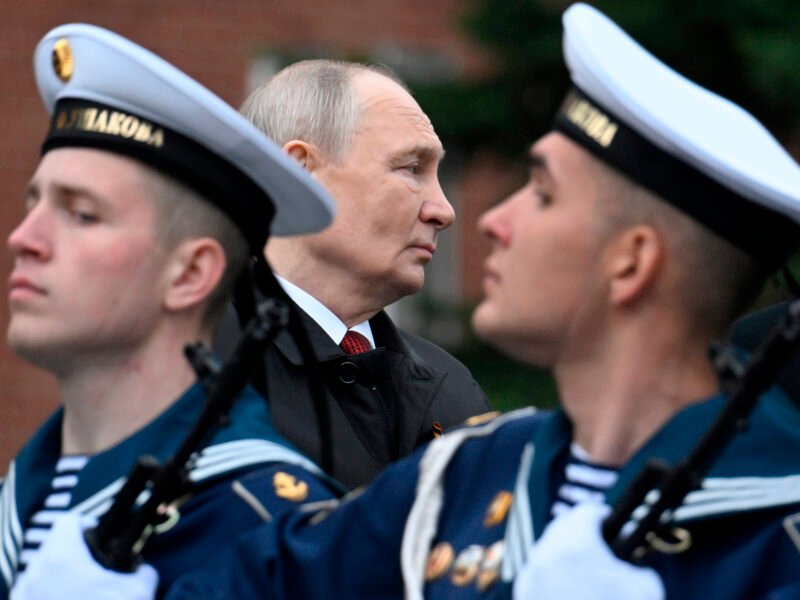

MOSCOW (AP) — Russian President Vladimir Putin on Saturday expressed confidence of victory in Ukraine as he oversaw a military parade in Red Square commemorating the defeat of Nazi Germany in World War II – a display that did not include heavy weapons for the first time in almost two decades.
Security was tight in Moscow as Putin and several foreign leaders attended the parade, which was also reduced to a Three-day ceasefire brokered by the US allayed concerns about possible Ukrainian efforts to disrupt the celebrations.
Putin, in power for more than a quarter of a century, has used Victory Day, Russia’s most important secular holiday, to show off the country’s military might and rally support for his military action in Ukraine, now in its fifth year.
Speaking at the parade, Putin hailed Russian troops fighting in Ukraine, declaring that they are “facing an aggressive force that is armed and supported by the entire NATO bloc” and are fighting for a “just cause”.
“Victory has always been and will be ours,” Putin said, as columns of troops lined Red Square. “The key to success is our moral strength, courage and bravery, unity and our ability to endure anything and overcome any challenge.”
But in a marked change this year, the parade took place without tanks, rockets and other heavy equipment, apart from a traditional flyover of fighter jets.
Officials explained the sudden change in format to the “current operational situation” and said additional security measures have been taken in response to the threat of Ukrainian attacks. Commentators on state television said heavy weaponry was most needed on the battlefield in Ukraine.
For the first time, Saturday’s parade featured troops from North Korea, a tribute to Pyongyang that sent its soldiers to fight alongside Moscow’s forces to repel a Ukrainian incursion into Russia’s Kursk region.
Previous ceasefires failed
Russia declared a unilateral TRUCE for Friday and Saturday, while Ukrainian President Volodymyr Zelenskyy announced a cease-fire that was supposed to begin on May 6, but neither held as the sides traded blame for the ongoing attacks.
US President Donald Trump announced on Friday that Russia and Ukraine have bowed to his demand for a ceasefire from Saturday to Monday and a prisoner exchange, saying the cessation of hostilities could be the “beginning of the end” of the war.
Zelenskyy, who said earlier this week that Russian authorities “fear drones may buzz over Red Square” on May 9, followed up Trump’s statement by issuing a mock decree allowing Russia to hold its Victory Day celebrations on Saturday, declaring Red Square temporarily off limits to Ukrainian strikes.
Kremlin spokesman Dmitry Peskov dismissed Zelenskyy’s decree as a “silly joke.” “We don’t need anyone’s permission to be proud of our Victory Day,” Peskov told reporters.
Victory Day remains a rare point of consensus in Russia
Russia’s largest and best-equipped army has made slow but steady advances along a front line of more than 1,000 kilometers (over 600 miles). Ukraine has responded with increasingly effective long-range strikes, hitting Russian energy facilities, manufacturing plants and military depots. It has developed drones capable of reaching targets over 1,000 kilometers (more than 600 miles) deep in Russia, well beyond its capabilities before 2022.
Russian authorities warned that if Ukraine tried to disrupt Saturday’s celebrations, Russia would launch a “massive missile attack on the center of Kiev”. The Russian Defense Ministry warned the civilian population there and employees of foreign diplomatic missions about the “need to leave the city immediately”. The EU said its diplomats would not leave the Ukrainian capital despite Russian threats.
Putin has used the Victory Day celebrations to encourage national pride and underscore Russia’s position as a global power. The Soviet Union lost 27 million people in 1941-45 in what he calls The Great Patriotic Wara great sacrifice that left a deep scar on the national psyche and remains a rare point of consensus in the nation’s divisive history under communist rule.
“We celebrate it with feelings of pride and love for our country, with an understanding of our common duty to protect the interests and future of our homeland,” Putin said at the parade.
“Our soldiers suffered colossal losses, made a colossal sacrifice in the name of the freedom and dignity of the peoples of Europe, became the embodiment of courage and nobility, courage and humanity, and were crowned with the great glory of a magnificent victory.”
Victory Day parades in Red Square have featured a wide range of heavy weapons – from armored vehicles to nuclear-tipped intercontinental ballistic missiles – every year since 2008. Smaller parades are held elsewhere around the country, but this time many of them have also been destroyed or even canceled altogether for security reasons.
Authorities on Saturday ordered restrictions on all mobile Internet access and text messaging services in the Russian capital, citing the need to ensure public safety. The government has tightened methodically Internet censorship and imposed ever-tighter controls on online activities, causing uproar and rare public expressions of displeasure.
Merz criticizes Fico’s trip to Moscow
King of Malaysia Sultan Ibrahim Iskandar, President of Laos Thongloun Sisoulith, President of Kazakhstan Kassym-Jomart Tokayev, President of Uzbekistan Shavkat Mirziyoyev and authoritarian leader of Belarus Alexander Lukashenko attended the celebrations in the Russian capital.
Prime Minister Robert Fico of Slovakia, a member of the European Union, laid flowers at the Tomb of the Unknown Soldier memorial just outside the Kremlin walls, but stayed away from the Red Square parade. German Chancellor Friedrich Merz criticized Fico’s trip, saying: “I am very sorry for this and we will discuss his visit to Moscow with him.”
Speaking at a meeting with Putin in the Kremlin, Fico complained about what he called a new “Iron Curtain” in Europe that was impeding trade and stressed the importance of Russia’s energy supplies to Slovakia. Putin hailed the Slovak leader for running a “sovereign” foreign policy and honoring the memory of fallen Red Army soldiers.
Subscribe to our free newsletters
Our weekly newsletter Closing arguments provides the latest on ongoing trials, major litigation and decisions in courts around the US and the world, while monthly Under the lights feeds legal dirt from Hollywood, sports, Big Tech and the arts.



