
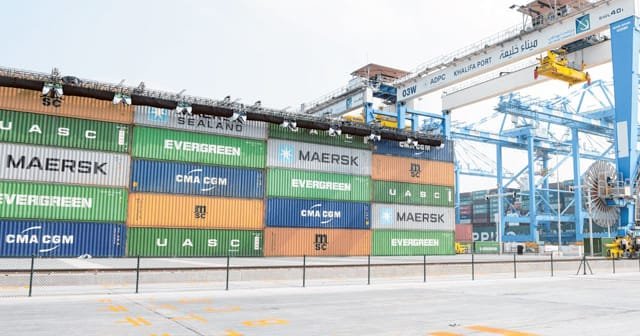

Cargo diversions, overcrowding, gap tracking
With cargo increasingly diverted to ports across the region – including Fujairah, Khor Fakkan and Sohar – cargo clearance is facing hurdles.
Ports are experiencing congestion and delays, while traders are facing limited visibility into shipments due to the involvement of multiple actors in handling cargo across different countries.
“There is a visibility gap and traders are sometimes unable to track where the container is at the moment,” Almuhairi added.
The shift has also increased cross-border trucking, leading to higher ground transportation costs and a shortage of available trucks. Regulatory hurdles across borders and the need to coordinate between multiple customs authorities have added further complexity.
Dubai Customs intervenes with emergency measures
In response, Dubai Customs has taken a number of measures to maintain the flow of goods.
-
Opening a green corridor between the UAE and Oman for the movement of goods
-
Extension of transit time limits from 30 days to 90 days
-
Allowing cargo diversion through multiple ports with revised customs clearance processes
-
Setting up a one-stop shop for traders to resolve issues with stakeholders
-
Conducted over 25 workshops with more than 300 industry participants
Dubai Customs has also coordinated with customs authorities in Oman and other GCC countries to streamline cross-border movement.
“We engaged Sharjah customs, Oman customs … and facilitated the flow of cargo,” Almuhairi said.
According to the government policy, initially the focus was to ensure the smooth flow of import of essential goods such as food and medicine, especially during the peak of the disruption.
Almuhairi added, “The priority of essential goods is to ensure the availability of the required stock in the market.”
He added that these steps helped prevent shortages and ensured that shelves remained stocked despite the delays.
The industry wants clarity on processes
Shipping agents say that while the measures have helped, operational challenges remain – particularly around documentation, container movement and cross-port coordination.
The Dubai Transport Agents Association said members are demanding clearer procedures for transit shipments, the movement of bound cargo and customs documentation.
“Members are asking for more clarity and flexibility around bill of entry changes and cancellations,” Ghaya AlMansoori, general manager of the association.
Limited tracking visibility, delays in handling containers and inconsistent procedures across ports were also noted as key concerns.
Costs rise as delays continue
The disruption also has a direct financial impact on the sector.
Shipping agents highlighted additional costs, including warehousing, breakdown and storage fees, especially when delays are out of their control.
At the same time, congestion at smaller regional ports – which lack the capacity of Jebel Ali – has led to longer waits for ships.
“Just to be allowed to enter a terminal… it will take approximately 10 days,” Almuhairi said, referring to delays caused by overcrowding.
Air transport and road transport are involved
With disruptions affecting sea and air routes, alternative logistics solutions have been put in place.
Cargo has been re-routed through neighboring countries, with road transport connecting to airports in Oman to maintain air cargo connectivity during flight disruptions.
“The other option was to move it by road to… an airport in Oman, where it would depart from there,” Almuhairi said.

Dhanusha is a senior reporter at Gulf News in Dubai, with her finger on the pulse of UAE, regional and global aviation. It takes a deep dive into how airlines and airports operate, expand and embrace the latest technology. Known for her keen eye for detail, Dhanusha makes complex topics like new aircraft, emerging travel trends and aviation regulations easy to understand. Recently, she is particularly fascinated by the world of eVTOL and flying cars. With nearly two decades in journalism, Dhanusha has covered a wide range, from health and education to pandemics, local transport and technology. When she’s not following what’s happening in the sky, she enjoys exploring social media trends, technological innovations, and anything that sparks readers’ curiosity. Outside of work, you’ll find him immersed in electronic dance music, pop culture, movies, and video games.



