
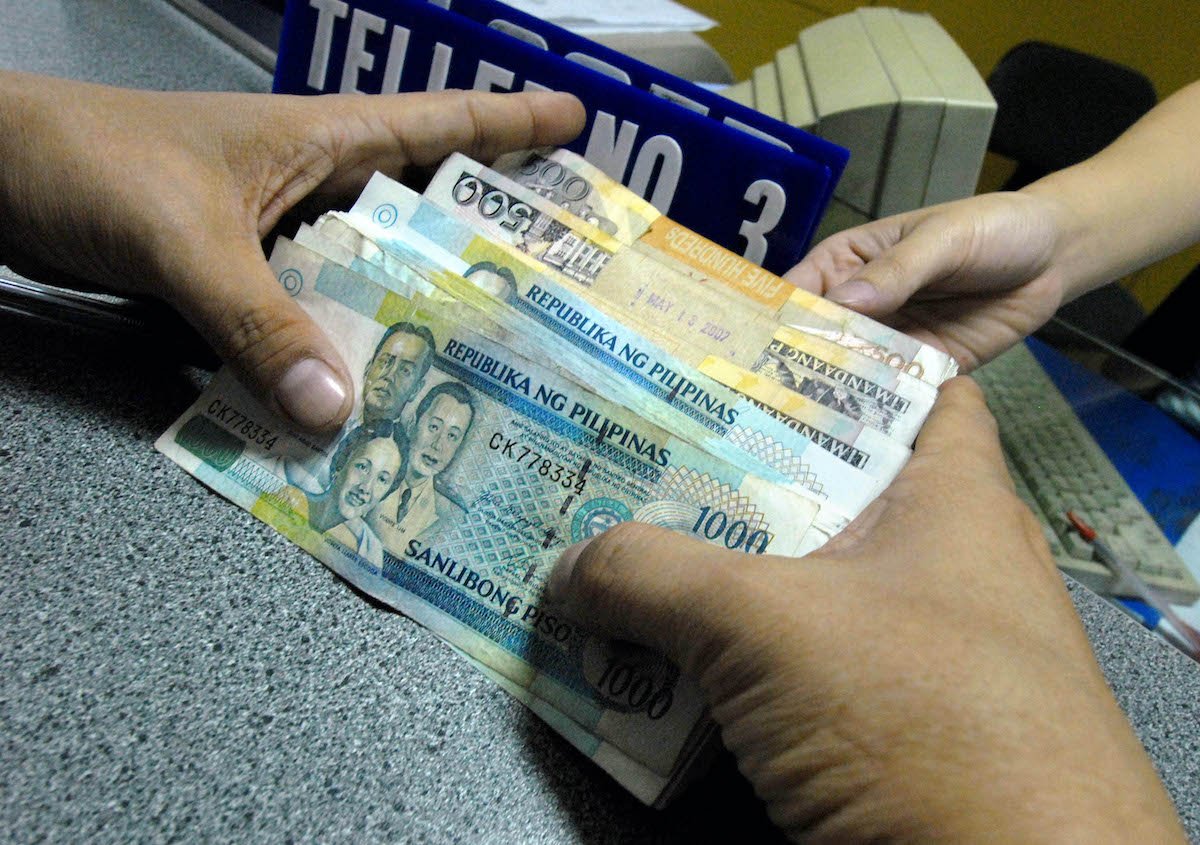

TOKYO – The rise in inflation in the Philippines in April is a serious warning sign – an economic canary in the coal mine that should not be ignored.
The 7.2% year-over-year jump is roughly double the first quarter Growth rate 3.4%. Clearly, the Philippines falling into the stagflation zone was not on President Ferdinand Marcos Jr.’s 2026 Bingo card. The predicament is more than just a sudden wake-up call for officials in Manila. It is a signal of concern for developing Asia.
It is safe to say that the Philippines is the first inflationary domino of the Iran war in Asia to fall. It is the vanguard of the economic trauma to come – trauma that will worsen the longer the Strait of Hormuz remains closed.
What worries economists most is how widespread the price hike is proving to be. From food to transportation to utilities, the scale and breadth of increases mean Philippine inflation is likely to reach 8% in the second quarter. This makes it a virtual deadlock that the Bangko Sentral ng Pilipinas (BSP), the Philippines’ central bank, will raise rates in June.
South Korea looks to be another domino to watch. Today, investors learned that consumer prices rose at the fastest pace in nearly two years amid rising oil prices. The 2.6% year-over-year jump compared to a 2.2% rate in March. This greatly increases the likelihood that the Bank of Korea will raise rates.
However, the Philippines’ challenges are much more acute. It is a reminder of the vulnerabilities facing Southeast Asia, which imports almost all of its oil needs from the Middle East.
“Asian economies rank as the most exposed, including Thailand, Singapore, the Philippines, as well as South Korea and Japan,” says economist Evghenia Sleptsova at Oxford Economics. “These economies have high dependence on imported energy, heavy reliance on Middle Eastern supply routes and limited domestic energy supplies.”
As economist Ronald Goseco, director of the Institute of Financial Executives of the Philippines, writes in a Manila Times op-ed: “The fuel crisis has highlighted our dependence on foreign oil. We have not been able to manage rising fuel prices. We are already seeing the spiraling inflation caused by the oil shock.”
Aris Dacanay, HSBC’s Southeast Asia economist, argues that “the BSP, given its price stability mandate, could raise rates as high as 6%” from 4.5% now.
Not everyone is worried about the Philippines’ trajectory – or that the BSP is woefully behind the curve. “However, we continue to believe that inflation will return to the BSP’s target range next year as this supply-side shock fades out of view,” said Miguel Chanco, an economist at Pantheon Macroeconomics in London.
However, pressure is mounting on the BSP to ensure that inflation expectations are not blown out.
In March, as the Strait of Hormuz was closing and markets were rising with oil and fertilizer costs, Marcos Jr. declared a national power emergency. Elevated oil prices and a weaker Philippine peso are a “double whammy that will double inflation in the coming months, hitting millions of poor Filipino families the hardest,” said the IBON Foundation, an advisory group.
Gabriel Collins, an economist at Rice University’s Baker Institute, notes that “when oil prices rise more than 40% in a few days, the effects are widespread.heat-or-eatDilemmas, in which households face a trade-off between energy expenditure and basic needs. In a developing market like the Philippines, where most people live with little economic cushion, a sharp increase in energy prices can have serious effects.
Serving as a proxy for developing oil-dependent economies, Collins notes, “The Philippines illustrates how the ongoing war in Iran can translate into social, fiscal and political pressures.”
The conflict is proving to be particularly important for the county because it is double the levers of oil. About 30% of the primary energy supply comes from oil, almost all imported.
Its transportation system is almost entirely oil-based. In addition, approx 2.5 million Filipinos work in the Gulf region, earning about $15 billion a year and sending a significant portion of their earnings home as remittances that support families and local economies.
For the Philippines, the stakes are even higher. Like David Dichoso of George Washington University writes in The Diplomat: “The Iran war isn’t just an economic blow to the Philippines—it’s a strategic stress test of the Marcos Jr. administration’s pro-US outreach.”
Julie Chernov Hwang, an economist at the Soufan Center, notes that Asia is experiencing shocks and reverberations in many economic sectors as a result of the US-Israel war against Iran. “The negative spillover effects are evident across the energy, food and labor sectors in South and Southeast Asia,” she says. “The energy crisis is also affecting parts of East Asia.”
Hwang adds that “if necessary TRUCE annul after the failure of the talks in Islamabad, and if Strait of Hormuz remains closed, there is a growing risk that large parts of Asia could face an economic recession. The worst has been the Philippines, which gets 90% of its oil from the Middle East.
It is not clear what Manila can do to protect the economy from these broader risks. Economic Planning Secretary Arsenio Balisacan argues that the government is “intensifying targeted interventions, especially to mitigate rising price pressures on food, energy and FREIGHT. Our priority is to ensure stable fuel supply, manageable prices and adequate protection for all sectors amid ongoing domestic and global challenges.
This is an expensive proposition, complicated by the peso decrease of 4.1%. against the US dollar so far this year. The peso’s fall and the Indian rupee’s decline also speak to how “Asia is facing a bigger price and terms of trade shock than global standards imply,” says Priyanka Kishore, chief economist at Asia Decoded. “The consequences for net energy importers are immediate and pronounced, in the context of weaker external balances. devaluation of currencies and higher inflationary pressures fueling lower real incomes, and ultimately, lower output.”
Altogether, Kishore explains, there is “significant divergence” within the region about how the supply disruption will be felt, how quickly it will be felt and to what degree.
“In our assessment,” she notes, “the risks of physical shortages in the oil and gas complex are highest for the Philippines, Vietnam, India and Thailand in the near future. However, pockets of severe disruption can emerge long before an economy reaches its tipping point – as the cooking gas shortage in India shows, leading to sharp declines in demand even as drag from higher prices materializes simultaneously.
All this has led Asian governments, for better or worse, to explore ways to switch to coal. Both Japan and Korea are considering increasing their idle coal power capacity.
“This,” says Kishore, “may help ease pressure on power generation, but will do little to address shortages of transportation fuels or cooking gas. Moreover, not all economies have the room to make this change. Thailand has limited coal reserve capacity, Singapore none, and room for incremental replacement in ChinaIndia, the Philippines and Vietnam are modest, given the already high share of coal in their energy mix.”
Investors worry that as the Philippines grapples with rising inflation, political wrangling in Manila may be getting in the way. Earlier this week, the House Judiciary Committee found that there is a possible reason for it rap Vice President Sara Duterte.
“There are many complicating factors in terms of how our ability to manage the crisis translates into a broader political narrative,” says Bob Herrera-Lim, managing director at Teneo Holdings.
“We can’t separate these things from what’s going on in the outside world.” And “if Sarah’s impeachment moves forward, does that affect the political calculations around that impeachment?” he asks, noting that political drama can have “material effects” on the economy.
In 2025, the Philippines grew by 4.4%, short of the government’s target of 5.5% to 6.5%. As the Philippines moves away from its 7% to 8% growth aspirations, Team Marcos cannot point the finger at US President Donald Trump’s trade war or imported Chinese deflation. The real culprit is chaotic local politics.
Amid the chaos, it is vital that policymakers in Manila restore households’ collective confidence in the economy, says HSBC’s Dacanay. “They’re not just moving from non-core to core spending,” he notes. “They’re cutting back on spending altogether,” he said, citing survey data showing that more households have set aside savings than before the pandemic.
It is clear that runaway inflation in a war time it won’t help Manila boost confidence. And as the Philippine domino swings in the coming weeks, it may be the first, but not the last, to fall in Asia.
Follow William Pesek on X at @WilliamPesek



