
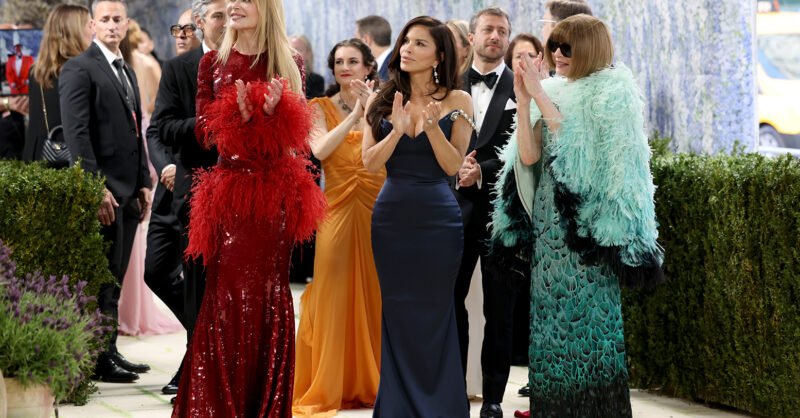

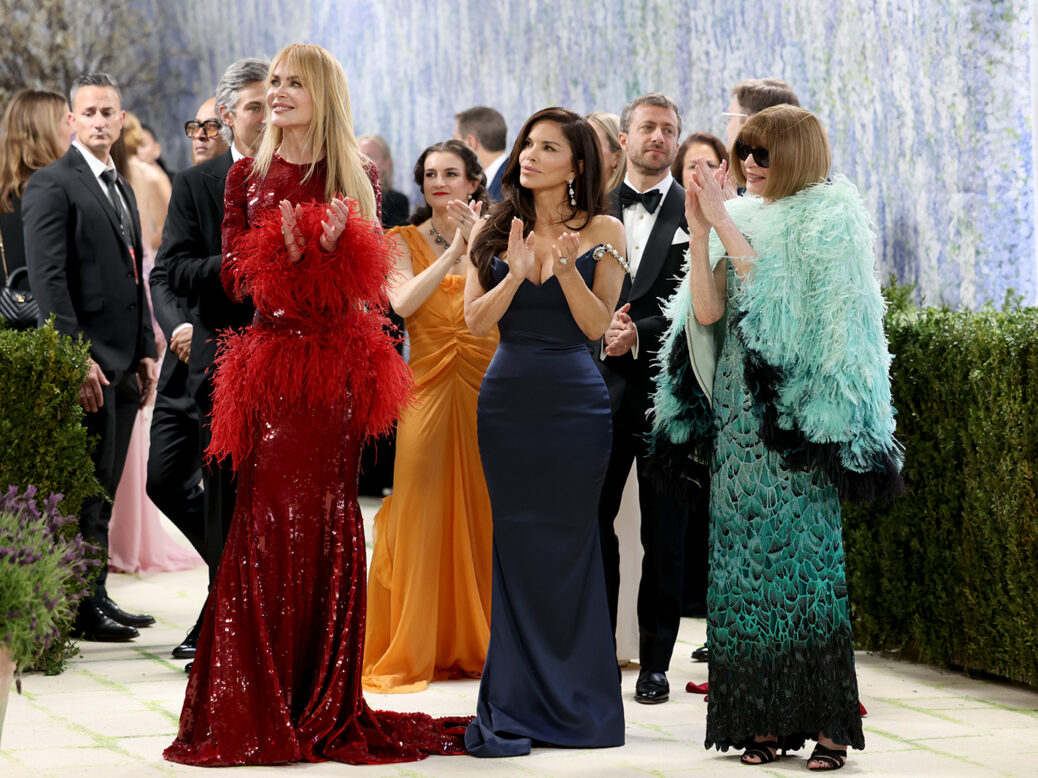
Fashion thrives on spectacle, and few events generate as much spectacle as the Met Gala. Held annually, it is fashion’s most powerful fundraiser, organized by Conde Nast’s global chief content editor, Anna Wintour, for New York’s Metropolitan Museum of Art’s Costume Institute. (Specifically, the gala celebrates the museum’s upcoming spring exhibition.) For those who worship at one of fashion’s most iconic altars, there’s no better way to commemorate the first Monday in May; to its critics, it’s just a big, sleazy party for the rich and famous. On either reading, it is indisputable that the Met Gala is one of the most meaningful ways in which the arts intersect with wealth, visibility, and power on a global stage.
The exhibition of the Institute this year is “The Art of Costumes”; respectively, the Met’s theme was “Fashion is Art.” (Costume for a costume exhibit? Groundbreaking.) In a press release from February, the Met Museum said, “The show will examine the centrality of the clothed body… to illuminate the inextricable connection between clothing and the body (and) the complex interplay between artistic representations of the body and fashion as an embodied art form.” Of all the themes the Met has chosen before, this year’s felt particularly abstract, compared to, for example, 2023’s theme, Karl Lagerfeld: The Line of Beauty.
But it feels especially important in a cultural moment that’s seeing (mostly) female celebrities slimming down fast, really fast. In recent years, the gilded color falsely attributed to celebrities has been exposed as a fragile veneer, and what was once considered aspirational is turning into a concern as bodies continue to get thinner and thinner. Last year’s Met was hailed as the Ozempic Olympics, and celebrities like Whoopi Goldberg, Vera Wang and Lizzo stood out for their much slimmer frames. (Although no one has publicly commented on their weight loss, or the means by which it was achieved.) And it’s a body ideal that’s clearly, strangely, still in vogue, with the ever-leaning figures of Olivia Wilde, Maude Apatow and Nicole Kidman slithering hauntedly across the carpet.
Fashion in general, but especially the avant-garde fashion that the Met is known for encouraging, has long resisted self-expression that feels constrained; designers have often used the body as a site of rebellion against conformity, subverting expectations of how the body should appear. Some of fashion’s most iconic moments emerged from its creators’ need to disrupt or disturb, banish or transform: Alexander McQueen’s 2009 otherworldly show Plato’s Atlantis saw its models resemble sea creatures; Rei Kawakubo’s 1997 collection “Body Meets Dress, Dress Meets Body” presented a radical image of the body through its bulbous, distorted and grotesque silhouettes; the Schiaparelli Haute Couture gown that Bella Hadid wore to the Cannes Film Festival five years ago, which featured a gilded bronze necklace of pulmonary veins of human lungs, transformed her from supermodel to anthropomorphic beauty.

Subscribe to the New Statesman today and save 75%
This disruptive spirit is amplified at the Met. When Princess Diana made her gala debut in 1996, wearing a navy blue Christian Dior gown designed by John Galliano, from which she had removed the corset, she destabilized what was understood to be appropriate attire for a royal; Rihanna sparked conversations about how to display cultural appreciation in 2015 when she wore a yellow dress, accompanied by an extravagant 16-meter train, by Chinese designer Guo Pei in recognition of the theme “China: Through the Looking Glass.” These moments have become iconic, not only because they challenged norms and expectations, but also because they made statements that mattered.
This is what distinguishes the Met from other red carpets, such as the Oscars or the Baftas. While the latter demands some adherence to the social nous, the former insists on rejecting it. Met loves theater, absurdity, camp. As the thread notes, fashion IS art and the body cannot be excluded, as it is the canvas on which aesthetic sensibilities are articulated. But the use of weight loss drugs in Hollywood is now so widespread that the body is becoming more and more purely performative; its natural mechanisms – in this case hunger – are deaf or ignored. Still, the question remains: how much can be expressed in an extremely thin body, a withered frame in a sea of withered frames?
Part of the allure of the Met is seeing the myriad interpretations of a theme; aesthetic diversity that inspires. But in this current climate of ultra-skinny celebrities, not only is the range of bodies that inhabit these garments narrowing, but also the range of statements that can be communicated through them. Fashion’s claim to protect diverse artistic expression is beginning to sound as hollow as the bodies we bear witness to. It is, in the immortal words of the great André Leon Talley, a famine of beauty.
Financially, the Met will endure: the event the Institute offers with the main source of funding for annual exhibitions, publications, acquisitions and operations. Individual tickets for this year’s gala are $100,000 (making it $25,000 more expensive than last year), while tables, which typically seat ten guests, start at $350,000. Last year, the event raised a record $31 million for the Institute. However, its cultural capital is less certain: some found it uncomfortable that this year’s honorary chairs were Jeff Bezos and his wife, Lauren; many celebrities, such as Meryl Streep and Zendaya, did not attend, and Zohran Mamdani, the mayor of New York, broke with tradition by declining his invitation; Regulars see thin figures as a disturbing race to the bottom that few outside of Hollywood want to see. (“It’s like watching women compete to be the thinnest,” observed my friend. “It’s pretty disgusting to watch.”) We’ve never watched the Met to tell us what to wear—it’s too theatrical—but we’ve always watched it for an inspired expression. But if we become increasingly horrified by what we see, will we have no choice but to avoid looking?
(Further reading: I read Russell Brand’s unreadable new book, About My Sins)
Content from our partners



