
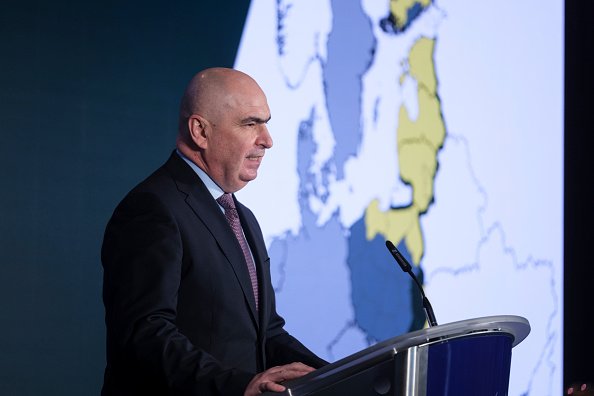

Romania’s parliament will vote on Tuesday on a no-confidence motion that could oust liberal Prime Minister Ilie Bolojan, deepening political turmoil in the country, an EU and NATO member bordering Ukraine.
Romania’s largest party, the Social Democrats (PSD), quit the government last month and joined forces with the far right to table the motion, a move that drew criticism for legitimizing a growing far right.
AUR, Romania’s main far-right party, has outperformed the PSD in polls since the last parliamentary election, by around 37 percent.
By joining forces with the AUR, the PSD has turned it “into an important political player, from a party that was isolated, excluded and kept on the margins of the political system,” said political scientist Costin Ciobanu. AFP.
Tensions with the PSD escalated as Bolojan pushed for unpopular austerity measures to reduce the deficit, the largest in the European Union.
Analysts expect the motion against Bolojan to pass, leading to difficult negotiations to form a new government.
Parliament began debating the motion shortly after 11:00 a.m. (08:00 GMT), with a vote expected in the afternoon.
Signed by 254 MPs when it was tabled, the motion needs 233 votes to pass in the 465-seat parliament.
Pro-EU President Nicusor Dan has given assurances that the Eastern European country of 19 million people will maintain its pro-Western stance, ruling out the possibility of a far-right government.
“Political discussions will be difficult, but it is my responsibility as president – and of the political parties – to lead Romania in the right direction,” he told reporters on Monday.
‘cramp’
Bolojan’s liberals, the PSD and two other pro-EU parties formed a government last year after elections in which the far-right won an unprecedented third of parliamentary seats.
The agreement ended a series of political upheavals, marked by the cancellation of presidential elections over allegations of Russian interference in December 2024.
The no-confidence motion against Bolojan, 57, now threatens to reignite the unrest.
“I think there is a very good chance that this motion will pass,” said political scientist Costin Ciobanu, a researcher at Aarhus University in Denmark.
He added that weeks of political negotiations are likely to follow, which could see a new government of the same four pro-EU parties but with a different prime minister.
“We are seeing this existential angst within the Social Democratic Party,” which “doesn’t know what to do now to get back to where it was,” Ciobanu added.
The alliance between the PSD and the far-right to table the motion also drew criticism from centre-right parties, which accused the Social Democrats of straying from the pro-EU path.
Around 30 NGOs also demanded that the Party of European Socialists suspend the PSD if they cooperate further with the far right, while a PSD senator has resigned from the party in protest.
The PSD has insisted there is “no political agreement behind the movement” with the far right, only “a common goal” to oust the Bolojian government.
Since the outbreak of the crisis, the interest rates at which Romania borrows have risen and the currency has depreciated against the euro, which reached an all-time high of 5.19 Romanian lei on Monday.
Romania, which had a deficit of 7.9 percent of GDP in the fourth quarter of last year, has been subject to an EU excessive deficit procedure since 2020.
(cm)



