
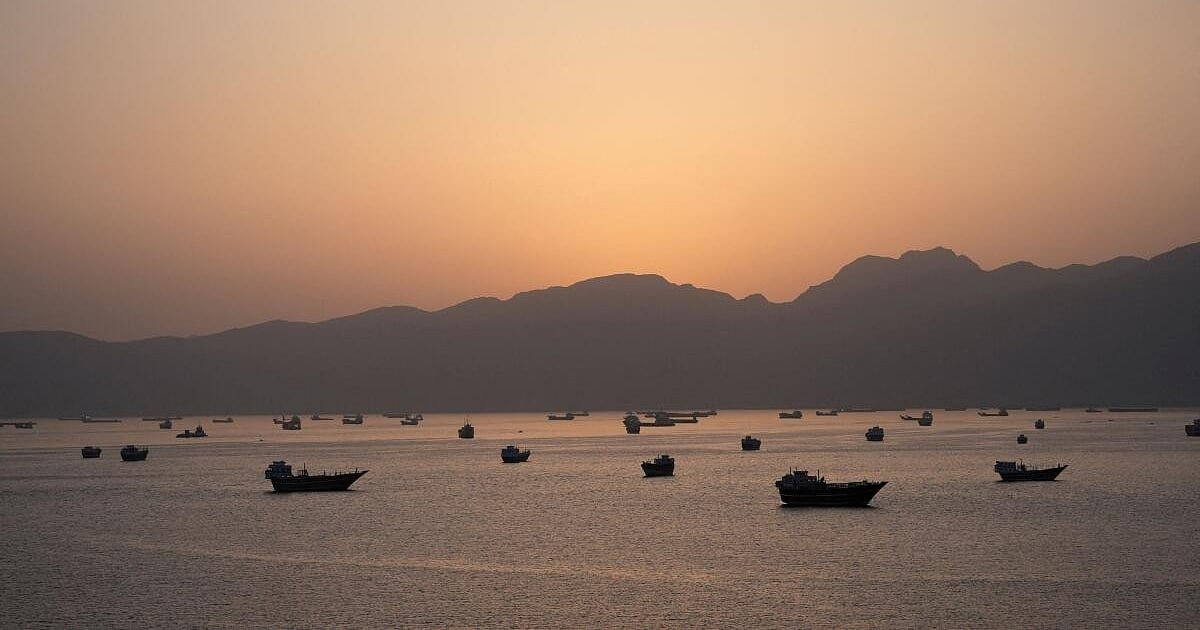

David B Roberts for The Conversation
London: Two months after the Iran war and Strait of Hormuz is still mostly closed. Shipping traffic is developing at a fraction of pre-war levels, with a patchwork of cease-fires, blockades and re-closures since February 28 that have not restored confidence in any tanker’s bridge.
Hormuz has long been understood as one of the main trading points in the world. It typically transports about 20 million barrels of crude oil and petroleum products each day, as well as roughly one-fifth of global liquefied natural gas (LNG) exports.
A third of the world’s helium and a similar amount of urea that ends up as fertilizer also passes through the strait.
Plans and projects to diversify away from Hormuz have been on the drawing boards for decades, and these solutions are now being stress-tested like never before. The bypass infrastructure is doing roughly what the architects had hoped, providing about 3.5 million barrels to 5.5 million barrels per day of gross capacity.
But that’s still nowhere near enough.
The solutions of Hormuz
The most important pipeline on the planet at the moment passes through Saudi Arabia. The East-West pipeline – also known as Petroline – was built in the 1980s during the original tanker war, when Iran and Iraq attacked merchant shipping in the Gulf as part of their wider conflict.
The pipeline’s capacity was expanded to an emergency ceiling of 7 million barrels in 2019. However, loading terminals in the city of Yanbu on Saudi Arabia’s Red Sea coast were never designed to transport so much oil so quickly, and analysts who track tanker traffic estimate that less oil is currently flowing through the pipeline than its theoretical ceiling.
From Yanbu, oil destined for Europe still has to pass through Egypt via the Sumed pipeline, which has a capacity of only 2.5 million barrels per day. Although oil flows through this pipeline have increased by 150 percent since the beginning of the war, its relatively small capacity remains a binding constraint on European supply.
Iran noted the geo-economic importance of Petroline and has targeted it accordingly. An Iranian drone strike on a pumping station in April knocked 700,000 barrels a day offline. Operator Saudi Aramco restored the line to full capacity within three days. While the repair time is reassuring, the fact of the strike is not.
The other half of the Gulf bypass story goes through the United Arab Emirates (UAE). The Abu Dhabi Crude Oil Pipeline (Adcop) runs from Habshan to Fujairah on the Gulf of Oman side of the country. With a capacity of just under 2 million barrels per day, Adcop is the only major bypass that exits the Gulf directly into the Indian Ocean.
But, as with Petroline, it has been targeted during the war. Iranian drone strikes in Fujairah on March 3, 14 and 16 set storage tanks on fire and suspended cargo. While Adcop provides some diversification for the UAE, it does not solve the targeting problem.
The situation is worse for other major oil producers in the Gulf region. Iraq’s 3.4 million barrels per day of pre-war crude exports went almost entirely through the southern port city of Basra and the Strait of Hormuz.
There is a northern pipeline, connecting the Kirkuk oil fields with Ceyhan in Turkey. This pipeline reopened in September 2025 after a two-and-a-half-year shutdown, with flows up to 250,000 barrels per day in March. But that volume pales in comparison to what Iraq has lost.
Kuwait has it even worse. Pre-war crude exports ran at about 2 million barrels per day, with every barrel going through Hormuz. Kuwait has no alternative to the pipeline. Kuwait Oil Corporation declared force majeure in March, allowing it to temporarily suspend its obligations to fulfill distribution contracts.
That was extended on April 20, with the oil company saying it could not meet contractual obligations even if Hormuz reopened. Overcoming the damage that has been done to Kuwait’s manufacturing base – and then ramping up production – will take months.
Qatar’s weakness is a different form. Its pre-war crude exports were smaller than those of its Gulf neighbors, at about 0.6 million bpd. All these exports left Qatar through the strait. For Qatar, history is gas. Its capacity of 77 million tonnes of LNG at Ras Laffan is the largest in the world, supplying around 19 percent of the global LNG trade. There is no alternative for transporting this gas through Hormuz.
Iran itself has built a Hormuz bypass: a 1,000 kilometer pipeline from Goreh at the head of the Gulf to a terminal at Jask in the Gulf of Oman. It is designed for 1 million barrels per day. But in practice, sanctions and unfinished terminal infrastructure have kept current throughput at a fraction of the design.
The US Energy Information Administration estimated that, in the summer of 2024, under 70,000 barrels per day were flowing through the pipeline. Uploads stopped altogether that September. According to Kpler, which provides real-time data on global ship movements, only a single tanker – about two million barrels – has been loaded into Jask during the war so far.
A call for more pipelines in the Gulf, as there has been since the war began, is understandable. But it is not an answer. Remaking Hormuz in pipelines would cost hundreds of billions of US dollars and a decade of construction. And at the end of it, the new pipelines and terminals in Yanbu, Fujairah and everywhere else would be no more difficult to reach with a drone than the old ones.
(David B Roberts is an Associate Professor at the School of Security Studies, King’s College London)



