
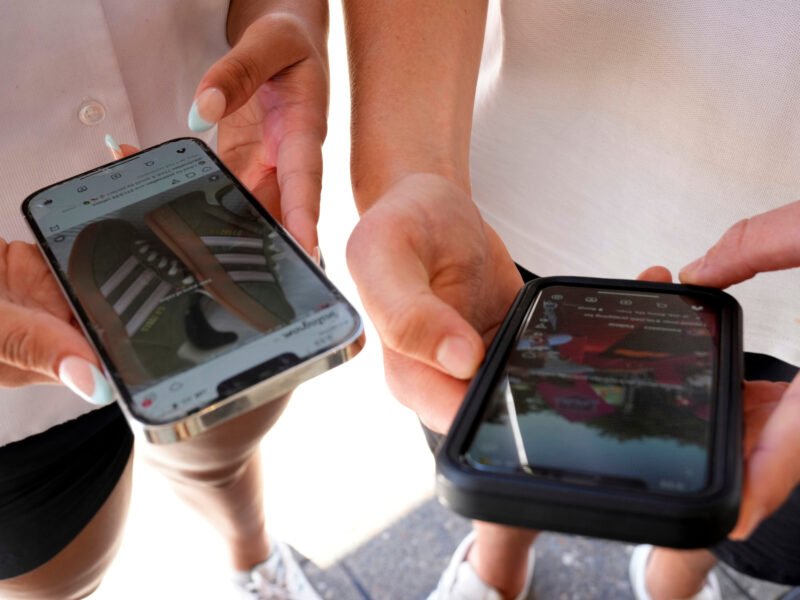

WASHINGTON (CN) – With their security settings top of mind, the Supreme Court on Monday considered how the government could use cellphone location data to solve crime.
Geofence orders allow the government to obtain location data from service providers to identify users in a specific area at a specific time. Law enforcement used technology to capture a bank robbery suspect in Virginia.
Monday’s two-hour oral argument session on the constitutionality of such actions showcase the technological skills of the judges themselves.
“It seems very complicated from a user’s point of view, frankly,” said Judge Amy Coney Barrett, an appointee of Donald Trump. “You know, I have no idea how my data is stored and whether it’s in these virtual lockers or not.”
Okello Chatrie said the police search of his virtual closet violated his Fourth Amendment rights. His data turned up in a geofence warrant that a Virginia detective obtained after running out of leads while investigating the 2019 robbery.
Chatrie told the court that the search violated his Fourth Amendment right because it authorized police to search the virtual private papers of any person within the geographic area simply because of their proximity to the crime.
“The applicant had a reasonable expectation of privacy in his location history, given its sensitive and revealing nature and the fact that it was stored in his password-protected account,” said Adam Unikowsky, an attorney with Jenner & Block representing Chatrie.
Justice Samuel Alito, a George W. Bush appointee, was skeptical that the government had taken anything that was not freely offered.
“Not only did he turn it on, but if he had read his contract with Google, he could have seen that Google retained the right to turn over this information to law enforcement if it felt it was appropriate,” Alito said.
Not all of Alito’s colleagues seemed to agree. Justice Sonia Sotomayor, an appointee of Barack Obama, noted that there was no way to predict what records might be included in a police investigation.
“People take their phone everywhere, including, I suspect, some people in the bathroom. You really have no idea what private information is because it will follow you to a brothel, it will follow you to a cannabis store, it will follow you almost anywhere there is a reasonable expectation of privacy,” Sotomayor said.
Unikowsky said it’s common enough for people to agree to putting their data in the cloud, but most people don’t expect that information to be given to police officers without their knowledge.
“Every time you send an email or send a document, have a Google calendar entry, all that stuff, you agree to send it encrypted from your phone to the cloud,” Unikowsky said. “But I don’t think that simply consenting to store your data in this virtual storage locker is in itself consent to disclosure to the government.”
Google gave the detective anonymous data on 19 users within a 300-meter radius around a bank. The tech giant then provided additional data on nine users at the detective’s request and eventually de-anonymized three numbers.
Most of the other 19 users involved in the search were sitting in a nearby church. To some judges, identifying churchgoers seemed to embody the risk of giving the government unfettered access to sensitive information.
“So to prevent surveillance of sensitive sites, you have to rely on people turning off something that many, if not most, people think is an important service?” Chief Justice John Roberts, also a Bush appointee, asked.
Despite the judges’ concerns, the court appeared unlikely to rule out the felony warrants entirely. Judge Brett Kavanaugh, a Trump appointee, worried about obstructing investigators when a large percentage of murders and violent crimes are never solved.
“When it comes to the reviewing judge, we can’t prejudge what the issuing judge did as long as it doesn’t cross, you know, some boundaries that we’ve set,” Kavanaugh said.
By the end of the two-hour debate, the justices were rethinking their privacy settings.
“I need to check my location services settings, obviously,” Barret said. “Not that I’m going to commit crimes, but it looks like Google is giving away your information.”
“I suggest you do it,” Sotomayor replied.


Subscribe to our free newsletters
Our weekly newsletter Closing arguments provides the latest on ongoing trials, major litigation and decisions in courts around the US and the world, while monthly Under the lights feeds legal dirt from Hollywood, sports, Big Tech and the arts.



