
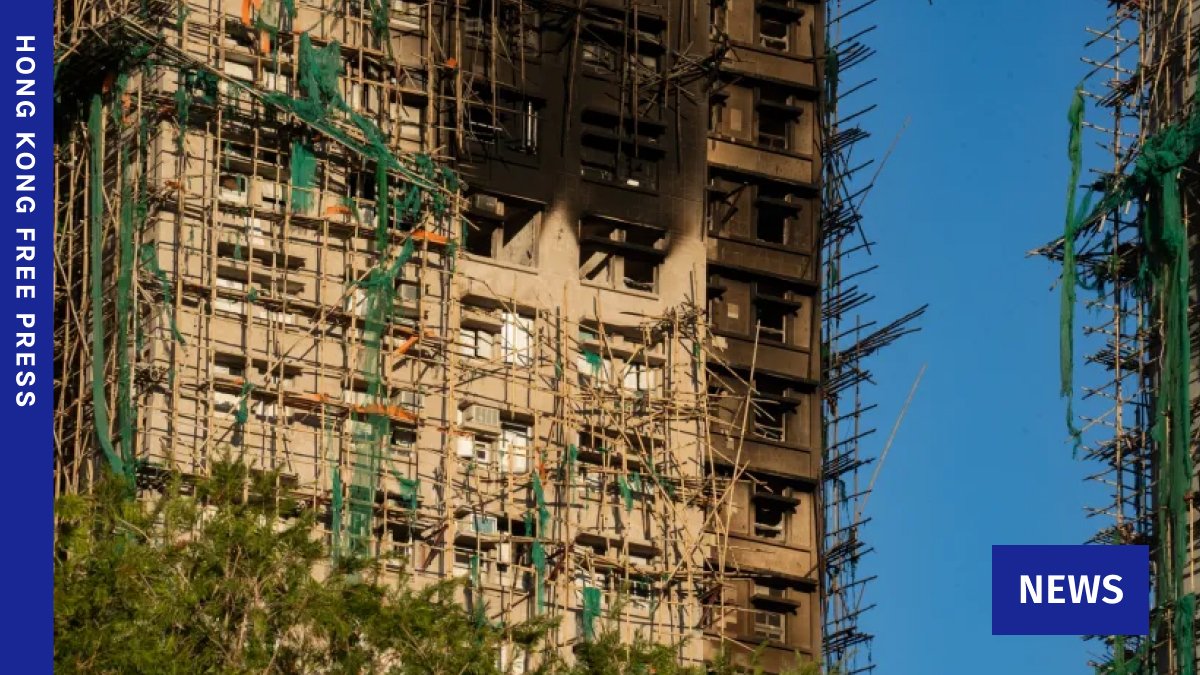

The Department of Buildings (BD) did not conduct flammability tests on the scaffolding netting covering Wang Fuk Court before the apartment complex was hit by a deadly fire last year, an official has told a public inquiry into the fire.

BD Assistant Director of Mandatory Building Inspection Karen Cheung testified Monday that her department “primarily” relied on fire-retardation certificates submitted by contractors and did not conduct field or laboratory tests, local media reported.
“In terms of scaffold nets, we really hadn’t done any tests before,” Cheung said.
In response to questions from Victor Dawes, lead counsel for the inquiry, she said the department would check where the certificates originated and whether they were recognized in Hong Kong.
Substandard scaffolding networks have been identified as one of the main factors contributing to the rapid spread of the fire in November. In the wake of the flames, the authorities imposed requirements for laboratory testing before nets can be used on site.
Wang Fuk Court was undergoing a major renovation when the fire broke out, killing 168 people and displacing thousands.
The independent committee tasked with investigating the blaze earlier heard that residents lodged complaints about potential fire hazards with authorities before tragedy struck.
Complaints included wooden slats installed to replace fireproof windows in emergency stairways so workers could access bamboo scaffolding, foam boards used to protect windows from falling debris, non-flame-resistant scaffold netting and workers smoking.

Cheung also confirmed that both the registered inspector and the contractor were responsible for submitting certificates and laboratory reports to ensure the nets met flame-retardant standards.
Powers
The Building (Construction) Regulation empowers the BD to take action against works covering windows with opaque materials, including foam board, for long periods, the official also said, but government housing complexes such as Wang Fuk Court are outside its purview.
As a government-subsidized housing complex, Wang Fuk Court fell under the responsibility of the Housing Bureau’s Independent Inspection Unit (ICU), Cheung said at the hearing.
However, ICU senior surveyor Andy Ku said in a written submission submitted to a hearing last week that the unit did not have the power to regulate “temporary construction materials”.
In the same session last weekMichael Yung, assistant director of fire safety at the Department of Fire Services, said fire hazards such as substandard scaffold netting, flammable foam boards and workers smoking on site were outside the scope of the FSD.
Under a transfer mechanism to ensure stability, BD can send senior staff to the ICU to help with inspections, according to a document presented at Monday’s hearing.
But Cheung told Dawes that BD did not conduct any inspections on Prestige Construction & Engineering Company, the maintenance contractor at Wang Fuk Court, and Will Power Architects, the consulting firm overseeing works on the estate.





