
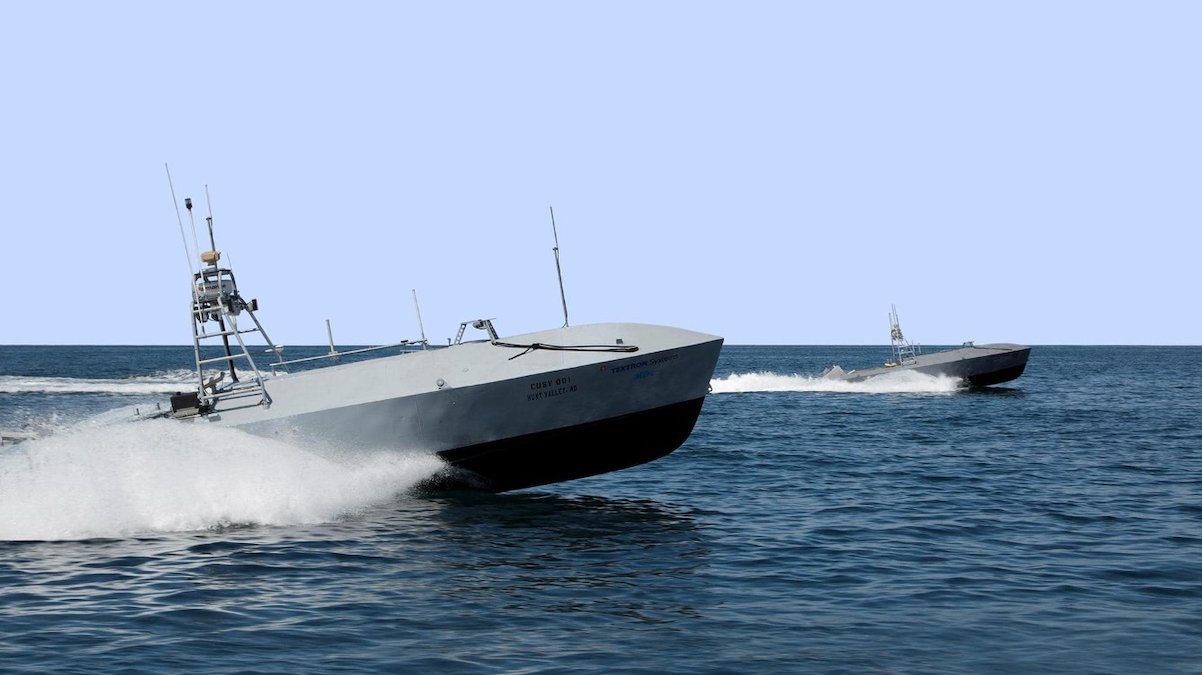

As the U.S. Navy moves to deploy thousands of unmanned surface ships in the Indo-Pacific, questions are mounting about whether these swarms of drones can deliver meaningful combat and deterrent effects against China.
This month, USNI News reported that the US Navy is looking to deploy thousands of unmanned surface vessels (USVs) to the Indo-Pacific by 2030 to bolster deterrence against China.
At the Naval Air-Space Symposium in National Harbor, Maryland, Capt. Garrett Miller, head of Surface Development Group One, said the initiative will include more than 30 medium unmanned surface vessels (MUSVs) and thousands of smaller USVs, along with unmanned aerial systems (UAS) based on project requirements. 2045.
The move is in line with the US Indo-Pacific Command’s (INDOPACOM) “hellscape” concept, which envisions a host of autonomous systems to defeat and deter Chinese military action, including a potential invasion of Taiwan.
Drawing in part on Ukraine’s use of naval drones against Russia and recent operations in the Middle East, the US Navy aims to adapt such tactics to the Pacific, although officials warned that the vast distances and open ocean conditions present challenges compared to closed seas.
Rear Admiral Douglas Sasse noted that Indo-Pacific operations will require more innovative approaches. Recent tests, including the autonomous fueling of a medium USV, highlight the progress, while deployments alongside carrier strike groups are expected to increase surveillance, flexibility and maritime domain awareness.
The planned large-scale deployment of USV swarms in the Indo-Pacific raises questions about their effectiveness at the tactical, operational, and strategic levels in enhancing combat performance and deterrence against China.
At the tactical level, USV swarms derive their effectiveness from overwhelming defenses, exploiting cost asymmetry and sustaining pressure to degrade combat resilience.
Scott Savitz notes in a January 2023 RAND ITEM that explosive USVs can hit ships by swarming and approaching from multiple angles, making them difficult to detect and intercept.
Savitz says these USVs can hit the waterline with larger payloads than comparably sized missiles or unmanned aircraft, potentially causing devastating damage. He adds that even one or two penetrating USV defenses would constitute mission success.
Moreover, Rudraksh Pathak notes on a March 2026 ITEM for the Center for International Maritime Security (CIMSEC) that autonomous systems achieve effectiveness by exploiting cost asymmetry and defensive saturation, creating an “interceptor trap” in which defenders are forced to expend scarce, high-value missiles against low-cost targets, ultimately depleting their stockpiles and persuasive retreat.
He adds that such systems do not need to penetrate defenses perfectly; they only need to force defenders to use their most capable weapons against low-value targets, degrading operational tempo and sustainability over time.
Together, these dynamics suggest that USV swarms are less about decisive hits than about cumulative defense degradation.
Drawing on tactical lessons from the war in Iran, Kateryna Bondar notes in a March 2026 ITEM for the Center for Strategic and International Studies (CSIS) that drone campaigns are effective because they generate sustained pressure at relatively low cost, allowing actors to impose economic, psychological and operational strain while maintaining higher-end missile assets.
She points out that Iran’s campaign followed a two-phase pattern—an initial wave of large-scale saturation followed by a more steady and steady pace of strikes over several days—demonstrating how drones function as an ongoing campaign tool rather than a one-off attack tool.
In a Taiwan Strait scenario, swarms of USVs could challenge the defenses of the People’s Liberation Army Navy (PLAN) and end their operational viability with costly strikes. Their success depends on resilient targeting and communication, but may be limited by the range and protection of Chinese layers.
However, tactical disruption alone does not guarantee operational success, as battlefield effects must be translated into coordinated employment of forces. At the operational level, USV groups depend on integration into existing naval formations and broader joint and allied frameworks.
George Galdorisi, at a CIMSEC February 2026 ITEMdescribes the incorporation of USVs into a hybrid fleet through human-machine coupling, where unmanned and manned platforms operate as a coordinated and synergistic force.
It emphasizes the use of large USVs as “trucks” to transport and deploy smaller USVs, unmanned underwater vehicles (UUVs) and unmanned aerial vehicles (UAVs) in contested areas.
He adds that this approach enables distributed operations by allowing manned ships to stay out of range of adversary anti-access/area denial (A2/AD) systems, provided they are supported by robust command and control.
Additionally, Thomas Clare notes in a November 2025 Center for Strategic and Budgetary Assessments (CSBA) REPORT that USVs have proven effective in enabling sea denial and extending operational reach, but their employment is limited by factors such as range, control links and the need for supporting infrastructure.
It suggests that USVs are best used as part of a wider consumption and distribution operations campaign rather than as stand-alone solutions, highlighting their potential and limitations.
Considering operations in the Taiwan Strait, the USVs would serve as the forward extension, connected to the manned force network, supporting distributed, multi-domain operations from standoff distance. Their effectiveness depends on resilient command links, ISR integration and access to forward-positioned systems. However, effective employment at scale depends on more than force structure.
Beyond operational integration, their broader value lies in shaping strategic deterrence by influencing how adversaries assess risk and assess their success.
Xidi Chen and Lun Li note in a February 2026 Frontiers in Political Science ITEM that unmanned maritime vehicles offer advantages such as low cost, potential for mass deployment, long endurance and avoidance of personnel casualties, enabling states to increase maritime situational awareness and reshape maritime competition patterns.
They add that these characteristics enable small and medium-sized states to narrow capability gaps in specific operational areas and strengthen their ability to achieve area denial and deterrence.
They further argue that the unmanned nature of these systems reduces personnel risks, easing political and public constraints and expanding the strategic freedom of action of leaders. This shifts deterrence from high-level punishment to sustained, theater-specific pressure.
Additionally, Christopher Knight argues in a September 2024 Proceeding ITEM that unmanned systems can support deterrence by enabling theater deterrence, defined as the deployment of sufficient localized combat power within a specific geographic area to make the adversary doubt whether the intended operation will succeed.
He notes that, unlike nuclear deterrence, which operates at the high end of the conflict spectrum, unmanned systems can be tailored to specific operational problems and deployed forward to help counter capabilities such as China’s A2/AD approach.
He points out that their deterrent value depends on the organization, testing, deployment, and visible demonstration of these systems to influence an adversary’s pre-conflict calculations.
USV swarms can enhance deterrence by providing flexible, forward-deployed capabilities that challenge Chinese planning and raise suspicions of invasion, but their impact relies on credible integration and clear demonstration to influence China’s pre-conflict decisions.
Ultimately, swarms of USVs will matter less about their scale than whether they can be transformed into reliable, networked combat systems that contribute to a larger operational framework and shape adversary perceptions of deterrence.



