
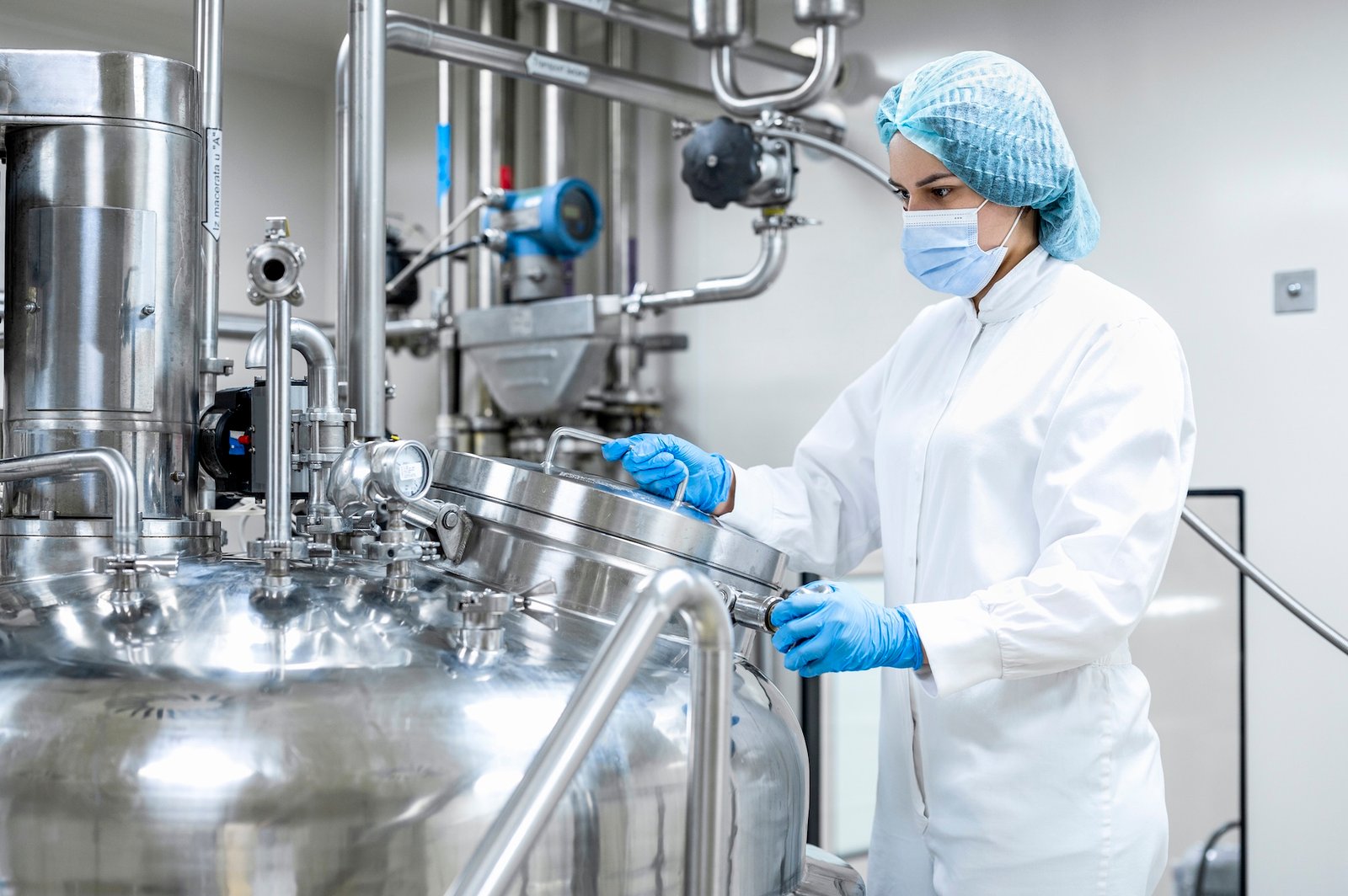

The opening of the API Production Technology Center (CeTeAPI) in Warsaw marks a strategic step towards increasing pharmaceutical safety both in Poland and in Europe. This investment aims to reduce the market’s dependence on imported active pharmaceutical ingredients (APIs) from Asia, which currently dominate global supply chains.
Director of the Department of Pharmaceutical Products at the Łukasiewicz Institute of Industrial Chemistry (IChP), Wojciech Maszewski, told Euractiv. “Our goal was to create a unique hybrid that connects research expertise with real industrial scale. Within a single facility, we manage the complete life cycle, from the initial development concept, to the molecule’s pathway. 100 kilograms, to final validation under the rigorous GMP regime.”
Maszewski says CeTeAPI is much more than just another production hall. It is a unique European-scale hybrid of a research unit and a manufacturing firm, developed within the IChP. The developed technologies can be applied directly at the institute or transferred to pharmaceutical companies both in Poland and abroad.
“By embedding research stations directly within our manufacturing infrastructure, the Institute can implement technologies in-house or transfer ready-to-use, industry-proven processes, which significantly accelerates the time needed to bring medications to the pharmacy,” he added.
This investment is part of the wider Mościcki Campus project, which also includes centers for low-emission technology (CeTeN) and pharmaceutical products, known as CeProFarm. The construction and equipment of the center cost over PLN 10 million, with PLN 5.2 million financed by the National Recovery Plan (KPO).
Scaling of production
The institute currently produces ten active pharmaceutical ingredients on a continuous basis, covering a wide spectrum of medical applications.
Their product portfolio includes substances for oncology, cardiology and ophthalmology, in addition to vitamin D analogues used in the treatment of autoimmune diseases and hormonal disorders. The facility also specializes in highly potent substances such as tacalcitol and alfacalcidol, where specialized manufacturing processes allow even small-scale production to meet a significant portion of global demand.
While the production potential of the Institute is estimated at approximately 10 tons of API per year, the expert points out that in modern pharmaceuticals, “quantity” is a relative concept. “In the case of very potent substances – those with an extremely low therapeutic dose – the production of just 20 grams per year can meet the demands of a quarter of the global market,” explains Maszewski.
Currently, the main beneficiaries of the Institute’s products are international firms, with the European Union and Japan serving as the main export markets.
Despite this international success, the Institute is determined to establish closer links with the domestic industry, which currently uses its services less frequently. “It is a great ambition of mine to see an increasing number of Polish drug manufacturers among our customers. However, I believe that for this to happen, a stronger systematic support and real promotion of products based on European APIs is essential,” concludes Maszewski.
The true cost of sovereignty
In the ongoing debate about pharmaceutical sovereignty, the question often arises: can domestic manufacturers really afford to choose more expensive European APIs over cheaper Asian alternatives? Maszewski points out that while the price difference for APIs is a reality, it rarely becomes a prohibitive obstacle to the viability of a pharmaceutical project.
In his assessment, the preference for cheaper components from Asia is often the result of standard business processes aimed at optimizing profit rather than a real risk of a drug losing its commercial viability.
“It is not true that buying a slightly more expensive active ingredient from Europe would drive a company into bankruptcy. While the API is an important cost component, it is rarely the only factor that determines the final price of a drug,” Maszewski noted.
Maszewski points out that to level the playing field, systematic mechanisms must be introduced to create genuine economic incentives for choosing local suppliers, mirroring the strong state support systems found in China and India.
Hidden weakness
It also highlights an often overlooked and “hidden” challenge: advanced intermediaries. “Even if an API is produced in Poland or elsewhere in Europe, it is very often assembled from ‘building blocks’ that are still produced in Asia,” he warns. This creates a secondary layer of dependency that is often ignored in policy discussions.
Asian suppliers have been known to use a strategic squeeze, lowering the prices of finished active substances while increasing the costs of the essential chemical intermediates needed for their production.
This tactic directly harms the profitability and competitiveness of European producers. To ensure real security, Maszewski argues that state support must extend beyond simple reimbursement mechanisms.
(VA, BM)



