
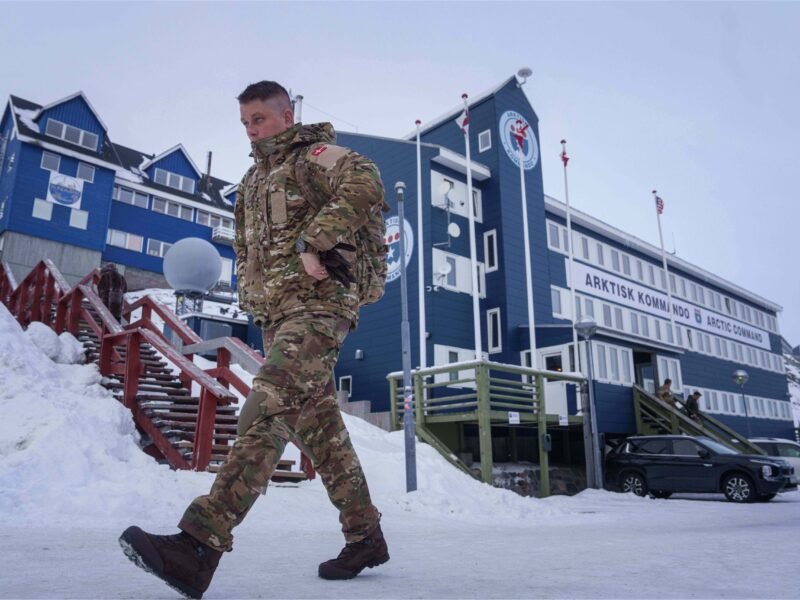

COPENHAGEN, Denmark (CN) – U.S. officials continue to baffle observers and researchers with statements that undermine the work of a high-level diplomatic group established in January with Denmark and Greenland to address US security concerns.
“The talks that are taking place at a high level have achieved nothing for the people of Greenland other than keeping them in the situation they are in today,” said US Special Envoy to Greenland Jeff Landry in a recent interview with the Greenlandic Broadcaster. KNR.
At the Arctic Circle Forum held last week in Rome, the head of the US Arctic Research Commission, Thomas E. Dans RECITED silenced the audience at the conference’s closing event by defending the Trump administration’s Greenland policy.
“It was absolutely painful to sit in the audience and listen to how the representative of the Trump administration was justifying its interests in Greenland,” wrote Johanna Ikävalko, director at the Center for Geopolitical, Peace and Security Studies. LinkedIn.
Greenland is a semi-autonomous territory of Denmark, located on the American continent in the Arctic Circle. Greenland’s foreign affairs and security policies are handled from Copenhagen, but Greenlandic officials are now more involved in decision-making processes than in previous years.
US President Donald Trump has repeatedly said that America should acquire Greenland for national security purposes. In an effort to achieve this security, he proposed a Golden Dome project, a total missile defense that would protect the US from foreign attack.
Because of Greenland’s strategic location, blocking the shortest missile route from Russia to Washington, the Arctic island plays a vital role in the Golden Dome project, which still lacks details.
“From my understanding, the project may be a bit unrealistic and fits well with Trump’s preference for shiny objects and catchy titles on big projects that may never be fully realized,” wrote Niels Byrjalsen, a postdoctoral researcher at the Center for Military Studies at the University of Copenhagen, in an email to Courthouse News.
But if the project is born, a missile defense system of the size of the Golden Dome project has “strategic implications” because of the changing balances regarding nuclear deterrence and stability among the great powers. This could force the hands of Russia and China, according to Byrjalsen.
“It is understandable that states want to protect themselves and their allies from military threats from above, but distortions in the overall balance of power are dangerous. If the Golden Dome project moves forward, it is likely that US adversaries such as China and Russia will react, potentially in destabilizing ways,” he said.
In pursuing Greenland, Byrjalsen joins a long list of scholars who find it difficult to see Trump’s purchase remarks as a rational endeavor “from a strategic perspective.” The United States already has agreements with Denmark and Greenland that allow the Americans to do “pretty much what they want” militarily on the Arctic island, the researcher said.
In addition, researchers and politicians from Denmark and Greenland have arguments denied by Trump for Chinese ships roaming near the Arctic island. Researcher Ulrik Pram Gad of the Danish Institute of International Studies, a specialist in Greenland-Denmark relations, said Trump publicly overestimates Greenland’s security role vis-à-vis the US.
A high-speed increase in weaponry can be read as a threat to Russia, the researcher said, which could end up undermining US security.
“Russia may see it as necessary to retaliate. This creates a classic security dilemma and a potential arms race that will make the US less secure,” Gad said.
of The Trump administration also has an interest in Greenland’s natural resources and rare minerals, which the EU considers critical to reducing over-reliance on China. The Asian giant currently holds one dominant position on world reserves.
According to the EU, 25 of 34 “critical raw minerals” used in green technology and the defense industry are found in Greenland.
But the notion that Trump wants to win Greenland because of these resources lacks logic, according to Per Kalvig, a mining geologist at the Geological Survey of Denmark and Greenland. Greenland is already open for business and welcomes US investment, and China’s advantageous position in value chains means it is likely to process those minerals.
“There is no guarantee that the minerals will be absorbed exclusively into a European or American supply chain, because it depends on where companies can get the cheapest offer to sell them for processing to make them usable,” he said.
This is why China is almost impossible to ignore. Chinese companies have specialized in processing minerals and rare metals to such a degree that companies around the world in the liberal market often choose the Asian superpower to turn raw materials into usable industrial products for a bargain price.
It would take years for the US and EU to build an industrial infrastructure that could rival China’s dominance.
“That’s why China has this fantastic position, right? Because they have all the value chains,” Kalvig said.
Another aspect that speaks against the importance of securing Greenland’s resources from rival countries is the composition of Greenland’s rare earth metals, which are difficult to transform in the magnetic industry compared to resources found in other countries.
US NATO allies Denmark and other European countries have already acknowledged that security in Greenland and the Arctic region needs a boost. Recently, NATO countries have increased their presence in the Arctic islands after Trump’s refusal to rule out a military takeover.
That prospect appears off the table after Trump and NATO Secretary General Mark Rutte agreed on one unclear framework agreement at the end of January.

Subscribe to our free newsletters
Our weekly newsletter Closing arguments provides the latest on ongoing trials, major litigation and decisions in courts around the US and the world, while monthly Under the lights feeds legal dirt from Hollywood, sports, Big Tech and the arts.



