
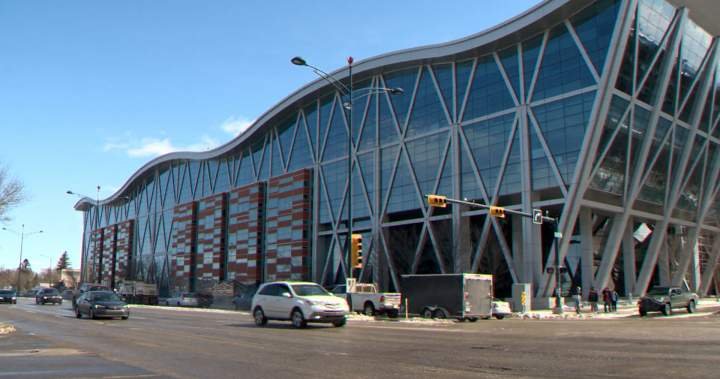

of Southern Alberta Institute of Technology (SAIT) is facing serious funding challenges caused by declining enrollment from international students, at the same time the Alberta government has placed a two per cent cap on tuition and fee increases for domestic students.

According to the 2025 Expert Panel on Post-Secondary Funding, student tuition and fees accounted for 23 per cent of total revenue for Alberta colleges and universities in the 2018-2019 school year.
That rose to 31 per cent during the 2023-2024 school year, as provincial funding fell by 10 per cent over the same period.
Like many post-secondary institutions in Alberta, SAIT had grown increasingly dependent on funding from international student enrollment to offset cuts in government funding.
According to the 2025 expert panel, the amount of tuition and fees paid by international students increased from just under $362 million during the 2020-2021 school year (seven percent of total revenue) to $670 million during the 2023-2024 school year (10 percent of total revenue).
At the same time, the percentage of total revenue from tuition and fees paid by domestic students remained unchanged at 14 percent.
But after concerns raised by some provinces about the growing number of international students, the impact on housing and the sometimes controversial programs they were enrolling in, the federal government reduced the number of permits issued to international students to study in Canada — from over a million in 2024 to about 725,000 by September 2025.
In an email to Global News, the SAIT Academic Faculty Association confirmed that 30 permanent faculty positions are being cut.
In a statement to Global News, SAIT management blames job cuts for declining international student enrollments.
Global News
SAIT declined an interview request from Global News on Friday.

Get weekly money news
Get expert insights, questions and answers on the markets, housing, inflation and personal finance information delivered to you every Saturday.
Instead, spokesperson Chris Gerritsen said in an emailed statement: “Like post-secondary institutions across Canada, SAIT has been affected by recent changes in federal international student policies. These changes have resulted in a decline in enrollment, requiring the institution to make difficult but necessary budgetary adjustments. We are currently working through organizational and workforce adjustments.”
Tiffany MacLennan, a senior research associate with the Higher Education Strategy Associates, says she is not at all surprised by the news of the job cuts at SAIT.
Global News
“I don’t think it’s surprising at all that we’re seeing institutions have to make cuts because of the decline in international students,” said Tiffany MacLennan, a senior research associate with the consulting group Herer Education Strategy Associates.
“Over the last decade, especially in Alberta, provincial funding has decreased quite a bit for institutions across the board. If you look at Alberta over the last five years, there’s been a 30 per cent drop in provincial transfers to universities,” McLennan said.
“That’s a lot of money. When you lose the next biggest source of income all of a sudden, that’s going to create big challenges.”
At the same time international student enrollment is declining, postsecondary enrollment by domestic students is projected to increase by 21 percent between 2023 and 2033.

To meet demand and continue to attract top talent to run institutions, McLennan contends that both institutions and the provincial government need to collaborate on developing a new funding model.
“I think one of the things that needs to be done is a lot of long-term financial planning. If you look at things like businesses, one of your strategies should be to have diverse sources of income and to have sustainable diverse sources of income — and if you look at our institutions, in many ways they didn’t do that.”
“When things change and suddenly you’re relying on millions and millions of dollars coming in from international students in markets that were completely unregulated, that’s a challenge,” McLennan said.
“Overall, I don’t think any one thing is to blame for the challenges that have occurred, but there was definitely a lack of that long-term revenue planning — not just in Alberta, but across the country — and now we’re seeing the effects of that.”
In an email to employees, obtained by Global News, SAIT says more than 30 positions at the high school are being cut, and some programs like peer mentoring and English-language conversations, along with student engagement initiatives, are being “discontinued.”
Global News
Alberta Advanced Education Minister Myles McDougall said the province is spending an extra $63 million on post-secondary funding in this year’s budget and has no plans to get rid of the two per cent cap on tuition increases for local students, but is looking at possible changes to how post-secondary institutions are funded.
“Our funding structure, we’re working on that now. We expect to have some changes in place by the next budget cycle and that funding model will respond to or reflect the government’s priorities, the students’ priorities in terms of what they’re looking for in terms of work and career development opportunities and so much of what we expect to be in place by the next budget,” McDougall said.
But McLennan insists that any new funding model must include a long-term plan.
“What does a 10-year plan look like? Something that will actually allow institutions to plan better, as opposed to this kind of year (or) every two years or three years that there’s a new shock to the system? ‘We’re going to cut funding, we’re going to have $200 million out of your budget.’
“This is not a plan and it is not sustainable.”

© 2026 Global News, a division of Corus Entertainment Inc.



