
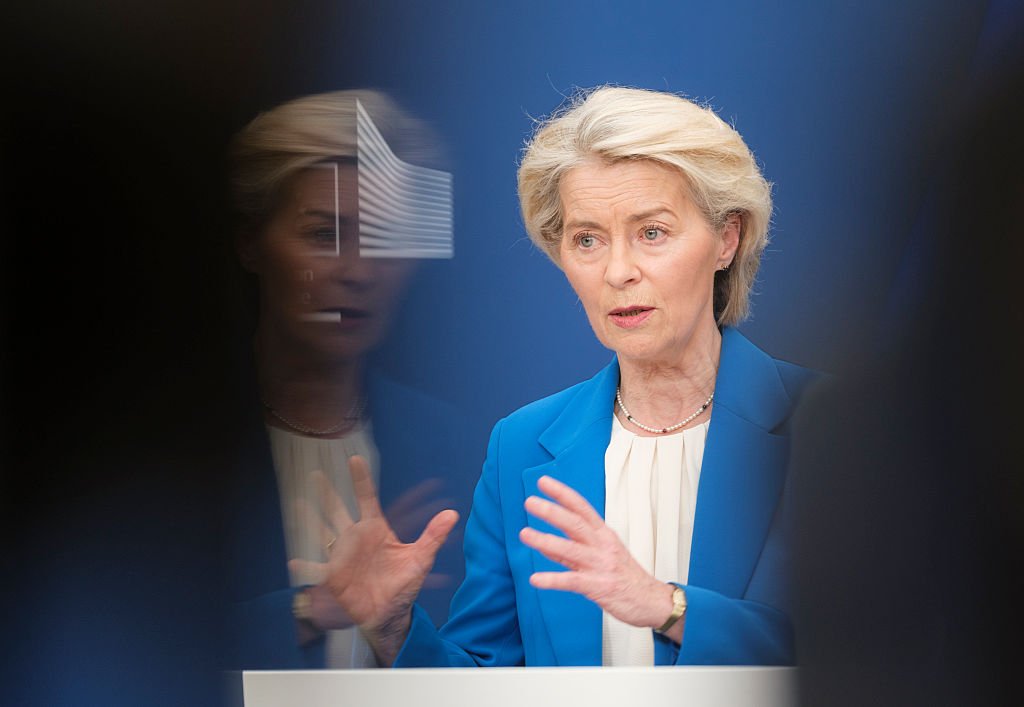

The EU is preparing to bypass rebel capitals in a last-ditch effort to revive its main economic zone by allowing countries to opt-out of major reforms.
In one strategic document received from EuractivUrsula von der Leyen’s European Commission suggests that countries favoring deeper integration should be able to move forward in groups of at least nine to strengthen the single market.
“In the absence of sufficient progress, the institutions will consider enhanced cooperation to ensure a rapid and ambitious delivery,” the document states.
Enhanced cooperation is a clause in EU treaties that allows at least nine capitals to move forward with certain policy measures when a majority vote would normally be required. it was last called in December to agree a 90 billion euro loan to Ukraine, without the support of the Czech Republic, Slovakia and Hungary.
The document, called the “One Europe, One Market” roadmap, lists 42 policy measures, most of which are not new, and aims to speed up their adoption by setting a deadline of the end of 2027.
EU leaders will seek to approve the plan at an informal meeting in Cyprus next Thursday.
Two-speed Europe
Von der Leyen has sailed repeatedly the idea of a “two-speed” Europe in recent months and has suggested she would personally support the use of enhanced cooperation to integrate countries’ capital markets if there is no progress towards a “capital markets union” by the end of 2026. French President Emmanuel Macron also supports this movement.
Among the range of proposed policy measures, the document calls for the Commission’s “Market Integration and Surveillance Package”, which aims to increase the powers of the Paris-based financial watchdog, the European Securities and Markets Authority (ESMA), to be adopted by the end of 2026.
The ‘E6’ group of rich EU countries, led by France and Germany, support giving ESMA greater powers. Under the Commission’s plan, such initiatives could go ahead on a smaller scale, with the likes of Luxembourg and Ireland, which are deeply suspicious of the measure, able to opt out.
The document also advocates a more muscular trade stance toward China — a policy strongly supported by France but traditionally resisted by Germany, whose export-oriented industries depend heavily on Chinese demand.
Brussels is also doubling down on enforcement of EU rules against slow or recalcitrant national capitals – which is lasting. he vowed to do in 2025 with little effect.
Deputies aside
The new non-binding document will have to be approved by the European Commission, the European Council and the European Parliament. A Commission spokesman said the target was to finalize it on Thursday in Cyprus.
Von der Leyen and her counterpart, European Council president António Costa, have pledged that Parliament will be fully consulted – but there is likely to be minimal input from MEPs before Thursday.
“Parliament will have its full say in shaping these decisions,” Costa told MEPs in March. Several MEPs focused on the single market said Euractiv they had no role in prescribing the strategy.
“It’s really strange, it’s strange,” said a parliamentary official, who said he expected Parliament to have been formally consulted by now.
The commission shared only one draft with European Parliament President Roberta Metsola on Thursday, which itself was based on a draft ‘aide-memoire’ prepared by EU leaders in March.
Another official dismissed the extent to which MPs had been sidelined, saying that although there was no formal consultation process, the Commission mainly took into account what political groups wanted to see in the plan.
Parliament may seek to make some minor changes in the coming days, but will not want to make demands that could derail its approval in Cyprus next week, the second official said.
“If it was a big surprise, it would be more of a problem for us,” the person added.
An initial discussion between EU ambassadors took place on Friday. An EU diplomat said Euractiv that the strategy was widely welcomed, although some capitals warned that some of the targets may be too ambitious.
When it comes to implementing the two-year plan, the EU will create a tripartite steering group, bringing together officials from the three main institutions.
Nikolaus J. Kurmayer contributed to this report
(jp, aw)



