
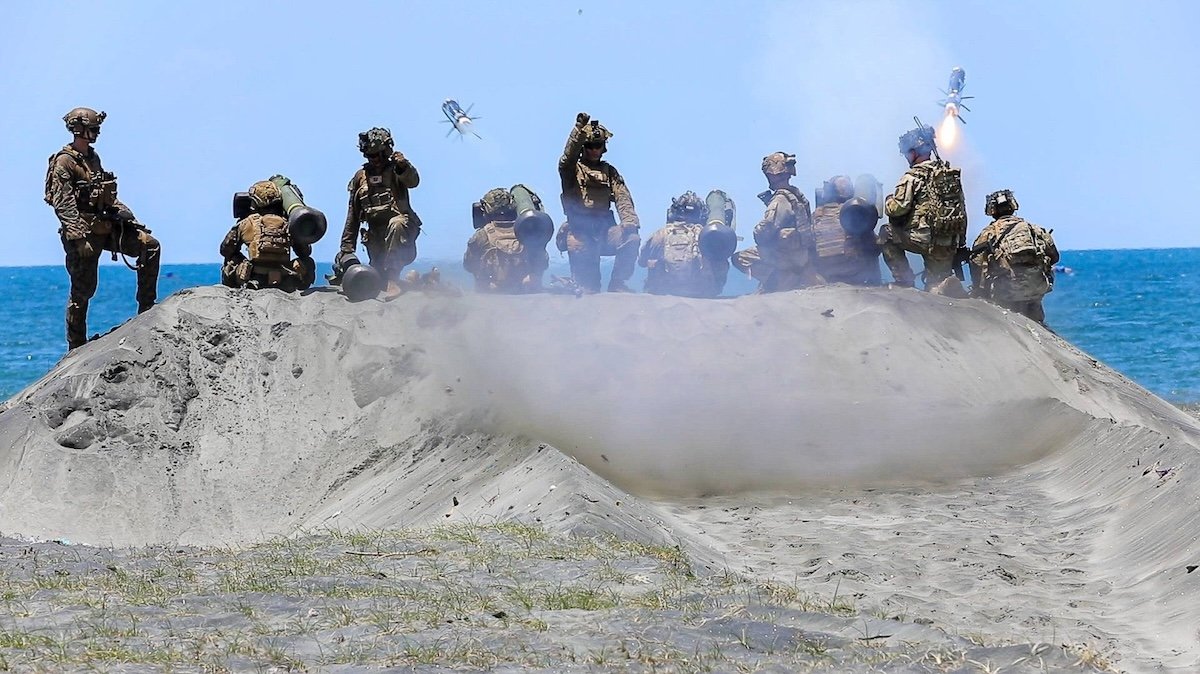

This year’s US-Philippines Balikatan exercise offers plenty of evidence that Japan is shaking off the ghosts of World War II and subsequent decades of false pacifism.
Japan is deploying a large multi-service force to participate in Balikatan. And it’s not hiding behind a “HA/DR” (humanitarian aid/disaster relief) fig leaf, nor just sending observers or a small unit hovering around the edges of training activities.
Instead, the Japanese will train for combat.
The Japan Self-Defense Force (JSDF) is sending 1,400 personnel and essentially deploying an amphibious task force (two amphibious ships and a destroyer) along with a large detachment of ground troops and their equipment. This is no different than a US Navy/Marine amphibious group.
It carries anti-ship missiles and air and missile defense systems. And it will be launching the Type 88 surface-to-ship missile as part of a sinkhole exercise against an older ship.
The Air Self-Defense Force (ASDF) is also sending transport and amphibious aircraft. The ASDF has often appeared reluctant to conduct joint exercises with the Japanese navy and army (but not with foreign air forces) – preferring to fly at 30,000 feet in search of a fight.
Ministry of Defense of Japan proclamation regarding Balikatan is a refreshing matter, while the list of combat exercises the JSDF will join:
- “0 amphibious actions”
- “counter-landing direct fire”
- “naval strike”
- “Integrated Air and Missile Defense”
- “joint medical operations”
These are training and skills needed in a war over Taiwan – or over Japan’s southern islands (Nansei Shoto, or Ryukyus), which China is now boldly claiming as its own.
And this training is taking place in the area where a war is likely to occur – instead of the JSDF going all the way to Australia or Southern California to train (hoping China doesn’t get angry.)
And the psychological and political aspects of it all are just as important as the operational benefits that come from training all three services of the JSDF together and with foreign militaries. This training builds confidence within Japan’s defense forces, while shaping the way the Japanese political class and public view the JSDF – no less as a competent fighting force, and not as typhoon and tsunami relief people.
And Japan’s partners and adversaries see the JSDF as a more capable force — and Japan as a nation that has some teeth to go with its mighty soft power. These perceptions matter.
Significantly, the Japanese public is not complaining about the JSDF and Balikatan, and almost no one in the Philippines (where the Imperial Japanese Army and Navy were brutalized during the war) is either. China grumbles, of course, but the rest of Asia doesn’t seem to mind.
Even the Prime Minister of Singapore pointed out Recently, Southeast Asian countries welcome Japan to play a more active role in regional security.
Japan’s Self-Defense Force today is unrecognizable from fifteen years ago, as anyone who was around back then will know.
The JSDF (and Japan) still have more to do before they are ready to fight a war – assuming a country is fully ready. And the JSDF is about half the size it needs to be to handle the missions required.
But it’s like climbing a ladder. You start climbing and you gradually find yourself at a level that seemed out of reach from the bottom.
Finally, despite all the good news about Japan and the Philippines, one fears that Japan regards the close attention to the Philippines as its contribution to the defense of Taiwan.
Tokyo has in recent years provided coastal and air defense radars, patrol boats and retired coast guard aircraft and cutters. It is talking about the sale of old MSDF destroyers to the Philippine Navy. It has also helped with dual-use infrastructure (ports, airfields, bridges) for a long time.
All of this is important, but at some point Japan will have to bite the bullet and do more for Taiwan’s defense than provide real estate (bases) and guard services and expect the Americans to take care of things.
Today’s JSDF is capable of doing this. Americans should make a specific demand sooner rather than later.
Colonel Grant Newsham (US Marines – Ret.) is the author of When China Strikes: A Warning to America.



