
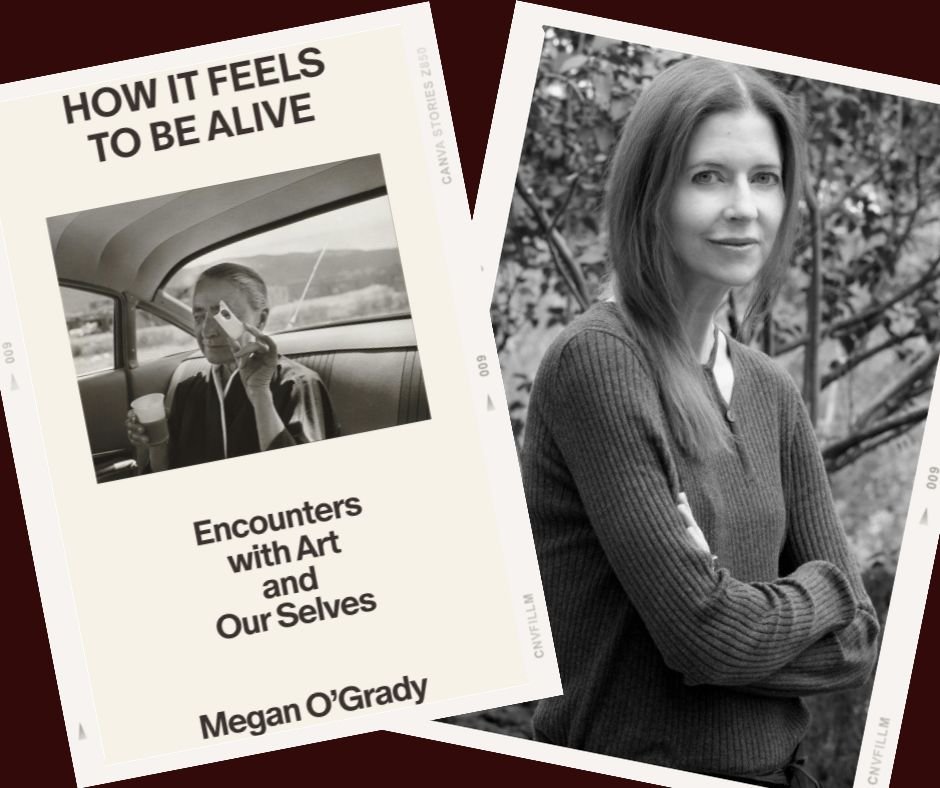


“What attracted me to criticism, before I knew how to call it criticism, was its assertion that ideas were central to life, which, in my experience, had not always been a given.” Megan O’Grady writes in her new collection of essays How It Feels to Be Alive: Encounters with Art and Ourselveswhich hits shelves on April 21. O’Grady art critic in the New York Times and a professor at the University of Colorado at Boulder – writes here about artists from the painter Agnes Martin to the photographer Carrie Mae Weems to the performance artist Papa.L. And in each case, she tries to explain why their ideas have been central to her own life and experiences of divorce, of motherhood, of living in an increasingly authoritarian America. Art, she writes, “provokes unanswered questions,” ignites “energy, joy, and challenge,” and “suggests new forms of questioning and belonging.”
Fine art is usually seen as an elite enterprise for elite audiences – an aesthetic experience accessible only through multiple higher degrees and a boatload of cash. But O’Grady tells the Observer that in her own life, she has found that “we need art. A lot of us have it, almost as a kind of lifeline – or I did, certainly growing up. The music, the film, the books I read as a child really taught me who I could be or what I wanted, or how to think about myself in relation to the world or as part of a community -“.
Many people find music, books and film more accessible than visual art. One of O’Grady’s goals in putting How it feels to be alive out into the world is to show how her interactions with fine art and fine artists have been powerful, personal, and moving in a way that people often associate with less high culture. Her description of her first viewing of Agnes Martin’s abstract painting friendship– a kind of golden net – could almost be a memory of a beloved pop song:
“The wealth of gold calmed me, made me feel fulfilled, as if I were facing the sun instead of setting out for the destruction of my life. The painting drew a window on the wall, but did not let me see through it; it was a threshold to something too big to take in at once … I was frightened when I found myself in tears.”
However, O’Grady insists that emotional immediacy need not preclude intellectual engagement or discovery. In a long, probing essay on representation, self-representation, mothers, and daughters, she discusses Carrie Mae Weems’ Kitchen table series (1990) and self-portraits and portraits of the French Impressionist Berthe Morisot. The artists helped her see how “it’s really hard to own your own perspective when you’re so aware of everyone’s perspective on you.” Weems’ series, she further explains, “tells the fictional story of a woman, played by the photographer herself, and the various roles she embodies, as mother, lover, friend, herself.”
Many black women artists have spoken about how powerful it was to see an artist representing black women in such a direct, respectful and nuanced way. O’Grady is white, but she writes in her book that “something about the sight of mother and daughter in their mirrors brought me down.” As a young woman, O’Grady “identified more with the girl” in the Kitchen table series than with the mother. In particular, she was struck by how the mother was “modeling things for her daughter about what the woman around her was” and that the modeling was both conscious and unconscious. It’s an insight, O’Grady says, that has continued to haunt her as she’s raised her daughter.
O’Grady’s complex examination of the power and dangers of self-representation is reflected in her approach to the confessional aspects of How it feels to be alive. In the book, she notes that when she first started writing about art, she would mostly keep herself in the background—she wasn’t a figure or a presence in her writing. But over time, she felt that including herself or representing herself could also have value. Talking to artists, or going with Pope.L to Ferguson, where he was creating art about the water crisis, “these experiences were so important to me,” she says.
Speaking of the artwork’s effect on her directly, O’Grady says, “what I hoped, of course, was that readers would read it and not have the same experience that I had, but rather be prompted to think about other things in their lives, a book or a piece of art, or something that maybe made them see something differently.” Putting herself into her work mirrors how an artist like Weems puts herself into her work. By showing herself, Weems allows her audience to think about themselves and identity in relation to art. O’Grady is trying, in her medium, to offer that gift to her readers as well.
These gifts—of recognition, of solidarity, of confusion, of possibility—are ones that our current regime has made very clear it does not want us to have. O’Grady finished the book shortly after his re-election Donald Trumpso she doesn’t discuss much his attack on arts funding or his intervention at the Kennedy Center for the Performing Arts. But in our conversation, O’Grady points out that authoritarians often target art early and often. The arts, “make people feel things, and they make people upset and angry.” Trump’s sweeping censorship “shows how important the arts are. I think sometimes in our capitalist society, we sometimes forget how important they are.” O’Grady also says that, despite the current series of mounting crises, she doesn’t want her students to feel like they have to do political work or that art has to be something that is “instrumentalized for political means.” This seems like a political statement, too, in a way. Authoritarians want all art and expression to serve the state, which is why the Trumpified Kennedy Center is suing artists who refuse to perform and use their talent to validate or glorify the ruler.
Making beauty or meaning that does not recognize the authority of politics can be a kind of resistance in itself. “The history of art is full of stories of people who redefined the world for each other on their own terms, who made space for each other in a world that didn’t,” O’Grady writes. reading How it feels to be aliveit is clear that by making space for himself in art, O’Grady wants to make space for the rest of us.
More in Books




